
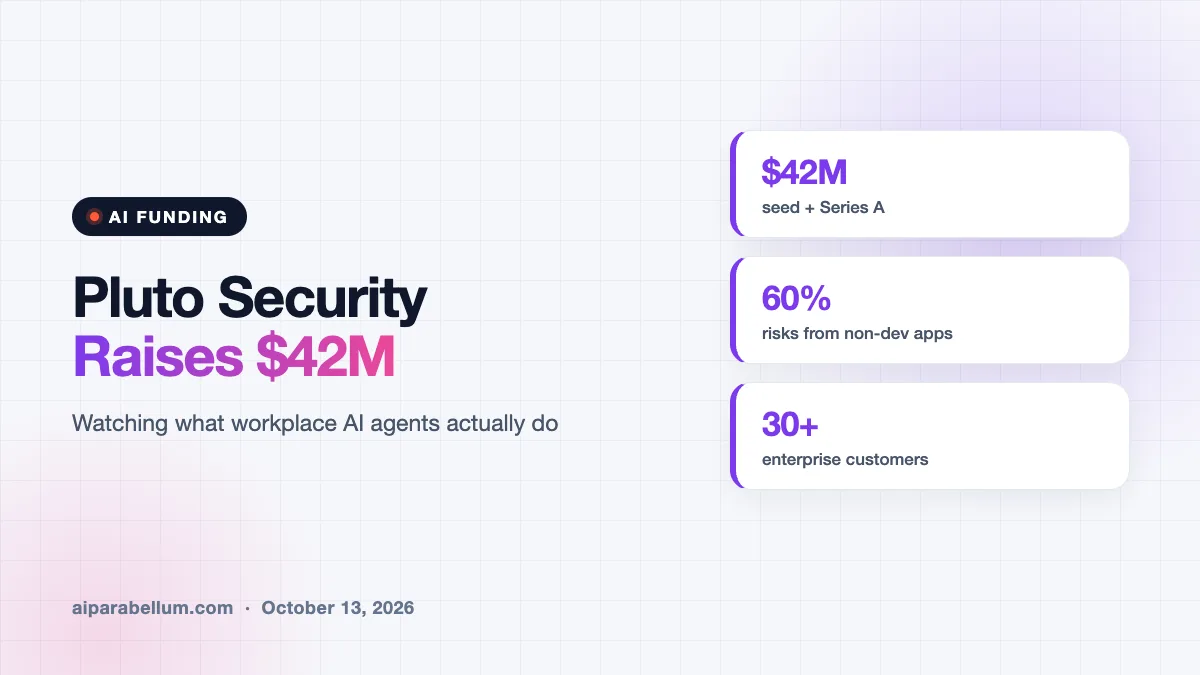
Pluto Security has come out of stealth with $42 million to help companies keep an eye on how employees use AI tools and agents. The startup’s pitch is simple: workers are building and running AI apps faster than security teams can track them. Pluto says its software can spot risky tools and even step in while an AI agent is working.
Here is what Pluto does, who is backing it, and why this kind of AI agent security is drawing big money.
Inside the Pluto Security Funding
The $42 million comes from two rounds. The startup’s 40 employees are split between the US and Israel.
| Detail | What We Know |
|---|---|
| Seed round | $8.5 million, led by TLV Partners, with Armis founders investing |
| Series A | $34 million, led by Jump Capital, with Shlomo Kramer’s Skinos and Ansa Capital joining |
| Revenue | More than $2 million in annual recurring revenue (company figure) |
| Customers | 30+ enterprises, including Oscar Health, Workato, Sixt, and AlphaSense |
| Started selling | April 2026 |
Pluto plans to spend the money on product development, security research, and a bigger US presence.
The Problem: Vibe-Coded Apps Nobody Is Watching
CEO and co-founder Shahar Bahat says a brand-new AI tool can show up inside a company’s systems within about two hours of launch. That speed leaves security teams little time to vet anything.
The bigger surprise is who creates the risk. According to Bahat, about 60% of the risks Pluto finds come from tools vibe-coded by people who are not developers.
- Finance teams are the largest source of these risks.
- Marketing comes second, followed by legal.
- Professional developers rank only fourth.
In one case, Pluto says it found an app built by a finance employee at a Fortune 500 company to track customer data and churn. That app had been left open to the internet.
Every Test Turned Up Something
Bahat claims every proof-of-concept trial Pluto ran found malicious components, such as bad extensions or skills. Some of those trials caught live attacks in progress.
How Pluto’s AI Agent Security Works
Pluto argues that older security tools were built to watch people, not software that acts on its own. Bahat sums up the shift as moving from tracking user behavior to tracking agent behavior.
The platform monitors the AI tools workers use, along with the skills, extensions, and MCP servers those tools connect to. It also tracks the apps and agents employees build themselves.
- It plugs into existing endpoint security and device management systems, or installs its own sensors.
- It collects signals such as prompts, commands, running processes, and permissions.
- Small models running on each device judge what an agent is trying to do.
- If an agent reaches for more access than the user intended, Pluto can block the action or tell the agent to ask for confirmation first.
That last step is the unusual part. Pluto says it can feed new instructions back into a live agent session to change how the agent behaves, without shutting the tool down.
A Free Tool as a Sales Funnel
In April, Pluto also launched Plutonium, a free platform for checking the risks of public AI skills, connectors, and add-ons. It includes an MCP scanner and a catalog of verified components. The company says about 70% of its sales pipeline now comes from inbound interest.
What This Means for You
If you use AI tools at work, the lesson is that your quick helper app may be a bigger risk than you think. A few simple habits help.
- Do not connect a homemade AI app to customer or financial data without checking with IT first.
- Be careful with third-party skills, extensions, and MCP servers, and stick to ones from trusted sources.
- Pay attention when an agent asks for broad permissions, and learn how your coding tools handle permission prompts before turning them off.
- If you run security for a team, look at AI threat detection options that cover agents, not just users.
You can explore more cybersecurity AI tools and AI agent tools in our directory. For more stories like this one, visit our AI news page.
Sources
This article is based on reporting from TechCrunch, which interviewed Pluto Security’s CEO.
Conclusion
Pluto Security’s $42 million raise shows how fast AI agent security has become its own market. The company’s core claim is that the riskiest AI tools at work are often built by finance, marketing, and legal staff, not engineers. Its answer is software that watches agents in real time and can nudge them back in line. Many of its figures come from the company itself, but the underlying problem of unvetted AI apps is one every business now faces. Expect more startups, and more funding, aimed at the same gap.
