Amazon Web Services has made Amazon Textract Insights generally available, a new generative AI feature that pulls data out of messy documents using plain-language instructions. You describe the fields you want, upload a file or a mixed packet, and get structured results back. Every value comes with a confidence score and a pointer to the exact page and spot it came from.
What Amazon Textract Insights Does
Amazon Textract has long turned scanned pages into text and tables. Textract Insights adds a new API on top that lets you ask for specific information in your own words, with no model training. AWS pitches it at banks, insurers, healthcare groups and government agencies that process piles of paperwork.
The big idea is trust. AWS argues that a general chatbot can give fluent answers but often cannot say which page a number came from or how sure it is. Textract Insights is built to return results a reviewer or auditor can check against the original document.
Blueprints define what to extract
You set up extraction with a “blueprint,” a JSON Schema where each field has a plain-English description of what to find. Each field is marked as either read word for word from the page or inferred from the document’s content. AWS offers ready-made public blueprints for common forms, and you can write your own for business-specific documents.
- W-2 wage statements
- Form 1040 tax returns
- Form 1098 mortgage interest statements
- Passports
- Birth certificates
Handling Mixed Document Packets
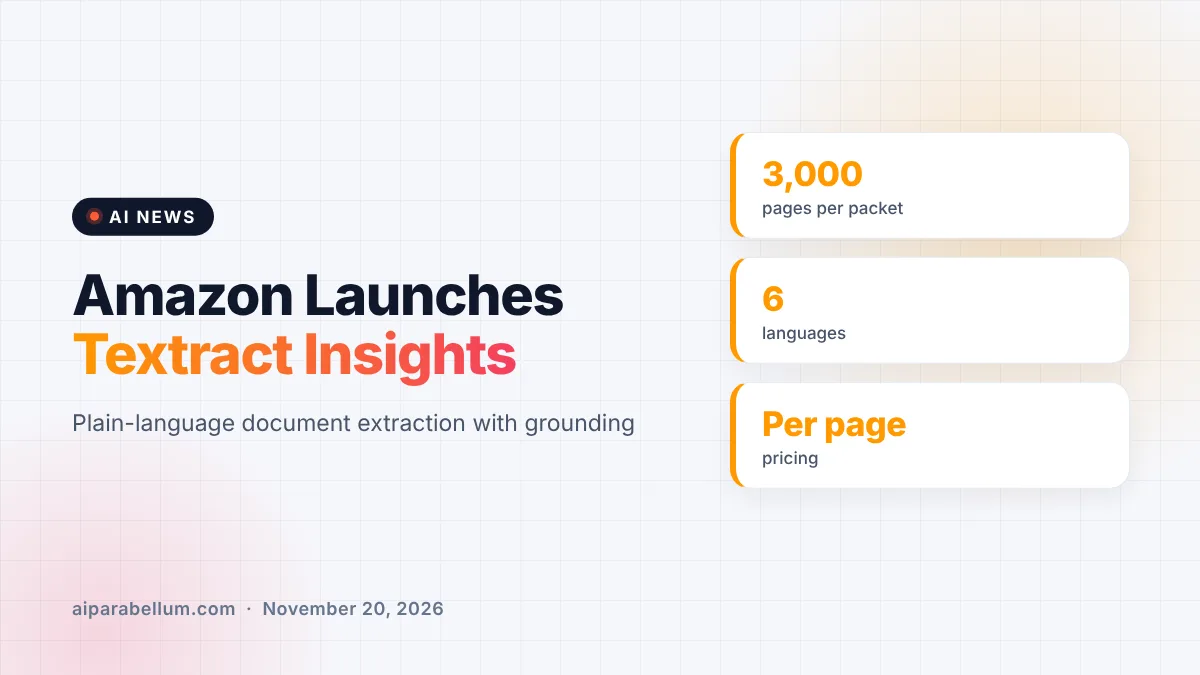
Real-world files are rarely tidy. A mortgage application might arrive as one scan holding a W-2, payslips, bank statements and handwritten notes in no set order. Textract Insights can take a single file of up to 3,000 pages, split it into separate documents, match each to the right blueprint and extract the fields.
That whole flow runs as one asynchronous request using a call named StartDocumentInsights. Results land in your own Amazon S3 bucket. Each value includes the page and bounding box it was drawn from, so you can trace it back quickly.
Insurance claims and customer onboarding files look similar, mixing typed forms, dense tables, receipts and letters. AWS shared a quote from Symbeo, a CorVel company, which said plain-language field descriptions help because its medical bills arrive in many layouts. Rules built for one sender often fail on another, so this kind of AI document checking can save real time.
Amazon Textract Insights Features and Limits
| Feature | Details |
|---|---|
| Availability | Generally available now |
| Max packet size | 3,000 pages per file |
| File types | PDF, PNG, JPEG, TIFF |
| Languages | English, French, German, Italian, Portuguese, Spanish |
| Output | Values with confidence scores and page-level grounding |
| Pricing model | Per page, no minimum commitment |
| Training needed | None |
Because pricing is per page rather than per token, costs should be easier to predict than with a typical language model API. AWS did not list specific rates in its announcement and points customers to the Textract pricing page.
Security and data handling
Projects and blueprints are encrypted with AWS-owned keys by default, and you can bring your own key through AWS KMS. Intermediate job data is temporary and deleted when a job finishes. AWS says requests are routed to compute within the same geography, so a US request is processed in the US.
Upgrades to Textract Core
AWS also updated Amazon Textract Core, the reading engine behind the service. It says accuracy is better on dense tables and handwriting, and language coverage now reaches 40 languages for its standard text and analysis APIs. Existing customers get these gains without changing any code.
Textract Core is now available in Tokyo and Zurich too, bringing it to 18 AWS Regions in total. However, Textract Insights itself is not yet offered in those two new regions.
What This Means for You
If your team handles loan files, claims or patient forms, Textract Insights could cut the custom code you maintain. Instead of chaining OCR, splitting, classification and a model prompt, you make one API call. The confidence scores let you decide which values to accept automatically and which to send to a person.
- Start with a public blueprint if you process standard US tax or ID forms.
- Test on a sample of your own documents and tune a confidence threshold.
- Keep humans in the loop for low-confidence fields and judgment calls.
- Check language and region support before planning a rollout.
The launch is part of a steady stream of AWS AI moves, following tools like TorchNeuron for Trainium. For more updates, visit our AI news page.
Sources
Primary source: AWS’s Amazon Textract Insights announcement.
Conclusion
Amazon Textract Insights brings generative AI to document processing while keeping every answer traceable to its source page. Plain-language blueprints, packet splitting and confidence scores target the slow, manual review work that holds back automation. It is limited to six languages for now and lacks published rates in the launch post. Still, for paperwork-heavy industries, it is a practical step toward AI you can audit.