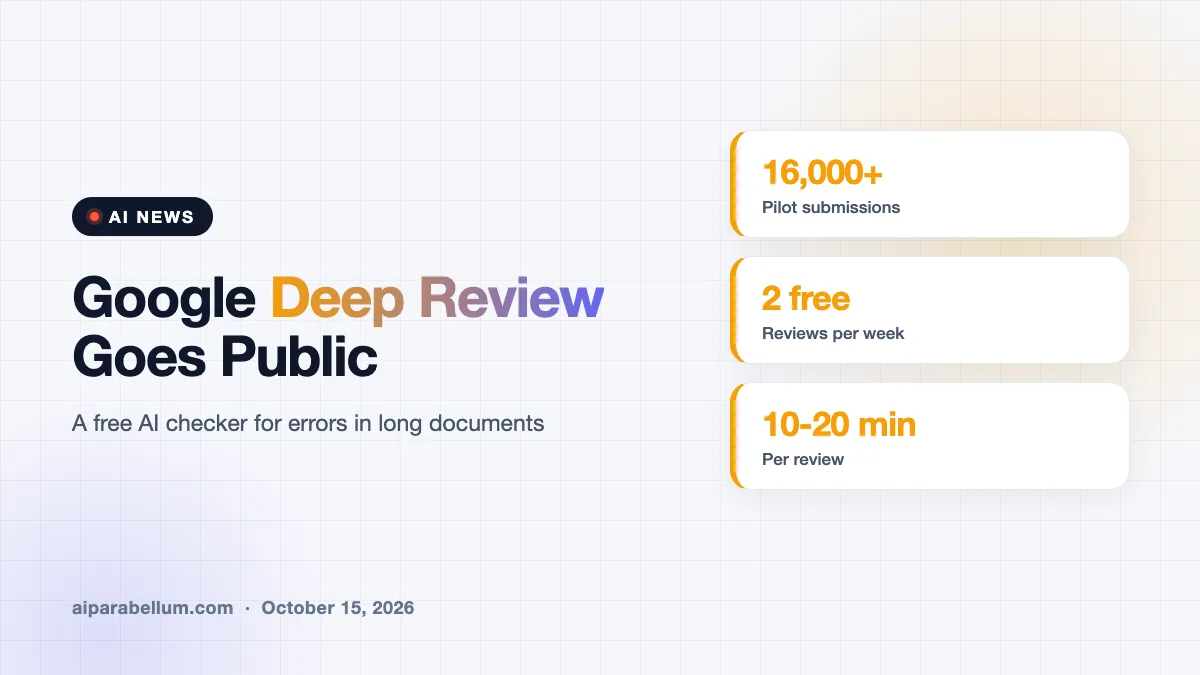
Google Deep Review is now open to the public, giving anyone a free AI system that reads long technical documents and flags math errors, logic gaps and claims that lack support. Google Research released it on October 14 after testing an earlier version on thousands of computer science papers. The pitch is simple: AI makes writing faster, so something needs to make checking faster too.
What Google Deep Review Actually Does
You upload a document, and a team of AI agents goes through it section by section. A review takes about 10 to 20 minutes, according to Google research scientist Rajesh Jayaram. You get back a list of major and minor issues, suggestions and summaries, with comments tied to the exact spot in the text.
Google built it for dense material like research papers, where a single mistake in a proof can sink the whole argument. It now pitches the tool for other kinds of work too. That includes design documents, slide decks, and legal or financial files where the numbers and clauses need to line up.
How the four-step review works
Google says one long prompt to a chatbot often fails on big documents. The model runs out of reasoning room, misses links between sections, or accepts tricky claims too easily. Deep Review splits the job into stages instead:
- Splitting: an agent breaks the document into logical parts, such as the introduction, methods and results.
- Budgeting: the system gives more computing power to hard sections, like dense math, and less to easy ones.
- Parallel checking: separate agents review each part at the same time, while still seeing the full document.
- Final pass: a synthesis agent merges the findings, checks the sections against each other and runs outside grounding checks, including Google Search, to catch hallucinations.
From Conference Pilot to Public Tool
Deep Review grew out of an experiment called the Paper Assistant Tool. Over the past year, Google offered it to authors at four major computer science conferences: STOC, ICML, NeurIPS and ICLR. Authors who opted in got private feedback before their deadlines, separate from the official peer review.
Google says more than 16,000 submissions went through those pilots. The pressure behind the project is real. Google counts over 74,000 submissions this year to ICLR, NeurIPS and ICML combined, up from about 23,000 in 2023.
The accuracy numbers so far
In a June preprint, Google researchers reported that the pilot tool caught 89.7% of known math and proof errors in a test set. A single response from Gemini 3.1 Pro caught 55.2%. That test was small, covering 29 errors across 26 papers, so treat it as an early signal rather than proof.
Pilot users also reported times when the system wrongly challenged a correct proof or argument. In other words, it can be confidently wrong. Google now runs the tool on its newer Gemini 4 Argon model, which it says improves the quality of the feedback.
Deep Review Access, Limits and Privacy
Here is a quick look at how you can use it today, based on Google’s launch details.
| Feature | What Google offers |
|---|---|
| Free use | Two document reviews per week for every user |
| Heavier use | Connect a Gemini API key for higher limits and API access |
| File types | PDF and plain text at launch, multi-file input coming soon |
| Review time | About 10 to 20 minutes per document |
| Training data | Uploads are not used to train Google models |
| Storage | Documents kept for one year so you can view them in the tool |
Google also added a related review pattern to Antigravity, its agent-based coding tool. Developers can call it with a preview command to run similar multi-agent checks on drafts and proposals. If you already use the Gemini 4 Argon model through the API, the Deep Review API can plug into your existing workflows.
Why AI Review Tools Matter Now
AI can now produce polished papers, reports and contracts in minutes. Checking that work still takes a trained human, and that supply has not grown. NeurIPS program chair Nika Haghtalab warned that AI makes it easier to write papers that look sharp but have “weak substance.”
Tools like this aim to handle the tedious checking so people can focus on bigger questions, like whether the work is new and important. That fits a wider trend of AI research tools moving from writing help to verification help. It also raises a fair question about how much reviewers should lean on a machine that can still make mistakes.
What This Means for You
You don’t need to be a scientist to get value here. Anyone who writes long, detail-heavy documents can try it for free. A few practical tips:
- Use your two free weekly reviews on your most important drafts, like a grant proposal, thesis chapter or contract.
- Treat each flag as a lead to investigate, not a final verdict, since the tool can wrongly challenge correct work.
- Run it before you send work to a human reviewer, so their time goes to the big-picture issues.
- Check your organization’s rules before uploading confidential files, even though Google says it won’t train on them.
- Pair it with good habits from your regular writing assistant workflow, such as clear structure and cited claims.
For more launches like this one, keep an eye on our latest AI news coverage.
Sources
This article is based on the Google Research announcement and launch coverage from R&D World.
Conclusion
Google Deep Review takes a tool that was tested on more than 16,000 conference submissions and opens it to everyone, with two free reviews a week. Its multi-agent design is built to catch the errors that a single chatbot reply tends to miss in long documents. Early numbers look promising, but the test set was small and the tool can still flag correct work as wrong. Used as a first-pass checker, it could save writers and reviewers real time. The final call on whether a document holds up should still belong to a person.