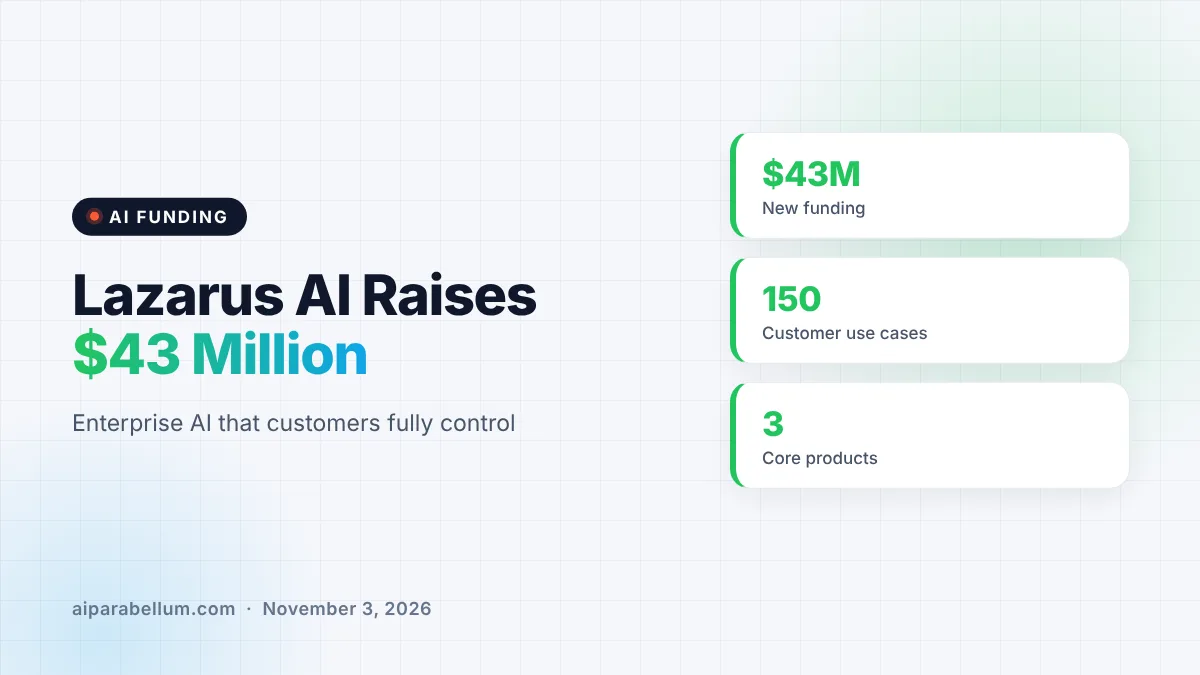
Lazarus AI, a Boston startup that sells AI to big insurers and government agencies, has raised $43 million in new funding. The company’s pitch is simple: customers keep control of their own data, models and costs instead of renting everything from a frontier lab. This Lazarus AI funding round lands at a moment when many large organizations are asking hard questions about who really owns their AI stack.
Inside the Lazarus AI Funding Round
The company announced the raise on November 3, 2026. It did not say what type of round this is or share a valuation. What it did share is a long list of backers.
Investors taking part include insurance giant QBE and State Farm Ventures, along with several venture firms and startup programs. Here is who joined the round, according to the company:
- QBE and State Farm Ventures, two names tied to the insurance industry
- Mucker Capital, Motivate Ventures and Wave Function Ventures
- Indelible Solutions, Joyance Partners, AllegisNL Capital and One Way Ventures
- AngelList, Techstars and Plug and Play, plus other investors
The insurance backers make sense. Lazarus says its customers include insurers, healthcare groups, government agencies, financial firms and technology companies across North America, Asia-Pacific and Europe.
What “Independent AI” Means Here
Lazarus calls its approach “independent AI.” In plain terms, the platform can run on a company’s own servers, inside sovereign government environments or in a customer’s own cloud account. The company says there are no per-token charges and no need to rebuild things when models or hardware change.
CEO Alex Panait framed the big issue as control over which models get used, where data lives and how costs behave. He said customers keep sensitive data “inside their walls,” approve every model change and can see the evidence behind each result. That is a direct contrast with the pay-per-use model most popular AI tools rely on.
Our take: as AI moves from pilots into core business systems, the fight is shifting from “which model is smartest” to “who controls the setup and the bill.”
Three Products Behind the Pitch
Lazarus focuses on three kinds of work where mistakes are costly. Each product targets a different pain point for large, regulated organizations.
| Product | What it does | Claim the company makes |
|---|---|---|
| Applied Intelligence System | Reads and understands complex documents | Cites each finding to its source page; 12.5 points higher field-level accuracy than standalone models across 150 customer use cases |
| Clearwing | Finds security flaws in source code | Reproduces bugs, grades the evidence and proposes a fix, while engineers decide when it ships |
| Constructor | Modernizes old software systems | Recovers business logic from decades-old systems and generates new code shown to match the original; piloting with two of the largest mainframe makers |
A cost claim worth watching
Lazarus also says that in a modeled high-volume scenario, its platform cut yearly operating costs by 78% compared with pay-per-use frontier models. Keep in mind this is a modeled company figure, not an independent test. Still, it shows how hard vendors are now competing on price as AI usage grows.
Where the Lazarus AI Money Goes
The company says it will use the new cash in three ways. It plans to expand strategic partnerships, invest in research and development, and bring new products to market.
Lazarus did not share a timeline or name specific upcoming products. Given its current lineup, more tools for documents, security threat detection and legacy code seem like the natural next steps.
A Crowded Field for Enterprise AI Control
Lazarus is not alone in chasing companies that want more say over their AI. Security and governance startups have pulled in large rounds this year, such as Harmonic Security‘s $50M raise and Reco’s funding round. The common thread is that businesses want AI they can audit, not a black box.
The legacy code angle is also heating up. Tools that help an AI explain legacy code are getting attention because so many banks, insurers and agencies still run on mainframes.
What This Means for You
Most people will never log in to Lazarus directly. But if you work at an insurer, a bank or a public agency, tools like this may soon shape how your team handles claims, contracts and code.
- If your company worries about sending data to outside AI services, on-premises options like this are becoming more common.
- Ask vendors whether their AI cites sources for each answer, since that makes errors easier to catch.
- Compare flat pricing against per-token pricing before scaling any AI project.
- Treat vendor cost and accuracy claims as starting points, and test them on your own workload.
For a wider look at options, our guide to business AI tools is a good place to start. You can also follow the latest funding moves on our AI news page.
Sources
The full text of Lazarus AI’s funding announcement, as distributed by Business Wire, was read via Yahoo Finance.
Conclusion
Lazarus AI’s $43 million raise is a bet that big, regulated organizations want AI on their own terms. Backing from QBE and State Farm Ventures suggests the insurance world is paying close attention. The company’s accuracy and savings claims still need outside proof. But the message is clear: control over data, models and costs is becoming a selling point of its own.