
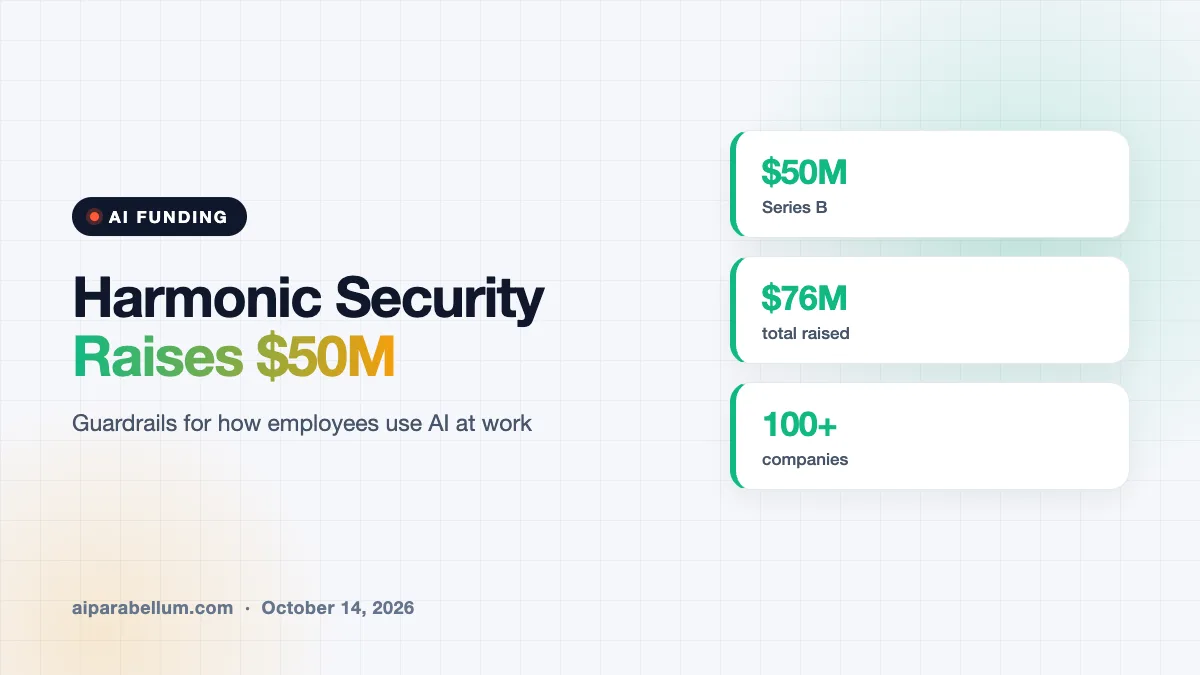
Harmonic Security, a startup that watches how employees use AI tools at work, has raised $50 million in a Series B round. The Harmonic Security funding was led by Crosspoint Capital Partners, with existing investors joining in, and it brings the company’s total raised to $76 million.
The pitch is simple. Companies want their teams to use AI, but they don’t want passwords, customer data or trade secrets pasted into a chatbot. Harmonic says it can catch those mistakes in real time without blocking the useful work.
Inside the Harmonic Security Funding Round
The company is based in San Francisco and London and now has more than 90 employees across the U.S. and U.K. It plans to spend the new money on engineering and go-to-market hires on both sides of the Atlantic.
Harmonic says more than 100 companies use its platform, including some of the world’s largest enterprises. Together, they cover millions of employees. It has also signed new distribution deals with Climb Global Solutions and Distology.
| Detail | Figure |
|---|---|
| New funding | $50 million Series B |
| Lead investor | Crosspoint Capital Partners |
| Total raised | $76 million |
| Customers | More than 100 companies |
| Team size | More than 90 people |
| Offices | San Francisco and London |
How Harmonic Security Checks AI Prompts
Harmonic inspects whatever an employee sends to an AI tool before it arrives. Instead of relying on simple keyword rules, it uses its own small language models that read each request in context. A verdict comes back in milliseconds.
That context is the key selling point. The company says its system can tell the difference between a developer mentioning a database schema, which is fine, and someone pasting live login credentials, which is not. Older data loss tools often struggle with that kind of nuance.
From the browser to AI agents
The checks first worked only inside the web browser. Over the past year, Harmonic has stretched them to desktop AI apps and agentic workflows. The company argues those are the places where trouble often starts, such as staff signing in to AI services with personal accounts.
Tracking value, not just risk
The same models also power a feature called Usage Intelligence. It shows leaders which AI use cases are paying off and even which employees have found faster ways to work. CEO Alastair Paterson said boards now ask two things: how to cut AI risk and whether AI is worth the money.
Claude and Cisco Integrations
Harmonic is also plugging into tools companies already run. It built an integration with the Claude Compliance API from Anthropic. That gives security teams access to activity logs from Anthropic-hosted Claude Platform deployments, plus conversation content for organizations on Claude Enterprise.
Separately, Cisco lists Harmonic as an ecosystem partner for Agent Builder in its Cloud Control platform. That connection runs over Model Context Protocol, the open standard many AI agents now use to reach outside tools.
What This Means for You
If your company has rolled out AI tools, a product like this may already be watching your prompts, or soon will be. Here are a few practical takeaways:
- Assume work prompts are monitored. Treat anything you type into a workplace AI tool like a company email.
- Don’t paste secrets. Passwords, API keys and customer records should never go into a chatbot, even a trusted assistant like Claude AI.
- Avoid personal AI accounts for work. Using a personal login is one of the most common ways company data slips out.
- Expect smarter guardrails. Context-aware filters should block fewer harmless requests than older keyword-based tools.
Harmonic joins a busy field. Just recently, Pluto Security raised $42M to lock down AI agent security. If you want to strengthen your own defenses, our guide to AI threat detection is a good place to start, and you can browse more business AI tools or the latest AI news.
Sources
This article draws on reporting from SiliconANGLE and Harmonic Security’s funding announcement, published via Business Wire on Yahoo Finance.
Conclusion
Harmonic Security’s $50 million Series B shows how fast the market for workplace AI governance is growing. As more employees lean on chatbots and AI agents every day, companies need a way to stop data leaks without killing productivity. Harmonic’s bet is that small, context-aware models can do both, while also showing which AI projects are worth the spend. Its customer count and coverage claims come from the company, so the next year will show how well that approach scales.
