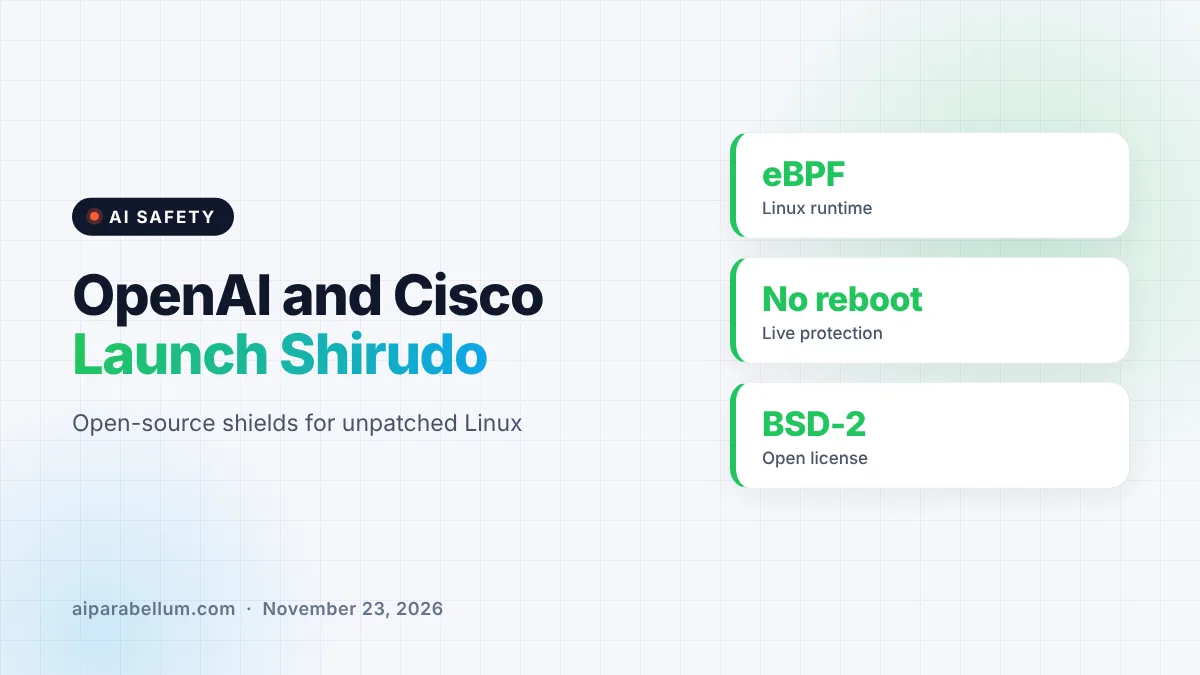
OpenAI and Cisco just launched Shirudo, an open-source security runtime that can guard a running Linux system while a patch is still on its way. The idea is simple: when a new vulnerability drops, you should not have to choose between leaving a server exposed and taking it offline. Shirudo lets AI agents draft a targeted temporary protection, called a shield, that a human can test and approve without restarting anything.
The two companies announced the project on November 23, 2026. The code is public, the license is permissive, and both companies are asking outside developers and security teams to help build it.
What OpenAI and Cisco’s Shirudo Does for Linux
Shirudo is Japanese for “shield,” and that is the core unit of the project. A shield is a small, focused safeguard that blocks the specific behavior a vulnerability depends on while letting normal traffic keep flowing. That matters because an exploit and a legitimate request often use the same Linux operation, so blocking it bluntly could knock a service offline.
Patching is still the real fix. But testing and rolling out a patch across many machines can take days or weeks, and attackers only need one machine that was missed. Shirudo is meant to cover that gap.
Built on eBPF
Under the hood, Shirudo uses eBPF, a Linux technology that runs small programs at specific points inside the operating system. That lets it watch for suspicious activity and apply narrow protections to systems that are already running. Teams can preview how a proposed shield would affect their apps before switching it on.
How the OpenAI and Cisco Shield Works
The companies describe four core capabilities. Here is how they break down:
| Capability | What it means in practice |
|---|---|
| Live protection | Shields block vulnerable code paths without a restart, and can be monitored before enforcement |
| Machine-speed defense | AI agents investigate a flaw, write a shield and test it against exploits and real workloads |
| Trusted deployment | Shields are cryptographically signed and verified before loading, and checked by the eBPF verifier |
| Hardware-backed verification | A Trusted Platform Module keeps a verifiable record of protections being loaded or removed |
One point both companies stress is that people stay in charge. Agents can do the legwork, but security teams decide what actually gets deployed. Cisco frames it as agents doing the work while “people keep the keys.”
The Java Test Case
OpenAI shared a controlled test as an example. Using its Codex coding model, the team generated a shield that added an input check to Java’s Base64 decoder and attached it to a live Elasticsearch process. When an exploit for the “Java4Shell” flaw was attempted, the shield rejected the malicious input and Elasticsearch kept running.
Cisco says Shirudo also detected and blocked exploit attempts against a recent PHP flaw in testing. These are company-run tests, so independent results will matter once outside teams try it on their own systems.
Why AI Companies Are Building Security Tools Like This
This launch fits a bigger trend. AI is speeding up how fast bugs get found, by defenders and attackers alike, and the slow part is now getting fixes in place. OpenAI has been pushing its models into security work, and this is a step from finding flaws toward actually holding them off.
If you follow how teams use AI threat detection, Shirudo moves that idea down into the operating system itself.
OpenAI President Greg Brockman put the reasoning plainly, noting that “finding a bug today doesn’t mean you can patch every system tomorrow.” Cisco President Jeetu Patel said security teams need tools that match “the speed of the AI-driven threats they are facing.”
Other big players are moving in a similar direction. Microsoft has rolled out its own agent security tools, and startups focused on AI agent security keep raising money. Shirudo stands out because it is fully open source rather than a paid product.
Shirudo’s Open Source License and How to Join
Shirudo is released under the BSD 2-Clause license, with its BPF programs dual-licensed under BSD and GPL. The companies are inviting help in several forms:
- Contributing tests that reproduce a real vulnerability
- Running a shield against a kernel build you already use
- Reporting cases where a shield breaks legitimate traffic
- Writing new shields or improving Linux and eBPF support
There is a VM quickstart for signing, loading and verifying a test protection, plus a self-guided lab from Isovalent. A technical deep-dive webinar is scheduled for December 15. Longer term, OpenAI says it wants tested shields to ship alongside vulnerability disclosures, so operators get a stopgap the same day a flaw goes public.
What This Means for You
If you run Linux servers, Shirudo is worth a look, but treat it as an early project. It does not replace patching, and the companies themselves call it a first step.
- Security and ops teams can test it in a lab now and see whether shields fit their patch process.
- Developers who use Codex-style tools get a real example of AI writing defensive code, with a human sign-off step.
- Smaller teams with slow patch cycles stand to gain the most if the project matures.
- Everyone should watch for independent testing before trusting shields on critical systems.
For more on how AI is changing day-to-day defense, see our latest AI news coverage.
Sources
Primary source: OpenAI’s Shirudo announcement. Additional details from Cisco’s press release.
Conclusion
Shirudo is a practical answer to an old problem: the risky window between a vulnerability going public and every machine getting patched. By pairing OpenAI’s models with Cisco’s infrastructure know-how, the project lets AI agents draft narrow, signed protections that humans approve and apply without a restart. Its open-source license means anyone can inspect and improve it. The early test results come from the companies themselves, so real-world trials will decide how useful it becomes. Still, it is a clear sign that AI security tools are moving from spotting flaws to actively holding them off.