Anthropic has launched Claude Ship, a beta toolset that lets Claude review GitHub pull requests, fix what breaks and approve routine changes when a team’s own policy allows it. The pitch is simple: if agents already write much of your code, the slow part is everything that happens after you open the PR. Claude Ship is available now on Claude Team and Enterprise plans.
What Claude Ship Actually Does
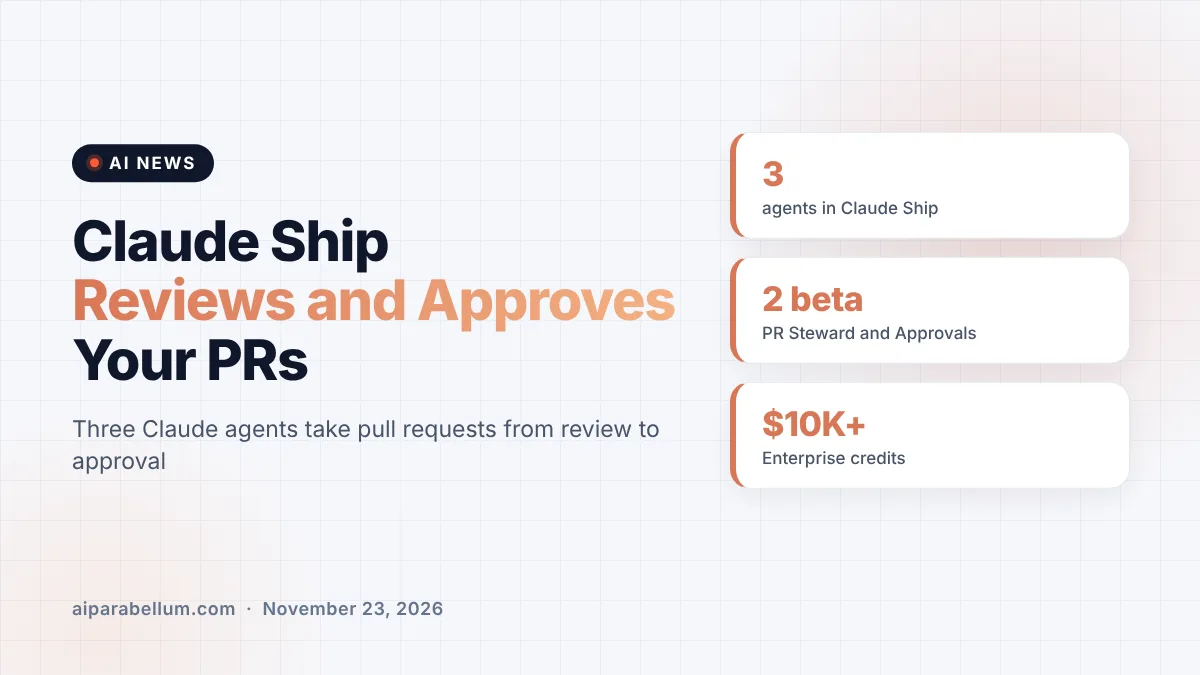
Claude Ship is not one tool but three agents that hand a pull request from one step to the next. Anthropic describes the goal as shipping code “as fast as teams write it,” while teams keep control over where it runs and which changes still need a person.
Here is how the pieces fit together:
- Code Review reads the pull request against the wider codebase, checks its own findings and posts them to the PR. It was already generally available before this launch.
- PR Steward, new in beta, works on failing CI checks, merge conflicts and review comments from Code Review, other tools or teammates.
- Claude Approvals, also new in beta, checks the pull request against an approval policy file the team keeps in the repository.
| Agent | Status | Main job | Can it approve? |
|---|---|---|---|
| Code Review | Generally available | Finds logic errors, security issues and broken edge cases | No |
| PR Steward | Beta | Fixes failing checks, merge conflicts and review feedback | No, and it never merges |
| Claude Approvals | Beta | Applies the team’s written approval policy | Yes, where the policy allows it |
How PR Steward and Claude Approvals Work
PR Steward keeps the pull request green
PR Steward steps in when a check fails, when the branch has conflicts, or when someone leaves review feedback. After every push it leaves a comment explaining what it changed and how to undo it. Developers can steer it by commenting @claude with an instruction, or tell it to step back with @claude stop.
The setup docs suggest starting PR Steward in a manual mode, where it only begins when someone asks for it. They also warn that it has no spend limit of its own until an admin sets one.
Claude Approvals works like a smarter CODEOWNERS file
Claude Approvals reads a policy file that says how many people each part of the repo needs and where Claude may approve. A policy can weigh facts about the pull request, such as how many lines changed or which branch it targets, plus Code Review findings and custom classifiers written in plain language.
Anthropic recommends running the policy in observe mode first, where the check only reports what it would have decided. Teams can then make it a required check in GitHub branch protection once they trust it.
Using Claude Ship From Claude Code With /ship
Individual developers get a new /ship command in Claude Code. When a change is ready, you run /ship and Claude pushes the branch, opens the PR, reviews it and works through feedback and failing checks. What can actually merge still depends on your permissions and the repo’s branch rules.
Admins can also switch Claude Ship on for a whole repository, so every pull request gets the treatment without anyone typing a command. It builds on the Code Review launch from earlier this year and works alongside existing branch protection and required checks.
Pricing, Limits and Who Can Use It
Claude Ship is billed on tokens, so turning it on can raise an organization’s costs. Anthropic says the bill depends on the number and size of pull requests, the review level, how often reviews run and how much fixing PR Steward does.
- Admins can set spend limits for Code Review and PR Steward.
- Claude Approvals has no base charge, but policy classifiers are billed on tokens, even in observe mode.
- Running /ship counts as regular Claude Code usage.
- Eligible Enterprise organizations can claim at least $10,000 in Claude Ship credits by January 15, 2027.
There are limits on who can use it. Claude Ship is not available to organizations with Zero Data Retention, the HIPAA configuration or customer-managed encryption keys, which matters given Anthropic’s recent retention beta. It also only supports repositories on GitHub for now.
Anthropic’s Own Results and the Risks
Anthropic says Claude writes most of the code on its Claude Code team, and it runs Claude Ship on many of its own pull requests. The company claims merged PRs on that team more than doubled from June to September while the share of reverted changes fell by more than 40%, with Claude’s review as one layer of a wider process.
The docs are candid about the risks. A policy with zero required seats can let a bot-written pull request merge with no human looking at it, and a rule that lets Claude approve does not start a review on its own. Some developers are wary too, and one ZDNET editor said the idea of shipping at the speed of writing “raises the hair on the back of my neck.”
Our take: Claude Ship moves AI from writing code to deciding what merges, so the approval policy file is now one of the most important files in your repo.
What This Means for You
If your team already leans on Claude or other agents to write code, Claude Ship targets the waiting game after the PR. If you work in a regulated setup, check your data settings first, since several configurations are excluded.
- Start with one low-risk repository and the Quick or Standard review level.
- Run Claude Approvals in observe mode and compare its calls with your reviewers’ decisions.
- Set monthly spend limits for Code Review and PR Steward before turning them on widely.
- Keep at least one human seat on sensitive paths like auth, payments and infrastructure.
- Review your Claude Code permissions so /ship only does what you expect.
For more coding-agent updates, see our latest AI news.
Sources
Primary source: Anthropic’s Claude Ship announcement. Product details from the Claude Ship docs, PR Steward docs and Claude Approvals docs. Additional reporting from The Verge and ZDNET.
Conclusion
Claude Ship is Anthropic’s bet that the bottleneck in AI-assisted coding has moved from writing code to reviewing and merging it. Code Review, PR Steward and Claude Approvals together let Claude carry a pull request from first review to an approval decision, under rules each team writes. The beta comes with real guardrails, like observe mode and spend limits, but also real ways to misconfigure it. Teams that start small and keep humans on sensitive code will learn fastest whether it earns a place in their workflow.