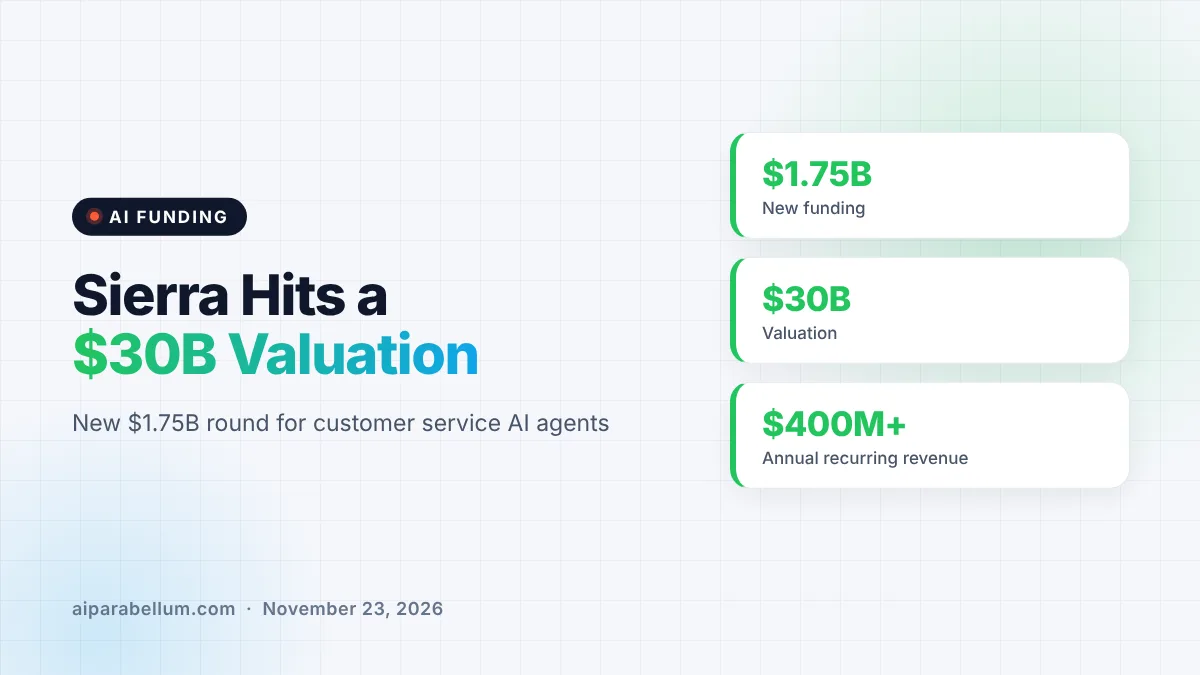
Sierra AI funding just hit a new level. The customer service agent startup co-founded by Bret Taylor and Clay Bavor says it is raising $1.75 billion at a $30 billion valuation, roughly double what investors paid for the company in May. Greenoaks and Lightspeed Venture Partners are leading the new round.
The company announced the deal on its own blog on November 23, 2026. Every one of Sierra’s earlier lead investors, Benchmark, Sequoia, Greenoaks, GV and Tiger Global, is putting in more money this time as well.
Sierra AI Funding Round at a Glance
The new round is the latest in a fast series of raises for the company. Here is how the key numbers line up, based on Sierra’s announcement and earlier disclosures.
| Detail | May 2026 round | November 2026 round |
|---|---|---|
| Amount raised | $950 million | $1.75 billion |
| Valuation | More than $15 billion | $30 billion |
| Lead investors | Tiger Global and GV | Greenoaks and Lightspeed |
| Annual recurring revenue | $150 million (as of February) | More than $400 million |
In plain terms, the company’s value doubled in about six months. Its revenue run rate grew even faster over a similar stretch.
What Sierra Actually Sells
Sierra builds AI agents that big companies put in front of their customers. These agents answer questions, handle returns, process insurance claims and take care of other tasks that used to need a call center worker. Sierra calls this idea the “digital front door” for every business.
Ghostwriter and a mix of models
A big part of the pitch is Ghostwriter, which Sierra describes as AI that builds AI. A team sets the goals and the guardrails, and Ghostwriter builds, tests and deploys the agent. It then reviews real conversations and suggests experiments to make the agent better over time.
Under the hood, Sierra says its agents draw on a “constellation” of more than 15 models. Different models handle different jobs, such as fast tool use, long reasoning or getting the tone right. Customers don’t have to pick a model or watch their token spending themselves.
Paying for results
Sierra also leans on outcome-based pricing, where a business pays when the agent actually resolves an issue. That ties Sierra’s revenue to results instead of seats. It also means the agents have to work on their own reliably, or Sierra earns less.
Why Investors Are Betting Big on Sierra
The simplest answer is growth. Sierra says it passed $400 million in annual recurring revenue in just over two and a half years, and it added more than $150 million of that in the third quarter alone. According to the company, its revenue run rate took six months to double from $100 million to $200 million, then five months to double again to $400 million.
The customer list helps too. Sierra names long-established, heavily regulated firms as clients, including:
- Banks such as JPMorganChase, Wells Fargo, BNY, HSBC and Santander
- Insurers and health companies like Cigna, Prudential Financial and Sutter Health
- Consumer brands including Next, BISSELL, ADT and ScottsMiracle-Gro
- Telecom and media names such as Singtel and Pearson
Earlier this year, Sierra said it worked with more than 40% of Fortune 50 companies. That share has reportedly grown to nearly half since then.
Taking on the bubble question
Taylor, who also chairs OpenAI’s board, and Bavor addressed AI bubble fears head-on in their post. They argue that some of the oldest companies in the world are adopting AI the fastest and seeing real returns. Of course, that is a company making its own case, so it is worth watching whether that growth holds as AI spending gets more scrutiny.
The round also lands in a busy month for AI money. It follows other giant raises, like the OpenAI funding round, and a wave of agent startups crossing the billion-dollar mark, such as Wabi’s personal agent.
What This Means for You
You may already be chatting with a Sierra agent without knowing it, since it powers support for many large banks, insurers and retailers. More funding usually means faster rollouts, so expect more of these agents when you call or message a big company. Here is how to make the most of it:
- Be specific when you describe a problem, since these agents work best with clear details like order numbers or dates.
- Ask to reach a person if the agent gets stuck or the issue involves money or health decisions.
- If you run a business, compare outcome-based pricing with per-seat tools before you sign, and read up on the support agent ROI first.
- Keep an eye on how agents handle sensitive data, a topic covered in our report on bank account agents.
For a broader view of how bots are reshaping help desks, see our guide to the impact of chatbots on support teams. You can follow more stories like this in our latest AI news.
Sources
Primary source: Sierra’s Series F announcement. Additional reporting from Unite.AI and MLQ.ai.
Conclusion
Sierra’s $1.75 billion raise at a $30 billion valuation makes it one of the most valuable AI application startups in the world. The money rests on fast revenue growth and a customer list full of big, cautious institutions. Investors are betting that customer service is where AI agents will pay off first. The real test is whether Sierra can keep its agents reliable as they take on more work. For now, the company has plenty of fuel to try.