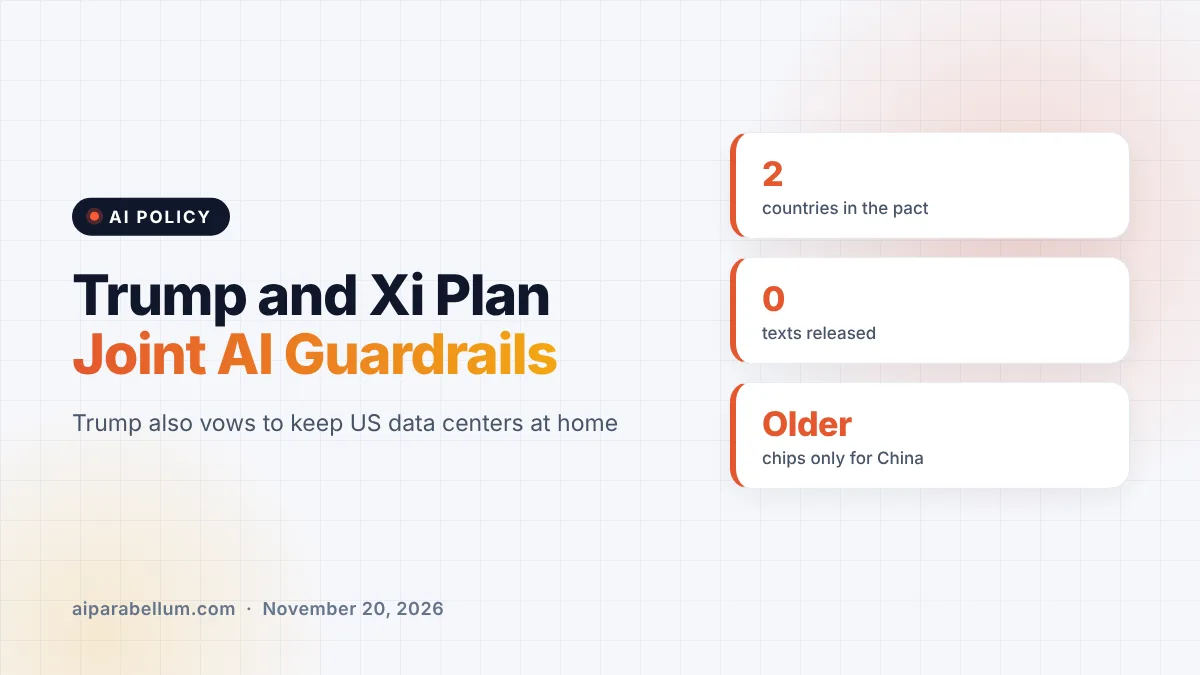
President Donald Trump said on Friday that he and Chinese President Xi Jinping agreed to work on joint AI guardrails, a surprising shift in tone from a leader who has spent months rejecting global rules for artificial intelligence. Speaking at a White House press conference after his trip to China, he also said his administration will not let American companies build data centers outside the United States.
The comments came on November 20, 2026, one day after Trump told the APEC summit that the US opposes what he called “globalist” AI regulation. Neither government has published any document describing what the guardrails would cover.
What Trump Said About Joint AI Guardrails With Xi
Trump framed the idea as a two-country arrangement between the leaders of the world’s two biggest AI powers. He spoke about it while reviewing his trip, which included trilateral talks with Xi and Russian President Vladimir Putin.
He said Xi likes his preferred term, “super intelligence,” and then added a rare note of caution about where the technology is heading. “President Xi and I agree that we’re going to do some joint guardrails, the two of us,” Trump said, after suggesting the technology “may be too super.”
That is a notable admission of risk. Earlier this week he warned at APEC that the US would not let other countries stifle AI, and you can read our APEC summit coverage for that backstory.
What we still do not know
- No joint statement, text or timeline for the guardrails has been released.
- Trump did not say which risks the guardrails would target, such as military use, cyberattacks or runaway systems.
- It is unclear whether China has confirmed the agreement in its own words.
- No agency has been named to negotiate or enforce anything.
Coverage of the wider summit described it as producing few concrete results. So for now, the AI guardrails exist only as a statement from the podium.
The Data Center Pledge: Building AI at Home
The second headline from the press conference was about where AI gets built. Trump said the US will not allow its companies to put data centers in other countries. He drew a contrast with chips, an industry that moved much of its production overseas over the years.
He also urged local communities not to block new facilities. Instead, he told towns to make data center operators pay them and take advantage of the investment.
He did not explain how such a rule would work or what legal tool would enforce it. That matters, because big US cloud companies already run large data center networks abroad, including the kind of deal we covered when Google pledged $15 billion for AI facilities in Malaysia.
Chips for China: older models only
Trump also said he wants only older chips sold to China, adding that he would not mind if none were sold at all. He noted that China makes its own chips and would simply build more if the US stopped selling. That fits a recent pattern of tighter export control moves on both sides.
Key Points From the Press Conference
| Topic | What Trump said | Status |
|---|---|---|
| AI guardrails | He and Xi will create joint guardrails | No text, timeline or Chinese confirmation released |
| Data centers | US companies will not be allowed to build them abroad | No policy details or enforcement method given |
| Local communities | Towns should make data centers pay them | Advice, not a policy |
| Chip sales to China | Only older chips should be sold | Matches a tighter export stance |
Why US-China AI Guardrails Would Be a Big Deal
The US and China are the two biggest AI powers, and they have mostly treated AI as a race. A real bilateral deal on safety limits would be one of the first serious steps toward shared rules between them.
It would also sit awkwardly next to the administration’s stance against international AI rules. A two-country pact is not the same as a global treaty, but critics and supporters alike will want to see whether it turns into anything binding.
Local acceptance is part of the backdrop too. Trump’s message to communities was to bargain for payments rather than shut projects off, a sign that local opposition to data centers is on the White House’s radar.
What This Means for You
For most people, nothing changes today. There is no new rule, and the tools you use, from the AI news you follow to the chatbots at work, will keep running as before.
- If you work in tech or cloud services, watch for any formal order on overseas data centers, since it could affect hiring, pricing and where services are hosted.
- If your town is weighing a new data center, expect more pressure to approve it, along with talk of community payments.
- If you follow AI safety, look for a written US-China statement; until one appears, treat the guardrails as a goal rather than a deal.
The White House AI task force and other federal AI efforts are the places where any follow-up policy would likely surface first.
Sources
Reporting from NPR. Additional reporting from NBC News.
Conclusion
Trump’s remarks put two big ideas on the table at once: a possible US-China safety pact for AI and a push to keep AI data centers on American soil. Both are significant if they become real policy, but neither comes with details yet. The guardrails have no published text, and the data center pledge has no stated enforcement plan. For now, the smart move is to watch for written commitments from Washington and Beijing before treating either one as settled.