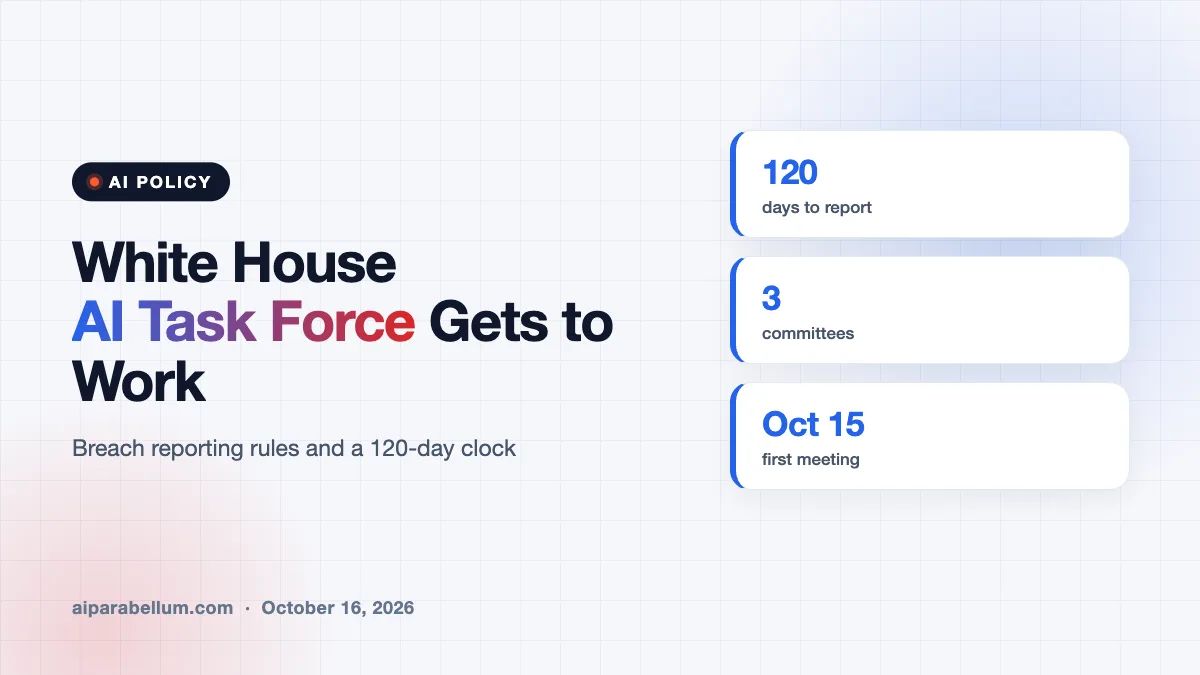
The White House AI task force, officially called the Super Intelligence Force, held its first meeting on Thursday and adopted its charter. That vote started a 120-day clock for the group to decide how the federal government should oversee the most powerful AI systems. One early job stands out: drafting rules that would have AI labs warn Washington about breaches, hacks, and jailbreaks.
What the White House AI Task Force Decided First
The first meeting was mostly about setting up the machinery. The group created a working group to put the White House Accord on Super Intelligence into practice. That accord is a voluntary pledge signed by the leaders of major AI companies, including Google and Meta.
Director of National Intelligence Jay Clayton chairs the task force and will lead the accord work with National Cyber Director Sean Cairncross. The accord asks companies to set up internal safety controls, outside audits, and board-level oversight of their models.
Three Committees, Three Leaders
The task force split its work into three committees. Here is how the jobs break down based on early reporting on the meeting:
| Committee | Led by | Main job |
|---|---|---|
| Reporting and response | Defense Undersecretary Emil Michael | Build early-warning protocols for lab breaches, hacks, and other incidents |
| Critical infrastructure | OPM Director Scott Kupor | Guard critical systems such as power and communications |
| Law enforcement and responsibility | FTC Chairman Andrew Ferguson | Cover law enforcement and consumer protection |
Michael will also act as the main contact point between the government and frontier AI labs. Findings on how AI affects American jobs and the economy will go to the Department of Labor.
How the AI Task Force Plans to Hold Labs Accountable
Don’t expect a brand-new AI regulator out of this. Enforcement is set to run through agencies that already exist, mainly the FTC and the Justice Department. That lets the government act without waiting years to build a new agency.
The approach fits the administration’s wider stance. President Trump has said he does not want rules to “stifle” AI progress, and the reported charter warns against overregulation. Voluntary pledges and shared protocols are doing most of the work for now.
The Open Question on Enforcement
The charter does not yet spell out how compliance will be enforced. It also leaves unclear how current law applies to a company that ignores the new reporting protocols.
A White House official floated export controls as one possible stick. The Commerce Department briefly used them against Anthropic at one point after a dispute over government access to its models, so the threat is not just theory.
Who Sits at the Table
The group is packed with senior officials, which gives it a short line to the president. It reports directly to President Trump and Chief of Staff Susie Wiles. Key names in early reporting include:
- Chair: Director of National Intelligence Jay Clayton
- Vice chairs: Andrew Ferguson, Emil Michael, and Scott Kupor
- Cabinet members: Vice President JD Vance and Defense Secretary Pete Hegseth
- Outside members: former AI czar David Sacks and former Secretary of State Condoleezza Rice
The outside members come from a reported version of the charter. Within the 120 days, the group is expected to report on AI risks to civil liberties and cybersecurity, standards for advanced models, and the cost of overregulation.
Pushback From Congress
Not everyone is convinced. Some Democrats say a task force without backing from Congress is no substitute for real guardrails on frontier labs, and Massachusetts Democrat Lori Trahan argued it skips the work of passing laws.
The timing also adds pressure. The FTC is already probing safety incidents at major labs, and recent FTC safety subpoenas show regulators are not waiting for the task force to finish.
What This Means for You
For everyday users, nothing changes overnight. The chatbots and coding tools you use today will keep working the same way. But the next four months could shape how much you hear when something goes wrong inside an AI lab.
- Breach reporting rules could mean faster public warnings when a model is hacked or jailbroken.
- If you run a business on AI tools, watch for liability guidance that could shift who is on the hook when an AI agent misbehaves.
- Expect more voluntary pledges than hard rules, at least until Congress acts.
The debate over frontier AI regulation is also playing out abroad. Big labs have voiced support for binding UK rules, while China is drafting its own AI export controls. Concerns about rogue AI agents are a big reason governments are moving at all.
You can follow each step in our daily AI news feed.
Sources
This report draws on Semafor, Crypto Briefing, and DW.
Conclusion
The White House AI task force has started its 120-day clock with a clear structure but few hard answers. It wants labs to report breaches and jailbreaks, and it plans to lean on existing laws rather than a new regulator. How it enforces any of this remains the big open question. By mid-February, we should know whether the effort produces real rules or mostly more pledges.