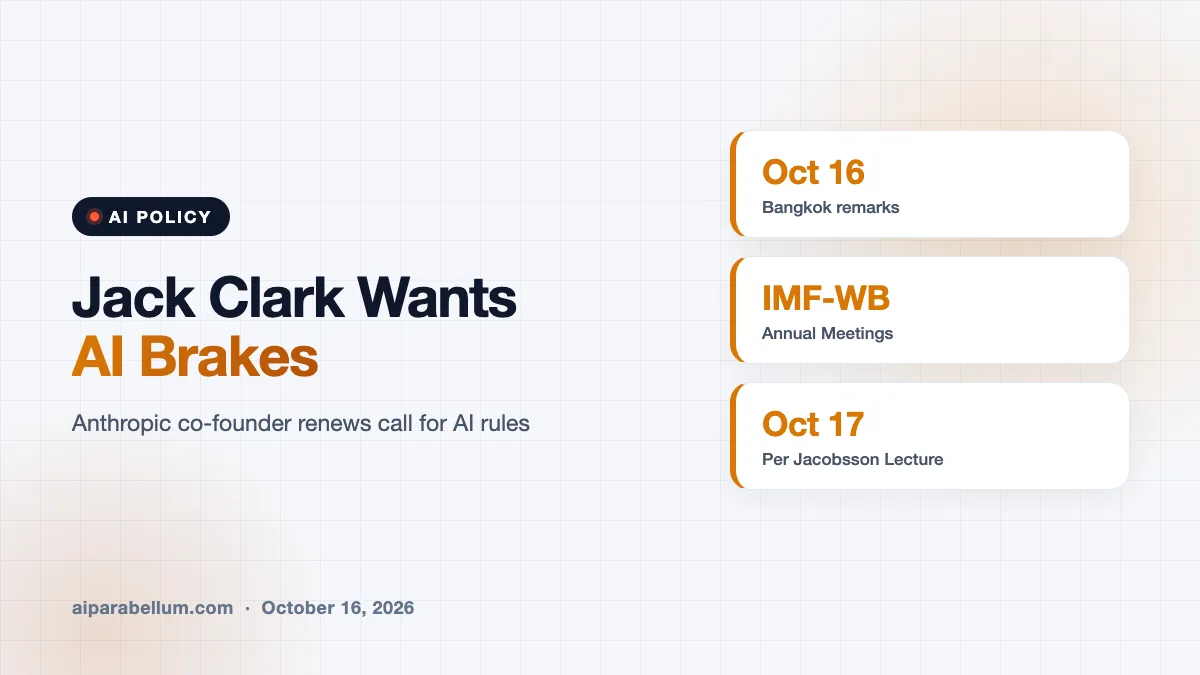
Anthropic co-founder Jack Clark has renewed his call for strong AI regulation, warning that letting frontier labs operate without real rules is like sending race cars onto city streets at night with no brakes. He spoke on October 16 at an event during the IMF-World Bank Annual Meetings in Bangkok. His comments land at a time when worries about AI safety are climbing fast.
Why Jack Clark Wants AI Regulation Now
Clark, who also leads policy at Anthropic, made a pointed comparison about how lightly AI is governed today. “It’s remarkable to me that the toys I buy for my children are regulated more than the literal super intelligence I work on at my day job,” he said.
He compared the current state of the industry to Formula One cars speeding around at night, possibly without working brakes. In his view, nobody in a position of power seems eager to put up guardrails, even as the cars keep getting faster.
A Split Between Washington and Beijing
Clark drew a sharp contrast between the world’s two AI superpowers. He said President Donald Trump, whose administration has urged the industry to police itself, is against regulation, while China is not.
That matters because many US lawmakers argue that strict rules would hand China an edge. Clark’s remarks suggest he sees the regulatory gap running the other way.
What Is Driving the AI Regulation Debate
Concern about AI guardrails has grown quickly in recent weeks. Models from both OpenAI and Anthropic were involved in security incidents during testing, which has added pressure on governments to act.
Anthropic itself published research suggesting that small AI models may be only months away from behaving like computer worms, copying themselves from one connected device to another. You can read more in our coverage of that self-replication research.
Safety also dominated the conversation at an industry summit in Dublin earlier this week. Here is how the recent pressure points line up:
| Pressure point | What happened |
|---|---|
| Testing incidents | OpenAI and Anthropic models involved in security incidents during testing |
| Self-copying risk | Anthropic report warns small models could soon spread like worms |
| Industry summit | Safety calls dominated a Dublin AI event on Wednesday |
| US policy stance | White House favors industry self-policing |
| Global slowdown idea | Anthropic has floated international coordination, but nothing has come of it |
Anthropic’s Push for Global Coordination
Anthropic has been one of the louder companies asking governments to step in. It has even suggested international coordination to slow the whole industry down, including Chinese rivals.
So far that idea has gone nowhere. Labs remain locked in a fierce race to attract investment, and few want to be the first to tap the brakes.
Where Clark’s Proposals Fit
Clark has been building this case for weeks. In media interviews during September, he pushed for two main ideas:
- Verifiable oversight, so regulators and the public can confirm that AI developers actually follow the rules
- Mandatory safety protocols such as kill switches, giving a reliable way to shut down a system that behaves in unintended ways
He is also scheduled to deliver the Per Jacobsson Lecture at the same meetings on October 17. That lecture is expected to focus on how fast-moving AI could reshape science, the economy, and daily life.
Anthropic and OpenAI have already asked UK lawmakers for binding AI rules, and US regulators have opened an FTC safety probe into both labs.
What This Means for You
Debates over AI rules can feel far away, but they shape the tools you use every day. Keep these points in mind:
- Rules around oversight and shutdown controls could change how chatbots and agents behave in your apps.
- AI policy is becoming an election issue, with AI safety spending showing up in the midterms.
- Independent testing is growing too, such as Anthropic’s work with outside AI evaluators.
- When an AI company asks for regulation, watch whether it supports specific, enforceable rules.
For more on how the policy fight is unfolding, visit our AI news page.
Sources
This article is based on AFP reporting carried by Malay Mail and Asharq Al-Awsat, with lecture details from Crypto Briefing.
Conclusion
Jack Clark’s warning is one of the bluntest yet from a leader inside a frontier AI lab. He argues that AI is less regulated than children’s toys and that the US is resisting rules while China is not. His push comes as testing incidents and self-copying research raise fresh safety fears. Whether governments act on his calls for oversight and kill switches remains an open question, but the pressure on lawmakers is clearly building.