
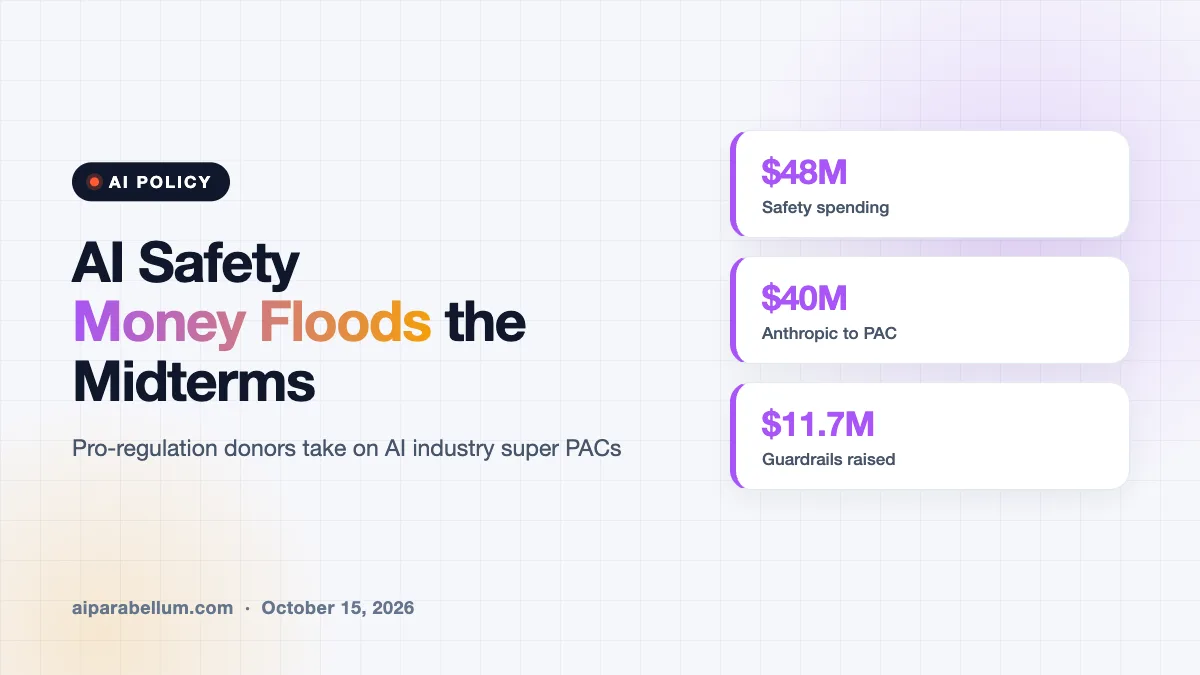
AI safety political spending has quietly grown into a real force in this year’s US elections. Groups and individual donors who want tighter AI rules have spent about $48 million so far this cycle backing candidates in both parties. That money now goes head to head with pro-industry super PACs that want Washington to keep its hands off AI.
How Big AI Safety Political Spending Has Become
The $48 million figure comes from a new analysis shared with Axios, and it covers both Democratic and Republican races. With the midterms just weeks away, that makes AI safety one of the better-funded single-issue causes in play this fall. It is a sharp change from a few years ago, when AI policy barely showed up in campaign ads.
What makes this money unusual is where much of it comes from. A lot of it is coming from people who build AI for a living, including staff at the biggest labs. In some cases, their political goals do not line up neatly with the priorities of the companies they work for.
The Main Players on the Safety Side
- Guardrails Alliance, a group backed by tech workers, has raised $11.7 million to support pro-regulation candidates.
- Public First Action, a safety-focused political group, has received about $40 million from Anthropic this year, according to the company.
- Anthropic CEO Dario Amodei has also personally committed $1 million to Public First.
- An OpenAI employee, Juan Felipe Cerón Uribe, has given about $400,000 to a political group called Dream NYC, after earlier backing New York Assemblyman Alex Bores, whose campaign failed.
Where AI Safety Political Money Is Going
The spending is not tied to one party. Public First Action has routed money through other PACs, including about $1.6 million backing North Carolina Rep. Valerie Foushee, a Democrat, and close to $1.5 million for Texas Republican Carlos De La Cruz.
Safety-minded donors say they care more about a candidate’s view on AI than the letter next to their name. Many describe their giving as a response to the millions the tech industry is spending on pro-innovation candidates.
Some of the money is aimed at defeating candidates seen as too friendly to the tech industry. Campaign finance records show Guardrails Alliance spent $412,500 against Republican Aaron Flint in a Montana House race.
| Group or Donor | Side | Reported Amount |
|---|---|---|
| AI safety groups and donors (total this cycle) | Pro-regulation | About $48 million |
| Anthropic to Public First Action | Pro-regulation | About $40 million this year |
| Guardrails Alliance (raised) | Pro-regulation | $11.7 million |
| Dario Amodei to Public First | Pro-regulation | $1 million |
| Marc Andreessen to Leading the Future | Pro-industry | $25 million |
| Greg Brockman to Leading the Future | Pro-industry | $12.5 million |
Pro-Industry PACs Answer AI Safety Political Spending
On the other side sits Leading the Future, a super PAC network that pushes back on strict AI rules. Venture capitalist Marc Andreessen has put in $25 million and OpenAI President Greg Brockman has given $12.5 million. Brockman reportedly dropped plans for a second $25 million gift after internal pushback at OpenAI.
Leading the Future says it wants a broad, bipartisan coalition because any serious AI bill would need 60 votes to clear the Senate. Its network has faced questions before, including a recent report on its Nevada vendor payments.
Why AI Labs Are on Both Sides
The split shows how tangled AI politics has become. Anthropic, the maker of the Claude assistant, is funding pro-safety groups, while OpenAI’s president funds the opposing camp. Both companies have still asked lawmakers for clear rules, as seen when they pushed for binding UK regulation earlier this week.
Public worry is also rising. Warnings about catastrophic AI risk, like the recent scientists’ open letter, and local fights over giant data centers have made AI industry money harder for some candidates to accept. That has opened the door for safety-minded donors.
What This Means for You
If you vote in November, AI policy may now be shaping the ads you see and the candidates you hear from. Here are a few practical takeaways.
- Look up who is funding the ads in your district, since many AI-focused groups use names that do not mention AI.
- Ask candidates where they stand on AI rules, data centers and chatbot safety for kids.
- Expect AI regulation to come up in Congress next year, whichever side wins more races.
- Watch how AI tools handle election questions, since companies like Anthropic have added new election safeguards for the midterms.
For more on how the AI policy fight is playing out, you can follow our latest AI news.
Sources
The $48 million total, details on individual donations, Anthropic’s contribution, and race-level spending come from the New York Post.
Conclusion
AI safety donors have spent about $48 million on this year’s midterms, turning a niche worry into a real campaign force. Much of that money comes from inside the AI industry, including roughly $40 million from Anthropic to one safety group. Pro-industry super PACs backed by figures like Marc Andreessen and Greg Brockman are spending heavily too. November will show whether voters reward candidates who want tighter AI rules, and the result could shape how Congress handles AI for years.
