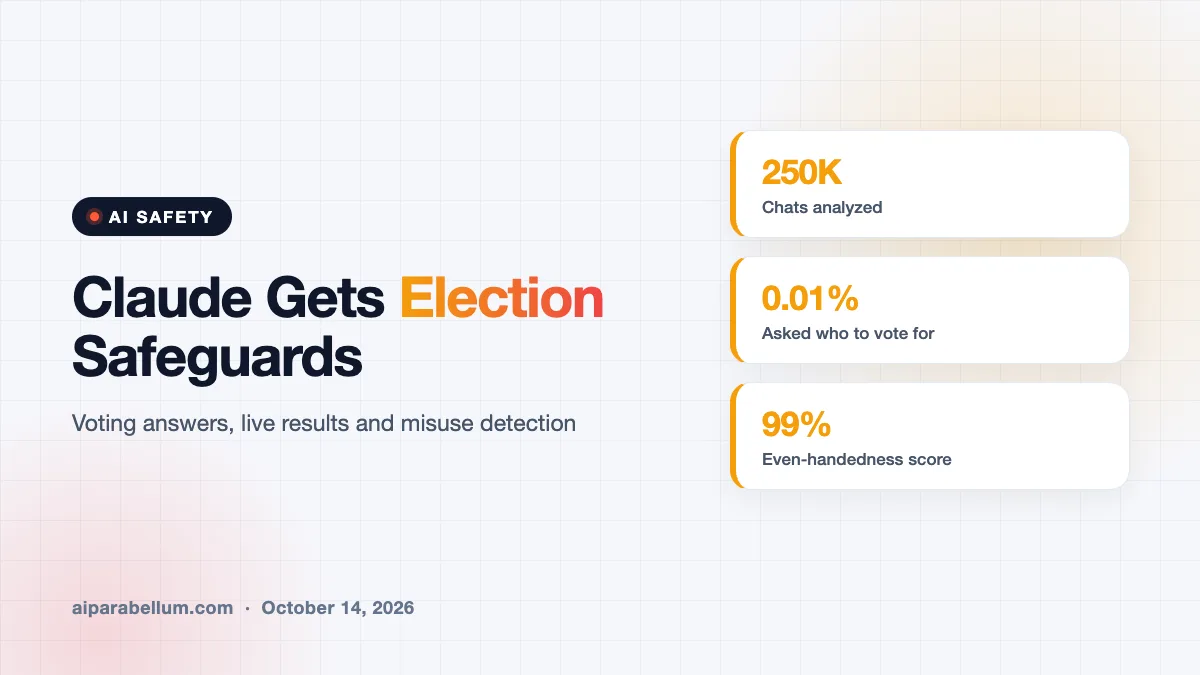
Anthropic is rolling out new Claude election safeguards ahead of the 2026 US midterms, including state-specific voting answers and live results on election night. The company also shared fresh data on how people actually talk to Claude about politics. Here is what changes, what the numbers show, and what it means when you ask an AI about the vote.
What Is New in Claude’s Election Safeguards
The biggest change for everyday users is where Claude gets its voting facts. Later this month, Claude.ai users in the US will start getting official voting information from Democracy Works, a nonpartisan group, woven right into Claude’s answers.
That means a question like “Where do I vote?” or “What ID do I need?” can get a reply tailored to your state. The data comes from public information Democracy Works gathers from state and local election offices.
Claude will also show current vote counts and official results on election night and in the days after. The existing banner that points people to TurboVote for registration, polling places, and dates will stay in place too.
The Quick List of Changes
- State-specific voting answers sourced from Democracy Works, starting later this month in the US
- Up-to-date official results on election night and the days that follow
- New classifiers aimed at multi-step misuse, like building fake news sites or fake social accounts
- Better detection of foreign state actors and stronger cyber protections for campaigns
- A published guide that tells political campaigns what they can and cannot use Claude for
How People Use Claude for Politics
Anthropic studied a random sample of 250,000 US conversations on Claude.ai from September 21 to 27, 2026. The company says it analyzed them in a privacy-preserving way. The results suggest people mostly use Claude to learn, not to be told how to vote.
| Type of conversation | Share of US Claude.ai chats |
|---|---|
| Politics, public policy, or social issues | About 5.75% |
| Elections or voting specifically | About 0.51% |
| Asking who or what to vote for | About 0.01% |
| Requests that broke election integrity rules | About 0.002% |
Most political chats were about following the news, researching policy, learning where candidates stand, or navigating government services. Anthropic expects these numbers to climb as Election Day gets closer.
Claude Election Safeguards Against Political Bias
Anthropic says its newest models, Claude Opus 5.5, Sonnet 5.5, and Haiku 5.5, each scored 99% on its internal political even-handedness test. It also says these models refuse fewer political requests than before, so people get the answers they came for.
The company did not rely only on its own grading. Three outside groups reviewed how Claude handles free expression, each using a different method.
What Outside Reviewers Found
The Future of Free Speech, a think tank at Vanderbilt University, and the Foundation for American Innovation rated most of Claude’s answers as strong. The Collective Intelligence Project surveyed more than 2,000 people across the US, UK, and India to build its own test.
The reviews also surfaced real weak spots. Claude sometimes added caveats or opposing views nobody asked for, such as slipping a counterargument into an advocacy email. One review found an older model, Claude Sonnet 4.5, was more likely to soften arguments for right-leaning positions.
Anthropic says it has improved how Claude handles short yes-or-no political questions, where answers were less balanced. It is also tuning when Claude adds caveats so requests from across the spectrum get the same treatment.
Stopping Election Misuse Before It Spreads
To stress-test its defenses, Anthropic worked with the Institute for Strategic Dialogue and the McCain Institute in the US, Israel, and Brazil. Testers found that Claude reliably refused a single harmful request. But it could miss a bad campaign when the work was broken into many small, innocent-looking tasks.
That finding led to the new classifiers aimed at multi-step abuse. It is a useful reminder that AI safety is not just about one prompt, but about patterns across many.
A chatbot that says no to one bad request is the easy part. The harder job is spotting a scheme that has been sliced into dozens of harmless-looking pieces.
Anthropic also shared real cases. Foreign-based operators of a fake news site used Claude to write US midterm coverage that pushed Russian, Iranian, and North Korean narratives.
Other actors used it to churn out fake news meant to earn ad money. The company says it banned the accounts involved and improved its detection.
What This Means for You
If you use Claude or other AI tools to follow the midterms, these changes should make basic voting questions easier to answer. Still, a few habits will keep you on solid ground.
- Use Claude to compare candidate positions, then confirm key details on your state or county election website.
- Double-check deadlines and polling locations close to Election Day, since they can change.
- Be wary of “news” sites you have never heard of, because AI makes fake outlets cheap to build.
- If you work on a campaign, read Anthropic’s usage guide before using AI for outreach or content.
Fake audio and video are part of the same problem, so it also helps to know how to spot AI voice scams before they reach your phone. If you are new to the assistant itself, our overview of Claude AI covers the basics.
This update follows other recent safety moves from the company, such as its work on distillation defenses and its new Singapore safety pact. You can follow more updates like these on our AI news page.
Sources
This article is based on Anthropic’s announcement, Preparing for the 2026 US midterms, published by Anthropic.
Conclusion
Anthropic is giving Claude state-specific voting answers, live results, and sharper tools to catch election abuse ahead of the 2026 midterms. Its own data shows people mostly use Claude to learn about issues, and very rarely to ask who to vote for. Outside reviews found Claude fairly balanced but flagged extra caveats and uneven hedging, which the company says it is fixing. The most useful takeaway is simple: let AI help you research, but confirm the details that decide your vote with official election sources.