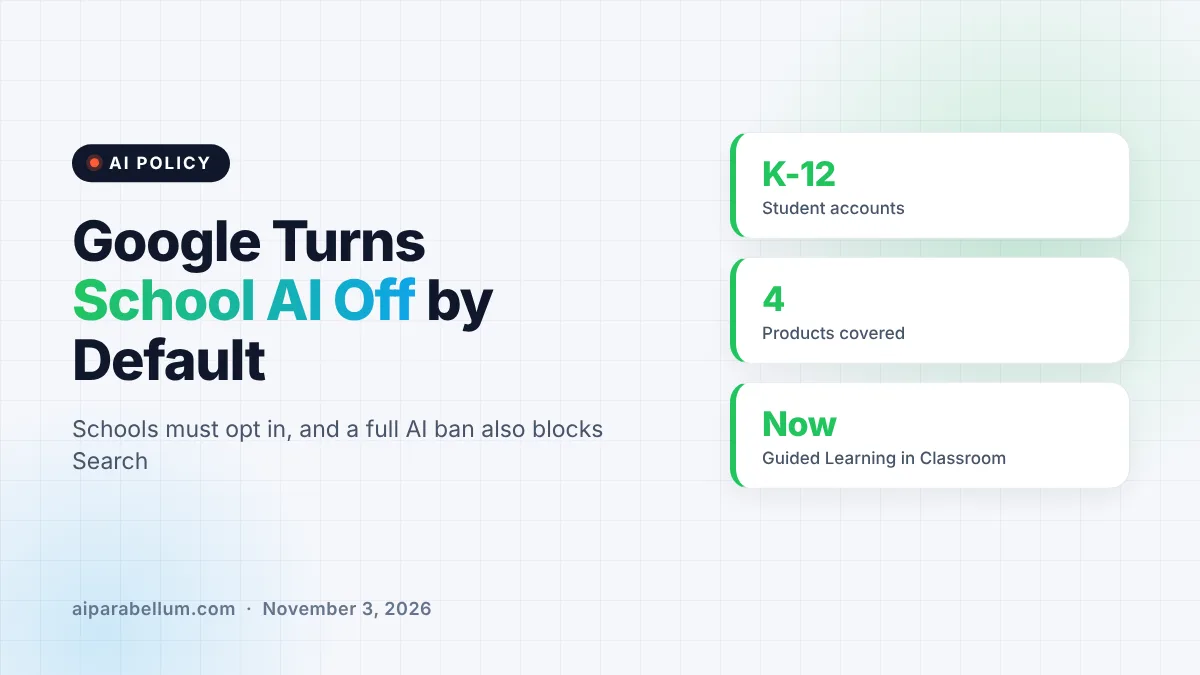
Google is changing how AI in schools works on its platforms: Gemini, Gemini Notebook, Gemini in Classroom and Google Search will be switched off for K-12 student accounts until a school administrator turns them on. The company announced the shift on November 3, 2026, alongside a wider rollout of its Guided Learning study tool. There is a catch, though, and it involves the search box nearly every student uses.
What Google Changed for AI in Schools
Until now, Google’s AI features have generally reached student accounts by default, which drew pushback from many educators. Under the new plan, the starting point flips. AI products will be fully off for K-12 student accounts, and each school decides whether to enable them.
Google says the change follows conversations with schools, teachers, researchers and policymakers. The company has not given an exact date yet. It says it will share more details with schools in the coming months so they have time to prepare before the new controls roll out.
The products covered by the new default are:
- Gemini, the company’s main AI assistant
- Gemini Notebook, its AI study and notes tool
- Gemini in Classroom, the AI features inside Google Classroom
- Google Search, which now carries built-in AI features
The Search Trade-Off for Schools That Say No
Search is where this gets complicated. Because AI features such as AI Overviews are now built into Google Search, a school that blocks AI entirely will also block Search for its students. Google’s education chief, Chris Phillips, told The New York Times that “Search and AI are deeply integrated,” and that students in those schools will see a message saying Search is not available.
That puts many districts in a tough spot. A teacher may not want students leaning on AI summaries for homework, but still wants them to find sources and research material on the open web. With Chromebooks and Google apps so common in US classrooms, walking away from Search is not a realistic option for most schools.
Critics argue this makes the opt-in less of a real choice. Some districts in New York and California had already restricted certain AI features in hopes of keeping plain search, and that path now looks closed. If you follow the wider fight over AI Mode changes, this is another sign that Google sees AI and Search as one product.
Guided Learning Comes to Classroom and Search
Google paired the controls news with an expansion of Guided Learning, a mode that coaches students through problems with questions and step-by-step hints instead of handing over final answers. Google says its research shows the approach leads to measurable learning gains. The idea is similar to tools like Socratiic by Google, which also push students to reason things out.
In Google Classroom
Starting today, Guided Learning is available worldwide in Google Classroom. When a teacher assigns a Guided Learning activity, it works like a one-on-one study partner anchored to class material. Teachers also get real-time insights showing where the class may need extra help.
In Google Search
For student accounts, Search will try to detect certain kinds of homework help requests. If a student pastes in a physics problem or asks for help with a book report, Search will walk them through the concepts rather than jump to the answer. A pilot starts later this month in select US schools before a wider rollout in the coming months.
| Change | Who it affects | Timing |
|---|---|---|
| AI products off by default | K-12 student accounts | Rolling out after more details in coming months |
| Search blocked if all AI is disabled | Schools that restrict AI entirely | Part of the same controls change |
| Guided Learning in Classroom | Teachers and students worldwide | Available now |
| Guided Learning in Search | Select US schools | Pilot starts later in November |
What This Means for You
If you are a parent, teacher or school IT admin, the practical impact depends on your district’s choices. Here is what to keep in mind:
- Expect a decision point. Your school will need to actively turn AI on, so ask your administrators what they plan to do.
- Know the Search link. Blocking all AI also removes Google Search for students, so a full ban has real research costs.
- Try Guided Learning with care. Teachers can test it in Classroom now and see whether it helps students think rather than copy answers.
- Watch for the fine print. Google has promised more specifics, and the final settings may offer more nuance than an all-or-nothing switch.
For families thinking about healthy study habits, our guide on AI in education covers ways to use these tools without skipping the learning. You can also browse more education AI tools to compare options outside Google’s ecosystem.
Why the Google AI Schools Debate Matters
Google’s reach in education is huge, from Chromebooks to Classroom to Gmail. A default-off setting gives schools more say over student AI use, which many teachers have asked for. But tying AI to Search means the most cautious schools still face a hard trade-off.
The move also lands as states weigh rules for AI use by minors and in public schools. How districts respond over the next few months could shape what other tech companies offer classrooms. For more on how AI answers in search are being scrutinized, see our story on AI Overviews liability, and catch the latest updates on our AI news page.
Sources
Primary source: Google’s education announcement. Additional reporting from TechCrunch and Futurism.
Conclusion
Google is handing schools the switch for AI on student accounts, with Gemini and related tools starting off until administrators opt in. The bigger story is the trade-off: because AI is now woven into Search, schools that block AI completely lose Search too. Guided Learning is Google’s pitch for AI that teaches rather than tells, and it is live in Classroom today with a Search pilot coming soon. Schools now have a few months to decide which side of that line they want to stand on.