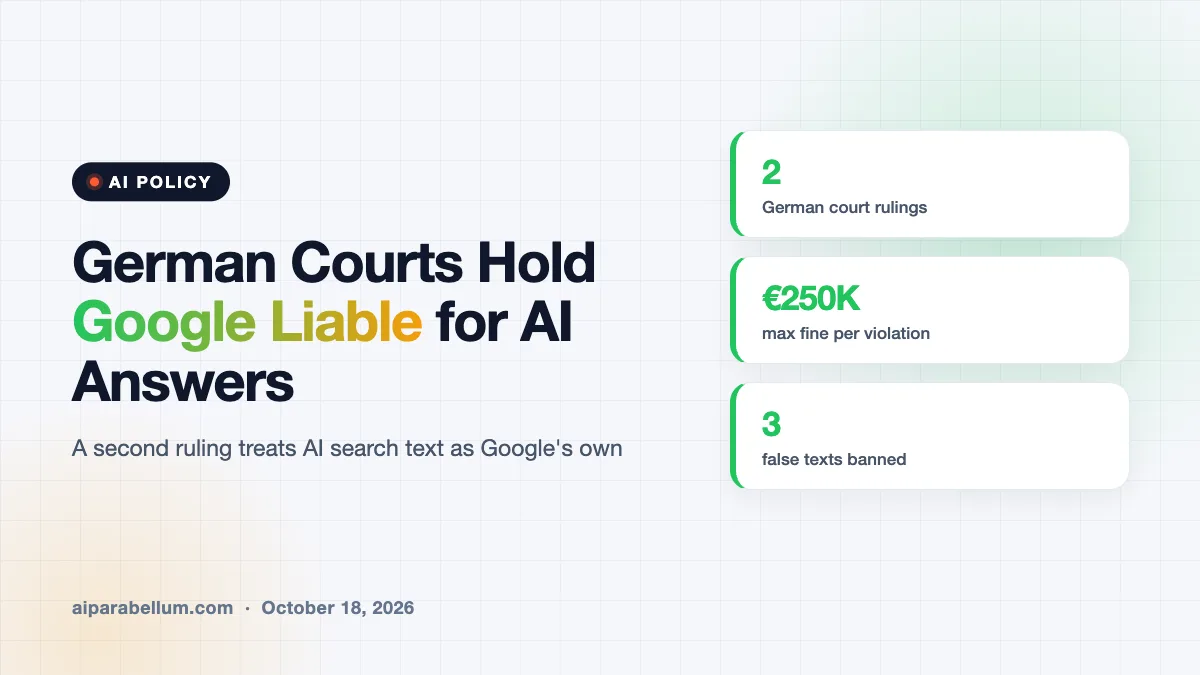
A second court in Germany has ruled that Google is directly responsible for false claims made by its AI search answers, raising fresh questions about Google AI Overviews liability. The Aachen Regional Court ordered Google to stop spreading made-up criminal allegations about a local doctor that its AI had pinned on the wrong man. The decision follows the same reasoning as an earlier Munich ruling and suggests a common legal view is taking shape.
How the AI Search Mix-Up Happened
The case involves a physician who worked as chief physician and professor of neuroradiology in Aachen from 2010 until late June 2026. On August 28, a colleague told him that Google’s AI Mode was explaining his departure with a claim that he had sexually assaulted his secretary. Follow-up searches with words like “suspension” and “court proceedings” produced long, detailed stories, complete with an invented legal aftermath.
None of it was about him. The AI had taken events tied to a different former university professor and attached them to the doctor. The court could confirm this from its own records, because the criminal case had been brought against someone else.
Google Declined to Remove the Answers
The doctor explained the mix-up in late August and asked Google by email to take the content down. In mid-September, Google said it would not act, and a formal legal demand sent the same day also went nowhere. According to the court, the false answers were still live after that.
Why the Ruling Matters for Google AI Overviews Liability
In a decision dated September 24, 2026, the Aachen court banned three versions of the false text. It acted on an emergency basis without hearing Google first, because the claims could badly harm the doctor’s career. Google faces fines of up to 250,000 euros for each violation, though it can still challenge the injunction.
The key point is how the court sees AI answers. It treated them as Google’s own statements, not as neutral links to other websites. The judges also said Google could check its AI output against the source pages it used, and that its own system would likely have caught the errors if Google had fed it the doctor’s complaint.
The Earlier Munich Decision
In late May, the Munich Regional Court I reached the same conclusion in a case where Google’s AI falsely linked two Munich publishers to fraud. Google announced an appeal but later settled, so no higher court ever ruled on the reasoning. It is not known whether money changed hands, and neither side would comment.
| Detail | Munich case | Aachen case |
|---|---|---|
| Timing | Late May 2026 | September 24, 2026 |
| Who was harmed | Two Munich publishers | A neuroradiology professor |
| False claim | Links to fraud schemes | Criminal allegations about another person |
| Google feature | AI Overviews | AI Mode |
| Outcome | Ruling, then settlement | Preliminary injunction, not yet final |
Bigger Stakes for Google AI Overviews
If German courts keep treating AI answers as Google’s own words, the risk does not stop at single false claims. Publishers whose articles feed those answers might one day argue they deserve payment, which would shake up the economics of AI search. That question was not part of either case, but it is a logical next step.
There is also a worry about gaming the system. Some observers fear people could probe AI search with targeted queries until it produces a damaging falsehood, then sue and push for a settlement. The debate also ties into recent changes to Google AI Mode links and the wider shift toward AI-driven search.
What This Means for You
Even if you are in the US, these rulings are a useful reminder about how much to trust AI search answers. A few practical steps can help:
- Search your own name and business now and then, including in AI Mode, to spot false claims early.
- Treat AI summaries about people as a starting point, and open the source links before you believe them.
- Save screenshots and dates if an AI answer gets facts about you wrong, since records matter in any complaint.
- Use trusted research tools that show where each claim comes from.
Our take: once a search engine writes the answer itself, it gets much harder to claim it is just pointing to someone else’s words.
For more on how search is changing, see our look at GEO versus SEO and the latest stories on our AI news page.
Sources
Court details, dates and quotes come from reporting by The Decoder.
Conclusion
Two German courts have now said the same thing: Google answers for what its AI search writes. The Aachen order is temporary and Google can still fight it, while the Munich case ended in a settlement before any appeal ruling. Even so, the shared reasoning puts real pressure on AI search in Germany. If higher courts ever agree, it could shape how AI answers are built and paid for far beyond Germany. For now, it is a strong signal that “the AI said it” may not work as a legal shield.