For over two decades, SEO has been the backbone of online visibility. You optimize your pages, target the right keywords, build backlinks, and climb the search rankings. That playbook still works. But a new challenger has entered the arena, and it is changing how people find information online.
Generative Engine Optimization, or GEO, is the practice of optimizing content so that AI-powered search engines and large language models reference, cite, or recommend it in their generated responses. Think ChatGPT, Google AI Overviews, Perplexity, and similar tools that answer questions directly instead of showing a list of blue links.
The question is not whether GEO will replace traditional SEO. It is how the two work together and where you should focus your efforts.
What Is Traditional SEO
Traditional SEO is the process of optimizing web pages to rank higher in search engine results pages (SERPs). It involves on-page optimization, technical improvements, content creation, and link building to signal relevance and authority to search engines like Google and Bing.
The core mechanics have been refined over years. You research keywords, create content that matches search intent, optimize meta tags and headings, ensure fast page load times, and earn backlinks from authoritative sites. The goal is to appear on page one when someone types a query into a search engine.
Traditional SEO targets human searchers who click through to your website. The entire model depends on driving traffic from search results to your pages, where visitors can convert, subscribe, or engage with your content. This is still how most SEO strategies operate today.
What Is Generative Engine Optimization
GEO focuses on making your content visible within AI-generated answers. When someone asks ChatGPT a question or uses Google’s AI Overview feature, the AI synthesizes information from multiple sources into a single response. GEO is about being one of those sources.
Instead of optimizing for keyword rankings, GEO optimizes for citation and inclusion. You want the AI to pull information from your content, attribute it to your brand, and ideally link back to your page as a reference. This requires a different approach to content structure, authority signals, and information presentation.
The rise of GEO is directly tied to the growth of AI-powered search. As more people use tools like Perplexity and ChatGPT for research, the traditional click-through model is shifting. Users get answers without ever visiting a website, which means visibility inside the AI response itself becomes the new battleground.
Key Differences Between GEO and Traditional SEO
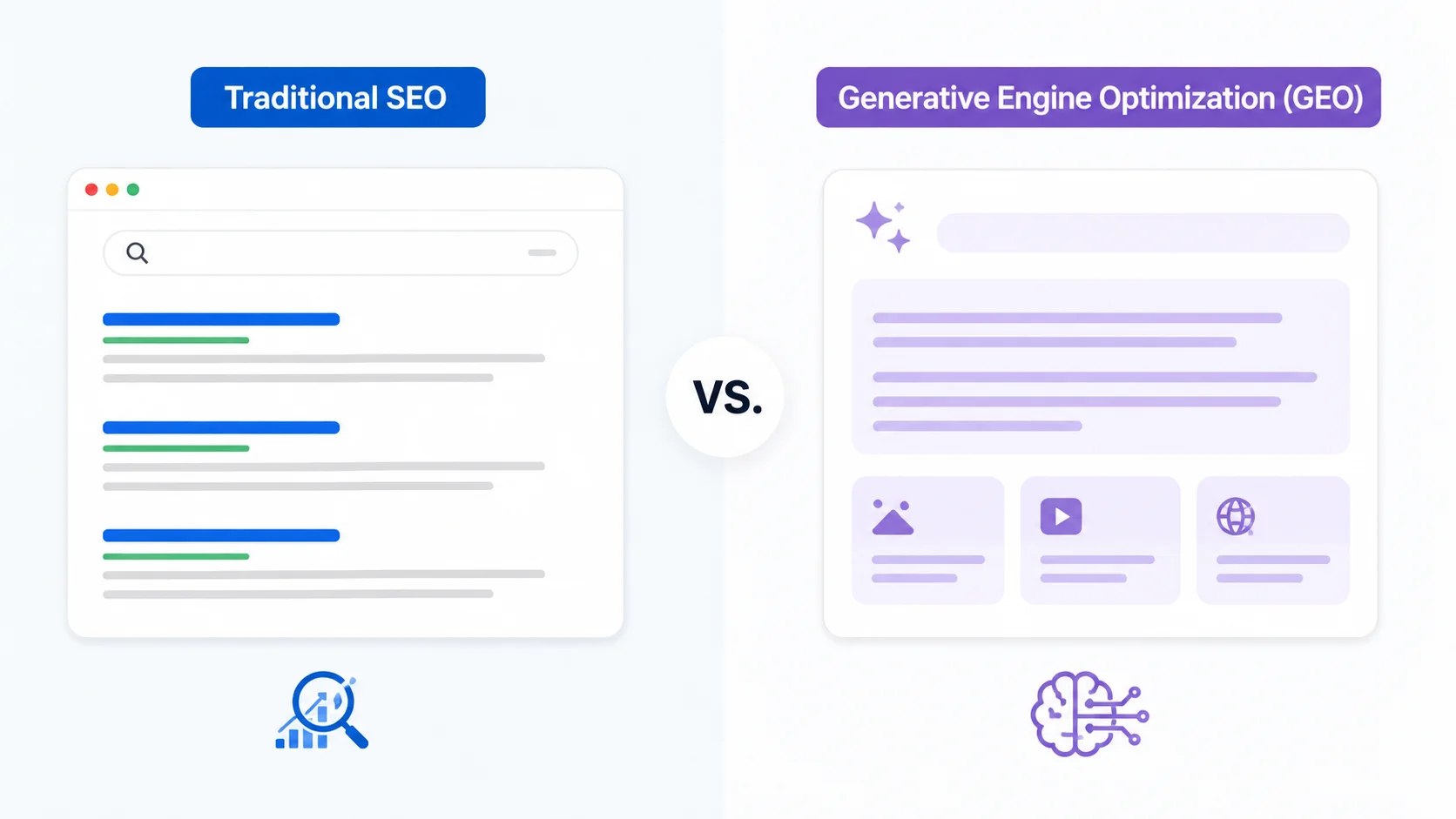
While GEO and traditional SEO share some DNA, the differences are significant enough that they require distinct strategies.
| Factor | Traditional SEO | GEO |
|---|---|---|
| Primary goal | Rank on SERPs, drive clicks | Get cited in AI-generated responses |
| Target platform | Google, Bing search results | ChatGPT, Perplexity, AI Overviews |
| Success metric | Rankings, organic traffic, CTR | Brand mentions, citations, AI visibility |
| Content format | Long-form, keyword-optimized pages | Clear, factual, well-structured data |
| Authority signals | Backlinks, domain authority | Expertise, citations, data originality |
| User interaction | User clicks through to your site | User may never visit your site |
| Optimization speed | Weeks to months for ranking changes | Varies by AI model training and indexing |
The most fundamental difference is the end result. Traditional SEO brings people to your website. GEO puts your brand and information in front of people without requiring a click. Both have value, but they serve different purposes in your marketing strategy.
How GEO Changes Content Strategy
Writing for AI engines requires a shift in how you think about content. Traditional SEO content is designed to satisfy search intent and keep readers on the page. GEO content needs to be the definitive, citable source on a topic.
Structure and Clarity Matter More
AI models favor content that is well-organized, factual, and easy to parse. Clear headings, concise definitions, structured data, and direct answers to common questions make it easier for AI to extract and cite your content. Fluff and filler work against you in GEO because AI systems are looking for signal, not word count.
Original Data and Research Win
One of the strongest GEO signals is original data. If your content includes unique statistics, survey results, case studies, or proprietary research, AI models are far more likely to reference it. Rehashing information that exists on hundreds of other sites gives the AI no reason to choose your version. This is similar to how AI SEO tools evaluate content quality and uniqueness.
Entity and Brand Authority
AI models assess the authority of a source before citing it. Building a strong brand presence across multiple platforms, being mentioned in authoritative publications, and maintaining consistent expertise signals all contribute to GEO performance. The concept of E-E-A-T (Experience, Expertise, Authoritativeness, Trustworthiness) that Google uses for traditional SEO is even more important in the GEO context.
Where Traditional SEO Still Dominates
Despite the rise of AI search, traditional SEO is far from dead. There are entire categories where conventional search rankings remain the primary traffic driver.
- E-commerce and product searches where users want to browse, compare, and buy directly on a website.
- Local searches for restaurants, services, and businesses where Google Maps and local packs drive foot traffic.
- Transactional queries where users have a clear intent to take action on a specific site.
- Visual searches for images, videos, and interactive content that AI text responses cannot fully replace.
- Complex decision-making processes where users want to explore multiple pages and reviews before committing.
For any business that depends on website visits for revenue, traditional SEO remains essential. The traffic it generates is direct, measurable, and actionable in ways that GEO visibility currently is not.
Where GEO Has the Edge
GEO shines in scenarios where users seek quick, definitive answers and are comfortable acting on AI-provided information without clicking through to a source.
- Informational queries where the user just wants a fact, definition, or explanation.
- Comparison queries where AI can synthesize information from multiple sources into a summary.
- Research-heavy topics where professionals use AI assistants to gather and organize information.
- Brand awareness plays where being cited by AI increases trust and recognition even without a click.
GEO is not about replacing traffic. It is about being the trusted source that AI turns to when millions of people ask questions in your domain.
For SaaS companies, consultancies, and thought leaders, GEO visibility can be more valuable than a page-one ranking because it positions them as the authoritative voice in AI responses that reach a massive audience.
How to Optimize for Both GEO and SEO
The good news is that many GEO best practices overlap with solid SEO fundamentals. Here is how to build a strategy that covers both.
Create Comprehensive, Well-Structured Content
Write content that answers questions directly, uses clear headings, and organizes information logically. This serves both traditional search crawlers and AI models. Use tables, lists, and concise paragraphs that make your content easy to scan and extract. The same principles that make content creation effective for SEO also work for GEO.
Invest in Original Research and Data
Publish original statistics, surveys, benchmarks, and case studies. This gives both search engines and AI models a reason to prioritize your content over competitors who are simply rewriting existing information. Original data is the strongest signal for both ranking authority and AI citation.
Build Topical Authority
Cover your subject area comprehensively. Instead of writing one article on a topic, create a cluster of related content that establishes your site as the go-to resource. This content strategy approach signals expertise to both Google and generative AI systems.
Use Schema Markup and Structured Data
Implementing schema markup helps search engines and AI systems understand your content better. FAQ schema, how-to schema, and organization schema all provide structured signals that make your content more accessible to automated systems. SEO tools can help you implement these technical elements correctly.
Maintain a Strong Brand Presence
Be active across multiple platforms. Publish on your website, contribute to industry publications, maintain social media presence, and participate in relevant communities. AI models build entity profiles from multiple sources, so a strong, consistent brand presence increases your chances of being cited.
Measuring GEO Performance
One of the biggest challenges with GEO is measurement. Traditional SEO has well-established metrics: rankings, organic traffic, click-through rates, and conversions. GEO metrics are still evolving.
| Metric | How to Track | What It Tells You |
|---|---|---|
| AI citations | Monitor AI responses for brand mentions | How often AI references your content |
| Brand search volume | Track branded keyword searches | Whether AI exposure drives name recognition |
| Referral traffic from AI | Check analytics for AI platform referrals | Clicks coming from AI-generated links |
| Share of voice in AI | Run common queries and count your mentions | Your visibility relative to competitors |
Tools specifically designed for tracking GEO performance are starting to emerge. As the space matures, expect more robust measurement frameworks that parallel what exists for traditional SEO.
The Future of Search Optimization
The search landscape is splitting into two parallel tracks. Traditional search engines will continue to serve users who want to browse, explore, and interact with websites directly. AI-powered search will increasingly handle informational queries, research tasks, and quick-answer needs.
Smart marketers and content marketers are already building strategies that address both. They optimize for Google rankings while simultaneously ensuring their content is structured, authoritative, and original enough to be cited by AI systems.
The businesses that will struggle are the ones that treat GEO and SEO as an either-or choice. Both channels reach different audiences at different stages of the decision-making process. Ignoring either one means leaving visibility on the table.
The future of search optimization is not about choosing between GEO and SEO. It is about understanding that your audience now finds information through two fundamentally different systems, and your content needs to work in both.
Common Mistakes to Avoid
As businesses rush to adopt GEO strategies, several common mistakes are emerging that are worth watching out for.
- Abandoning traditional SEO in favor of GEO. The vast majority of marketing traffic still comes from traditional search, and that will not change overnight.
- Stuffing content with AI-friendly formatting while sacrificing readability for human visitors.
- Ignoring content quality in favor of volume. AI models are getting better at distinguishing authoritative content from thin rewrites.
- Failing to track AI visibility because the metrics are harder to measure than traditional SEO metrics.
- Over-optimizing for one AI platform. Different AI models source and cite information differently, so a broad optimization approach works better than targeting a single system.
Conclusion
Generative Engine Optimization and traditional SEO are not competitors. They are complementary strategies that address different parts of how people discover and consume information. Traditional SEO drives traffic to your website and remains critical for transactional and commercial queries. GEO ensures your brand and expertise are visible in AI-generated responses where an increasing number of people now get their answers. The winning approach is to build a strong SEO foundation while layering GEO tactics on top: original research, structured content, topical authority, and a consistent brand presence across the web. Both systems reward the same core principle, which is creating genuinely valuable content that deserves to be found.