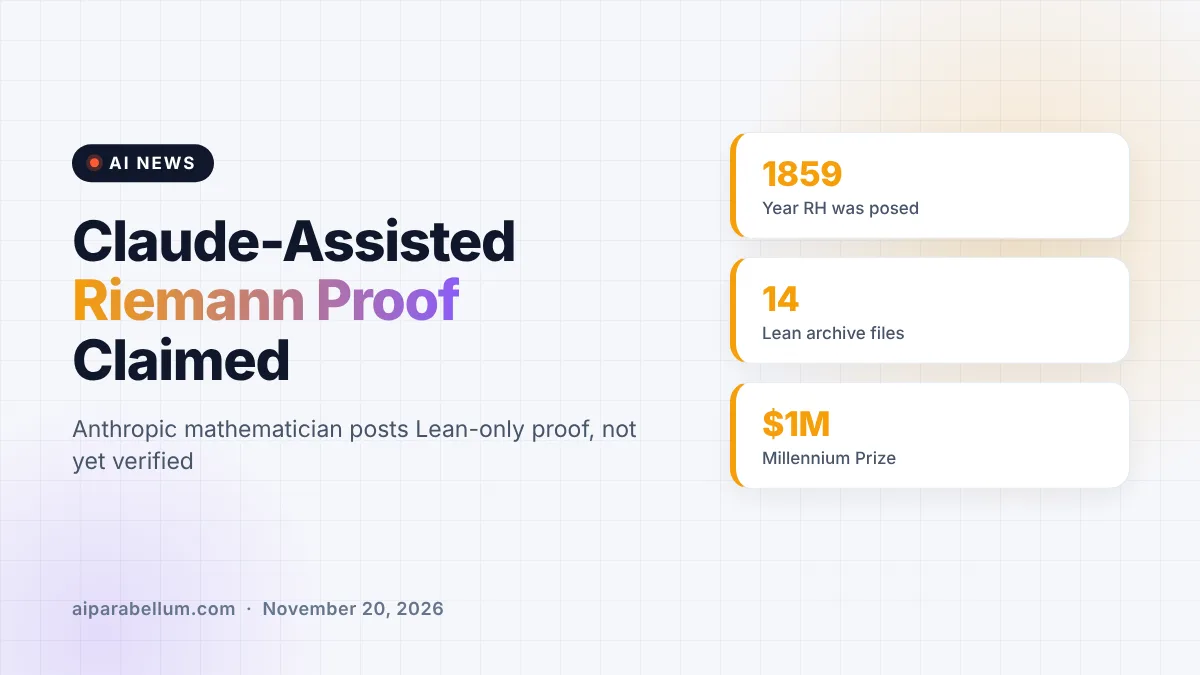
An Anthropic mathematician says he and Claude have found a proof of the Riemann hypothesis, the most famous unsolved problem in math. Levent Alpöge posted the claim on his personal website on Friday, November 20, along with a machine-checkable version of the proof written in the Lean language. No outside expert has confirmed it yet, so this Riemann hypothesis proof claim is big news that still needs careful checking.
What the Riemann Hypothesis Proof Claim Says
The claim lives in a short four-page note titled “Remark.” In it, Alpöge writes: “I believe I have, working with Claude, discovered a proof of the Riemann Hypothesis.” He goes further and says the same method also settles the Generalized Riemann Hypothesis, a much broader version of the problem.
He also says he expects to reach the Extended Riemann Hypothesis with more time. And he says the full argument has been formalized in Lean “without assumptions,” meaning a computer can check each logical step.
There is no traditional paper. Instead, the note links to a Lean project split into 14 compressed archive files on the same site. Alpöge explains that the informal write-up produced along the way ran past 250,000 pages, and he chose not to post that as an unreadable pile of AI text.
Why the problem matters so much
Bernhard Riemann proposed the hypothesis in 1859. It deals with the zeros of the zeta function, which encode how prime numbers are spread out along the number line. If it is true, primes are about as evenly distributed as they could possibly be.
Thousands of results in number theory already assume it is true. It is also one of the Clay Mathematics Institute’s seven Millennium Prize Problems, each carrying a $1 million award for an accepted solution.
How Claude Helped With the Riemann Hypothesis Work
The note gives Claude unusual credit. Alpöge says he steered the work toward the right setting, but that Claude “far outpaced” him near the end, especially in advanced areas he says he has not mastered himself.
The approach borrows from Stepanov’s method, which proved a version of the hypothesis for curves over finite fields. That method depends on a kind of “multiplicity” that has no obvious match for ordinary whole numbers. According to the note, Claude suggested building that multiplicity from a long chain of so-called theta lifts, with the chain growing like the square root of the size of the primes being counted.
A timeline in the note, which Alpöge says Claude compiled, runs from October 6 to November 16. The final step, the Generalized Riemann Hypothesis, is dated November 16.
| Detail | What we know |
|---|---|
| Who made the claim | Levent Alpöge, a mathematician at Anthropic |
| Where it appeared | A four-page note on his personal website |
| What it claims | Proofs of the Riemann and Generalized Riemann hypotheses |
| Format of the proof | Lean code in 14 archive files, no written paper |
| Work timeline | October 6 to November 16, 2026 |
| Independent verification | None yet |
Why Experts Are Saying Wait and See
A Lean proof that compiles is very strong evidence, but only if it proves the right statement using standard assumptions. Imperial College London mathematician Kevin Buzzard told New Scientist the first step is simply to see whether the code compiles at all. After that, specialists will need to check that the final theorem really matches the Riemann hypothesis.
The note itself is candid about rough edges. Alpöge warns that the argument is very long, may include strange or suboptimal choices, and expects much shorter proofs to follow. He says some descriptions of Claude’s steps are paraphrased from an AI-written summary that might not fully make sense.
Timing has also drawn attention. Anthropic’s shares started trading on November 19, and its first trading day was a big moment for the company. Alpöge calls the timing “horrible” in the note and says he waited because there was a constraint to respect, while rejecting the cynical reading of it.
A busy year for AI math
This claim lands in a year packed with AI math news. Here is the recent backdrop:
- In July, Alpöge shared a Claude-generated disproof of the Jacobian conjecture.
- In August, Anthropic said an unreleased Claude model raised a known lower bound on zeta zeros from 41.6% to 67.2%, while noting it had not proved the full hypothesis.
- In October, OpenAI released a large batch of AI-written math papers, including a result on the problem that stopped well short of a proof, as part of its AI math push.
As of Friday, Anthropic had not issued its own public statement on the new claim.
What This Means for You
If the proof holds up, it would be the clearest sign yet that AI models like Claude can do frontier-level research alongside experts. That is a big deal even if you never think about prime numbers.
- Treat headlines saying “solved” with caution until outside mathematicians confirm the Lean code builds and states the right theorem.
- Expect formal tools like Lean to matter more, since they let experts check AI-made proofs quickly.
- If you use AI for study or work, explore AI math helpers and other research AI tools, but always verify their output.
We will keep following the story in our AI news coverage as experts weigh in.
Sources
Primary source: Levent Alpöge’s note “Remark”. Additional reporting from Scientific American and New Scientist, with background from Anthropic’s August zeta research post.
Conclusion
An Anthropic mathematician says he and Claude have proved the Riemann hypothesis and even its generalized form, and he has released the proof as Lean code instead of a paper. Nobody outside his circle has checked it yet, and the first tests are simple: does it compile, and does it prove the right statement? If it passes, it would mark a historic moment for math and for AI. Until then, the fair reading is that this is a serious claim from a credible researcher that still needs proof of its own.