Superhuman, the company formerly known as Grammarly, announced on November 19 that its Superhuman Go assistant is getting a personal upgrade: an AI helper you can name, customize and let work in the background across your tools. The company is also pushing Go agents into its Docs and Mail apps, opening its Go platform SDK to partners, and adding more than 20 new partner agents. The news landed on the same day as Superhuman Assembly, the company’s first user conference in San Francisco.
What the Superhuman Go Assistant Will Do
Go started as a proactive agent platform that shows up wherever you type. The new personal assistant sits on top of that platform and acts like a coordinator for your work day. Superhuman says it will watch your connected tools, spot tasks, rank them and suggest what to do next, such as replying to an important email or prepping for a last-minute meeting.
The key promise is that you stay in charge. The company says the assistant only acts with your approval, and you decide what actually gets done.
A helper that writes like you
Superhuman says the assistant learns your context and writing style over time. It drafts content that sounds like you, polishes your text before you hit send, and keeps adapting as it sees more of your writing. A new onboarding flow will ask you to connect your tools up front, so the assistant can build a profile and recommend agents from day one.
You can also give the assistant a name and change how it looks. It manages your “team” of agents, whether they come from Superhuman, its partners, or ones you build yourself.
Go Agents Arrive in Superhuman Docs and Mail
The bigger shift may be where Go now lives. Superhuman is wiring its agents directly into the other apps in its suite, which includes Docs, Grammarly, GPTZero, Fathom and Mail.
- Docs: you can share a document with an agent like a coworker, @-mention it to hand off work, and set triggers so it updates the doc even when nobody has it open. Every change is logged and attributed to the agent.
- Mail: the existing Ask AI feature becomes Superhuman Go, and you can search across 100+ connected tools and finish tasks like updating a CRM from your inbox.
- Auto Drafts: reply drafts can now pull context from Slack, meeting notes or internal docs. Superhuman claims Auto Drafts already save about nine minutes per draft.
- Email Assistant: brings sorting, drafting and follow-up reminders straight into Gmail and Outlook.
- Fathom: the meeting notetaker adds live, shared collaborative notes and feeds action items to Go.
The Mail changes put Superhuman closer to the kind of inbox helpers we covered in our guide on how to organize your inbox with AI. The difference is that Go tries to pull context from every other app you use, not just your email.
New Partner Agents and an Open SDK
Superhuman says the Go platform SDK is now generally available to partners and customers. That lets outside companies build agents that appear anywhere Go does.
More than 20 partner agents are joining, including ones from Legora, Databricks, Amplitude, Blackboard, Apollo, Bitly, DeepL, Gamma and Saifr from Fidelity Labs. For example, Blackboard’s Assignment Coach is meant to help students improve coursework, while DeepL’s Brand Translator helps you keep your voice in other languages. It is a similar idea to the growing world of personal AI assistants that plug into many services at once.
Superhuman Go Rollout Timeline
Not everything ships today. Here is when each piece is expected, based on the company’s announcement.
| Feature | Availability |
|---|---|
| Go personal AI assistant | Rolling out over the next few months; early access via Superhuman Community |
| New partner agents | Rolling out starting today, over the coming weeks |
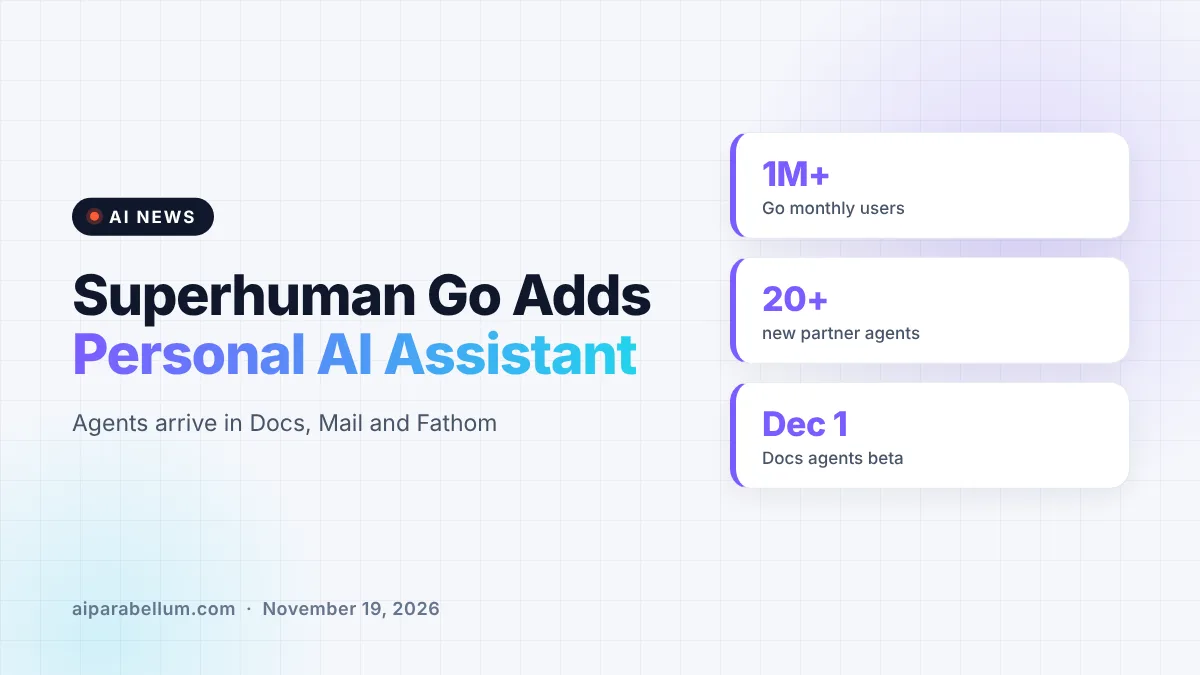
| Go agents in Docs | Open beta Dec. 1 for self-serve; Q1 2027 for enterprise |
| New Mail features | Beta this month; general availability in early 2027 |
| Fathom bot-free capture | Available today for most users |
How big is Go already?
Superhuman says Go has passed 1 million monthly active users and is growing 20 percent month over month. The company says more than 40 million people use its products daily, and that it makes over 100 billion LLM calls a week.
CEO Shishir Mehrotra framed the launch around adoption, saying Superhuman is “solving for the last mile of AI.” The pitch is that AI should work for everyone on a team, not only power users who seek it out.
What This Means for You
If you already use Grammarly or Superhuman Mail, these features will likely reach you without a new app. Here is how to think about it:
- Join early access if you want the assistant first, since the full rollout will take months.
- Review what you connect, because the assistant gets more useful with more tools, but also sees more of your data.
- Keep approving actions yourself, especially for emails and document edits that go out in your name.
- Try partner agents for specific jobs, like translation or fact checks, before trusting them with bigger workflows.
The takeaway: Superhuman is betting that AI wins when it lives inside the tools you already open every day, not in a separate chat window.
This launch also fits a wider trend of companies racing to build proactive agents, which you can follow in our latest AI news coverage. If you are comparing options, our roundup of productivity AI tools and our look at Grammarly Go offer useful background.
Sources
Primary source: Superhuman’s Go announcement. Additional reporting from SiliconANGLE.
Conclusion
Superhuman is turning Go from a writing helper into a personal assistant that manages other agents across Docs, Mail, Fathom and third-party tools. The assistant itself will take a few months to roll out, but partner agents start arriving now and Docs agents open in beta on December 1. With over 1 million monthly Go users already, the company has a real base to build on. The open question is whether people will trust a background assistant with their inbox and documents. For now, Superhuman’s answer is simple: it suggests, and you decide.