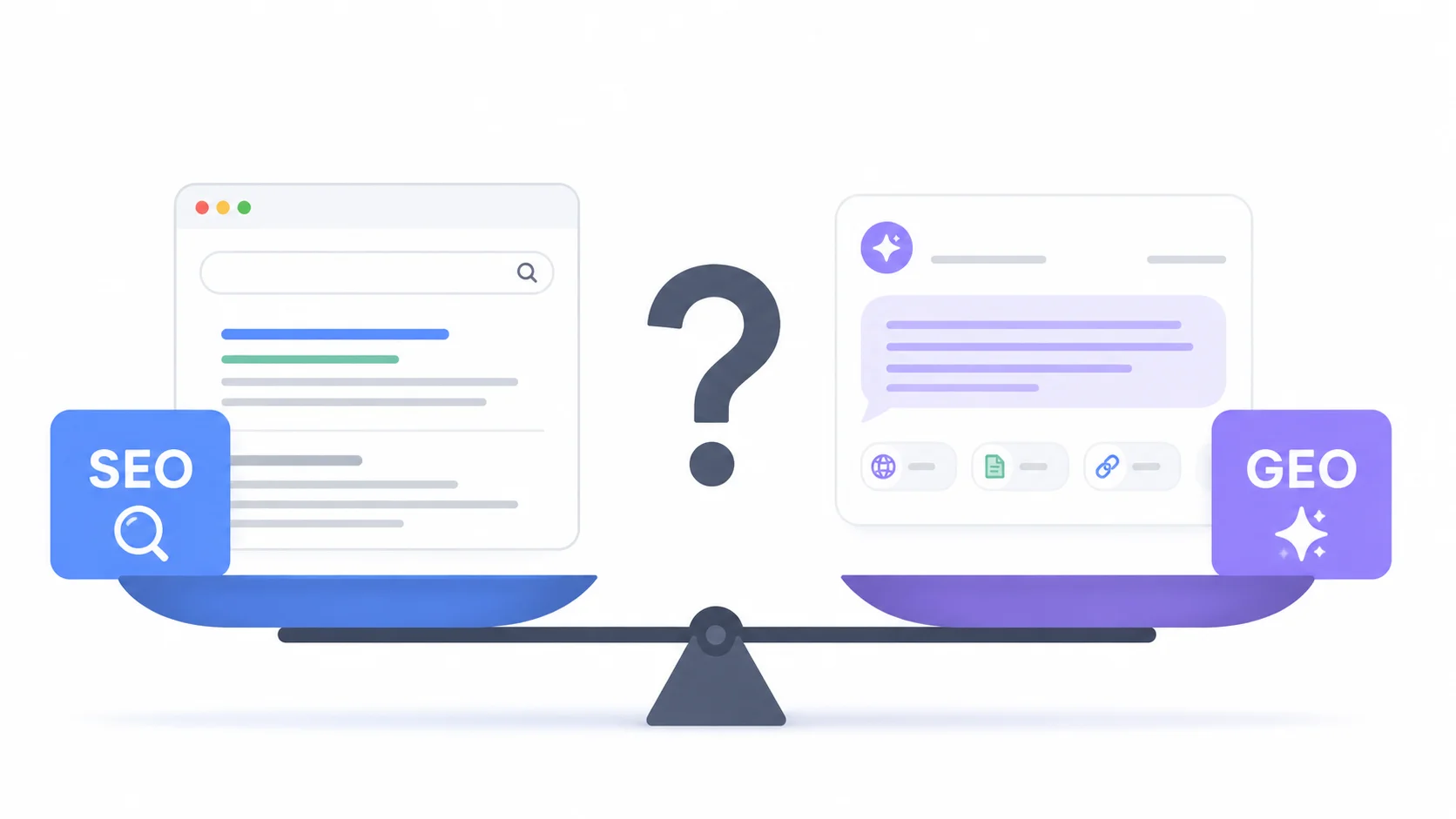
You have spent years learning SEO. You know how to research keywords, optimize meta tags, and build backlinks. Now everyone is talking about GEO, or Generative Engine Optimization, and saying it is the future of search visibility.
Does that mean SEO is dead? Not quite. But the way people find information online is changing fast, and ignoring GEO could cost you traffic you did not even realize you were losing.
The real answer is more nuanced than a simple yes or no. GEO is not replacing SEO. It is expanding what optimization means in a world where AI answers questions directly instead of just listing links.
What Is GEO and How Is It Different From SEO
SEO focuses on ranking your content in traditional search engine results pages. You optimize for Google, Bing, and other search engines so your pages appear as high as possible when someone types a query.
GEO focuses on getting your content cited or referenced by AI-powered answer engines. Tools like ChatGPT, Perplexity, Google AI Overviews, and Microsoft Copilot pull information from across the web and present summarized answers directly to users. GEO is about making sure your content is part of those AI-generated responses.
The fundamental difference comes down to how the user receives information. With SEO, users click through to your website. With GEO, the AI might reference your content without the user ever visiting your page. Understanding this shift is critical for anyone working with AI-powered SEO tools today.
Why People Think GEO Is Replacing SEO
The concern is not unfounded. AI-powered search tools are growing rapidly, and they are changing how millions of people find information online.
Google AI Overviews now appear for a significant percentage of search queries, providing AI-generated summaries at the top of search results. When users get their answer directly from the AI summary, they have less reason to click through to individual websites. This has led to what marketers call “zero-click searches,” where the user never leaves the search results page.
Meanwhile, standalone AI tools like Perplexity AI and ChatGPT are becoming go-to research tools for millions of users. Instead of typing a query into Google, people ask an AI chatbot and get a conversational answer with sources cited inline.
The question is not whether AI will change search. It already has. The question is whether your content strategy is keeping up with where people are actually looking for answers.
The Numbers Behind the Shift
Understanding the scale of this change puts the GEO versus SEO debate into perspective.
| Metric | Traditional Search (SEO) | AI-Powered Search (GEO) |
|---|---|---|
| Monthly active users | 8.5 billion searches/day (Google) | 300+ million monthly users (ChatGPT alone) |
| Click-through behavior | Users click links to visit sites | Users often get answers without clicking |
| Content format preference | Keyword-optimized pages | Authoritative, well-structured content |
| Growth trajectory | Stable but evolving | Rapid adoption year over year |
| Revenue model | Ads and organic clicks | Subscriptions and citations |
Google still dominates overall search volume by a massive margin. But the growth rate of AI-powered search tools signals where things are heading. Smart marketers are paying attention to both channels rather than betting everything on one.
What GEO Optimization Actually Looks Like
Optimizing for generative engines requires a different mindset than traditional SEO. Here is what GEO focuses on.
Authority and Credibility Signals
AI models prioritize content from sources they consider authoritative. This means brand mentions across the web, citations in other articles, and a strong reputation in your niche matter more than ever. The AI needs to trust your content enough to reference it in its answers.
Clear and Structured Information
AI engines extract information more effectively from content that is well-organized with clear headings, concise definitions, and direct answers to specific questions. Content that rambles or buries the key point in the fifth paragraph is less likely to be cited.
Unique Data and Original Insights
AI models are trained to value original research, unique statistics, expert opinions, and firsthand experience. If your content simply rephrases what everyone else has written, the AI has no reason to cite you specifically. Original perspectives and proprietary data give generative engines a reason to reference your content over competitors.
Entity Optimization
GEO puts heavy emphasis on entities, which are the people, brands, places, and concepts that AI models understand as distinct things. Making sure your brand and authors are recognized entities across the web helps AI models associate your content with expertise on specific topics.
Why SEO Is Not Going Anywhere
Despite the rise of GEO, traditional SEO remains essential for several important reasons.
- Google processes over 8.5 billion searches every day, and the vast majority still result in users clicking through to websites.
- E-commerce searches still rely heavily on traditional results. People searching for products want to compare options, read reviews, and make purchases on actual websites.
- Local searches like “plumber near me” or “best pizza in Chicago” still depend on traditional SEO signals like Google Business profiles, local citations, and reviews.
- Many industries, including legal, medical, and financial services, require users to visit actual websites for compliance and trust reasons.
- SEO drives compounding organic traffic over time. A well-optimized page can generate visitors for years with minimal maintenance.
The infrastructure of the internet still runs on websites, and websites still need SEO to be found. What is changing is that SEO alone is no longer sufficient for maximum visibility. Understanding how AI SEO tools analyze pages helps you see where the two approaches overlap.
GEO and SEO: Complementary, Not Competing
The most effective digital strategy treats GEO and SEO as complementary disciplines rather than opposing forces. Many of the best practices overlap significantly.
| Practice | Helps SEO | Helps GEO |
|---|---|---|
| High-quality, in-depth content | Yes | Yes |
| Structured data and schema markup | Yes | Yes |
| Building topical authority | Yes | Yes |
| Keyword density optimization | Yes | Less relevant |
| Brand mentions and citations | Indirect benefit | Yes |
| Original research and data | Yes | Yes |
| Technical site speed | Yes | Minimal impact |
| Backlink building | Yes | Indirect benefit |
Notice how much overlap exists. Creating authoritative, well-structured content with original insights helps you rank in traditional search and get cited by AI engines simultaneously. The foundation of good content strategy has not changed. The distribution channels have expanded.
For a deeper comparison of these two approaches, the breakdown of generative engine optimization versus traditional SEO covers the technical differences in detail.
How to Optimize for Both GEO and SEO
You do not need to choose between GEO and SEO. Here is a practical approach that covers both.
Start With Search Intent
Before creating any content, understand what the user actually wants to know. Both search engines and AI models reward content that directly and thoroughly answers the user’s question. If your content dances around the topic without providing clear answers, it will struggle in both channels.
Structure Content for Extraction
Use clear headings, bullet points, and concise paragraphs that make it easy for both search engine crawlers and AI models to understand and extract key information. Think of your content as a knowledge base that both humans and machines need to parse quickly.
Build Author and Brand Authority
AI models weigh the source of information heavily. Invest in building your brand’s presence across the web through guest posts, industry publications, podcast appearances, and social media authority. The more your brand is mentioned in credible contexts, the more likely AI models are to cite your content.
Add Original Value
Conduct surveys, publish case studies, share proprietary data, and include expert quotes. Content that provides information available nowhere else on the internet is exactly what AI engines are looking for when they need to cite a source. This same approach also helps with AI-powered content creation strategies.
Use Structured Data Markup
Schema markup helps search engines and AI models understand the context and relationships within your content. FAQ schema, HowTo schema, and Article schema all make your content more machine-readable, which benefits both SEO and GEO.
Industries Where GEO Matters Most
GEO does not impact all industries equally. Some sectors are feeling the shift more than others.
- Health and medical information, where users increasingly ask AI chatbots about symptoms, treatments, and medications before visiting a doctor or clicking a health website.
- Technology and software, where people ask AI to compare tools, explain features, and recommend solutions instead of reading multiple review articles.
- Education and research, where students and professionals use AI to summarize topics, explain concepts, and find relevant studies.
- Travel and hospitality, where AI-generated itineraries and recommendations are replacing traditional search-and-browse behavior.
- Financial advice and planning, where users ask AI for explanations of investment strategies, tax rules, and budgeting approaches.
If your industry is heavily information-based, GEO should already be part of your strategy. If your industry is more transaction-based, like e-commerce or local services, SEO remains the primary driver of revenue. Developing the right AI marketing tools strategy helps you stay visible across both channels.
Common Mistakes When Approaching GEO
The GEO space is new enough that many marketers are making avoidable errors.
- Abandoning SEO entirely in favor of GEO. This is premature and risky. Traditional search still drives the majority of web traffic.
- Trying to game AI models the way early SEO practitioners gamed search engines. AI models are harder to manipulate and are updated more frequently.
- Ignoring the importance of brand building. Unlike SEO, where a new site can rank quickly for long-tail keywords, GEO heavily favors established, recognized brands.
- Treating GEO as a separate discipline with its own team. The most efficient approach integrates GEO thinking into your existing content and SEO workflow.
- Not tracking AI citations. Tools are emerging that help you monitor when and where AI models reference your content. Start tracking this data now to understand your GEO performance.
GEO is not a replacement for SEO. It is an expansion of it. The marketers who thrive will be those who see AI as a new distribution channel for the same high-quality content that already drives organic search success.
The Future of Search Visibility
The search landscape is heading toward a hybrid model where traditional results and AI-generated answers coexist. Google is not abandoning its link-based results page. It is augmenting it with AI summaries. Other platforms are building entirely new search experiences around conversational AI.
For content creators and marketers, this means the bar for content quality is rising. Thin, generic content that exists only to rank for a keyword will increasingly lose to content that genuinely informs, educates, and provides unique value. Both search engines and AI models are getting better at identifying and rewarding substance over optimization tricks.
The skills that make a great SEO professional, understanding search intent, creating valuable content, building authority, are the same skills that drive GEO success. Learning how to write effective AI prompts is also becoming a valuable skill for understanding how these systems process and prioritize content.
How to Track Your GEO Performance
Measuring GEO results is still in its early stages, but several approaches give you useful data.
- Search your brand name and key topics in ChatGPT, Perplexity, and Google AI Overviews to see if your content is being cited.
- Monitor referral traffic from AI platforms in your analytics. Perplexity and some AI tools send trackable referral traffic.
- Track brand mention volume using tools that monitor the web for references to your brand, products, and key authors.
- Compare your AI visibility against competitors by searching for the same topics across multiple AI platforms and noting whose content gets cited.
As the SEO industry evolves, expect more sophisticated tracking tools to emerge that make GEO performance measurement as precise as traditional search analytics.
Conclusion
GEO is not replacing SEO. It is adding a new layer to search visibility that did not exist before. Traditional SEO remains the foundation of organic discoverability, but ignoring generative engine optimization means missing out on a growing share of how people find and consume information. The smartest approach is to do both: create high-quality, authoritative content that ranks well in traditional search and gets cited by AI engines. The content principles are the same. Structure it well, provide genuine value, build your authority, and make sure both search engines and AI models can find and trust your work. GEO is not the end of SEO. It is SEO’s next chapter.