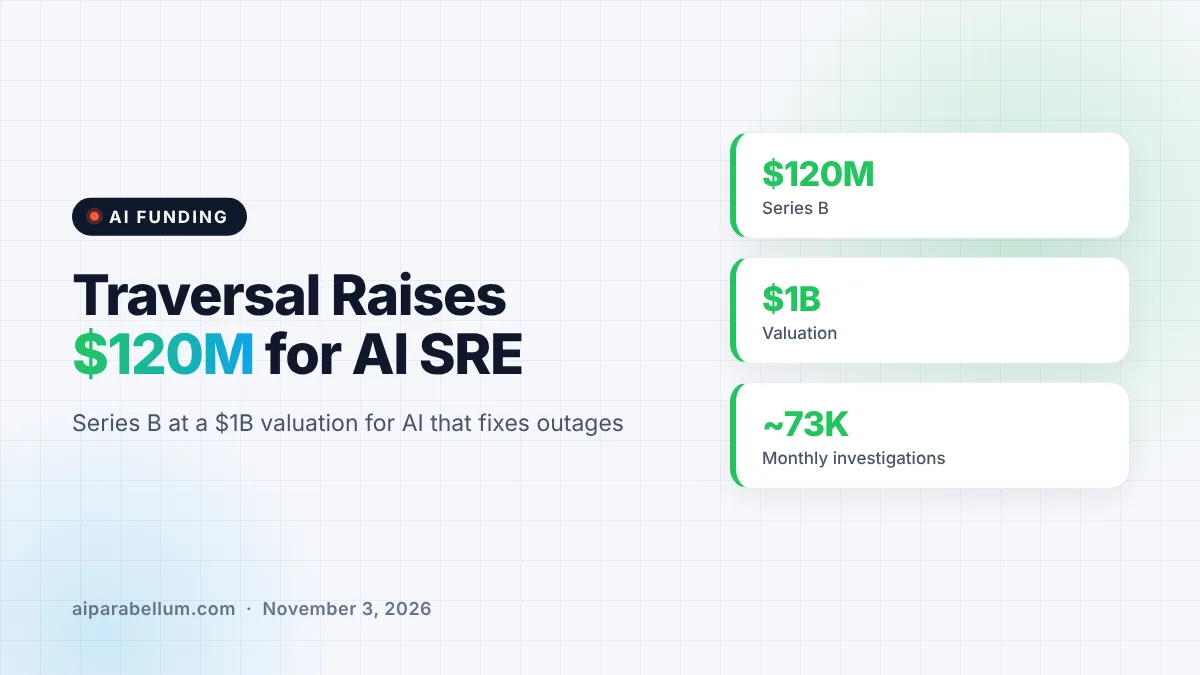
Traversal, the New York startup behind an AI SRE platform that hunts down the cause of software outages, has raised $120 million in Series B funding at a $1 billion valuation. The company announced the round on November 3, 2026, and says the money will push its AI site reliability engineer toward what it calls “self-driving production.”
The round was co-led by Kleiner Perkins, Redpoint Ventures and Khosla Ventures. Sequoia and Battery Ventures also took part, and both Kleiner Perkins and Sequoia added to earlier bets on the company.
What the Traversal AI SRE Actually Does
Site reliability engineering, or SRE, is the job of keeping software running. When an app goes dark or a payment system stalls, SRE teams get paged and start digging through logs, metrics and traces to find what broke.
Traversal wants an AI agent to do most of that digging. Its pitch rests on two pieces of technology the company introduced in March 2026:
- A Production World Model, which turns raw telemetry, code, deployment history and team knowledge into a constantly updated map of a company’s systems that AI can read.
- A Causal Search Engine, which lets agents test thousands of possible explanations in parallel and follow cause-and-effect links across services.
- Traversal Workers, long-running agents that start investigating the moment an alert or incident fires, instead of waiting for an engineer.
- Traversal MCP, which feeds that production knowledge back to coding agents so they can write sturdier code.
The founders argue that large language models on their own are poor at this work. They tend to spot what happens together rather than what actually caused a failure, and Traversal says its causal approach is built to fix that gap.
Why Investors Are Betting on AI SRE Now
The company frames the raise around a side effect of the coding-agent boom. AI tools now write more code faster, but that also means more complex systems and more chances for something to break once the code ships.
In its announcement, Traversal cites a survey finding that 52% of developers now spend more time debugging code in production. It also says unplanned outages cost Global 2000 companies a combined $600 billion in 2026. Those are the company’s figures, so treat them as part of the sales pitch.
The Growth Numbers Behind the Valuation
Traversal says monthly investigations on its platform grew more than 100-fold this year, from 513 to nearly 73,000. According to the company, about two-thirds of usage now goes beyond root cause analysis into areas like alert triage, release risk and security questions.
Additional reporting adds more company-supplied metrics, including an 8x jump in annual recurring revenue over six months. Named customers include DigitalOcean and PepsiCo, alongside several unnamed Fortune 100 financial firms.
| Detail | What Traversal Reports |
|---|---|
| New funding | $120 million Series B |
| Valuation | $1 billion |
| Co-leads | Kleiner Perkins, Redpoint Ventures, Khosla Ventures |
| Other investors | Sequoia, Battery Ventures |
| Monthly investigations | From 513 to nearly 73,000 this year |
| Founded | 2023, New York |
From Stealth to Unicorn in Under Two Years
Traversal was founded in 2023 by researchers who studied causal machine learning and reinforcement learning at MIT, Berkeley, Columbia and Cornell. CEO Anish Agarwal leads the team with cofounders Raaz Dwivedi, Raj Agrawal and Ahmed Lone.
The startup came out of stealth in June 2025 with $48 million in seed and Series A money, led by Sequoia and Kleiner Perkins. In March 2026, Amex Ventures made a strategic investment tied to a partnership with American Express. The card giant has been busy on other fronts too, including its own AI agent framework.
The new round is about two and a half times what the company raised when it launched. Traversal says it will spend the money hiring across research, engineering and sales to make its agents more autonomous.
What This Means for You
If you run or work on an engineering team, this round is another sign that AI agents are moving past writing code and into keeping it running. Here is what to keep in mind:
- Expect more AI SRE tools. Big funding rounds tend to pull rivals into a category fast, so pricing and features should improve.
- Ask for proof on your own incidents. Accuracy and recovery-time numbers come from vendors, so test any tool against real past outages before trusting it.
- Check where your data goes. These platforms read logs, code and deploy history, so review security and hosting options carefully.
- Pair it with your coding tools. If your team already leans on AI coding assistants, production feedback could help catch risky changes earlier.
Security-minded teams may also want to read about how other startups are tackling AI agent security, since giving agents access to production systems raises the same kinds of questions.
Sources
Primary source: Traversal’s Series B announcement. Additional reporting from Crypto Briefing.
Conclusion
Traversal’s $120 million raise turns a two-year-old AI SRE startup into a unicorn and puts serious money behind the idea of AI that fixes outages, not just code. The company’s growth figures are impressive, but they are self-reported, and customers will judge it on how fast real incidents get solved. For now, the round shows investors believe the next big AI job in software is keeping production running. You can follow more stories like this on our AI news page.