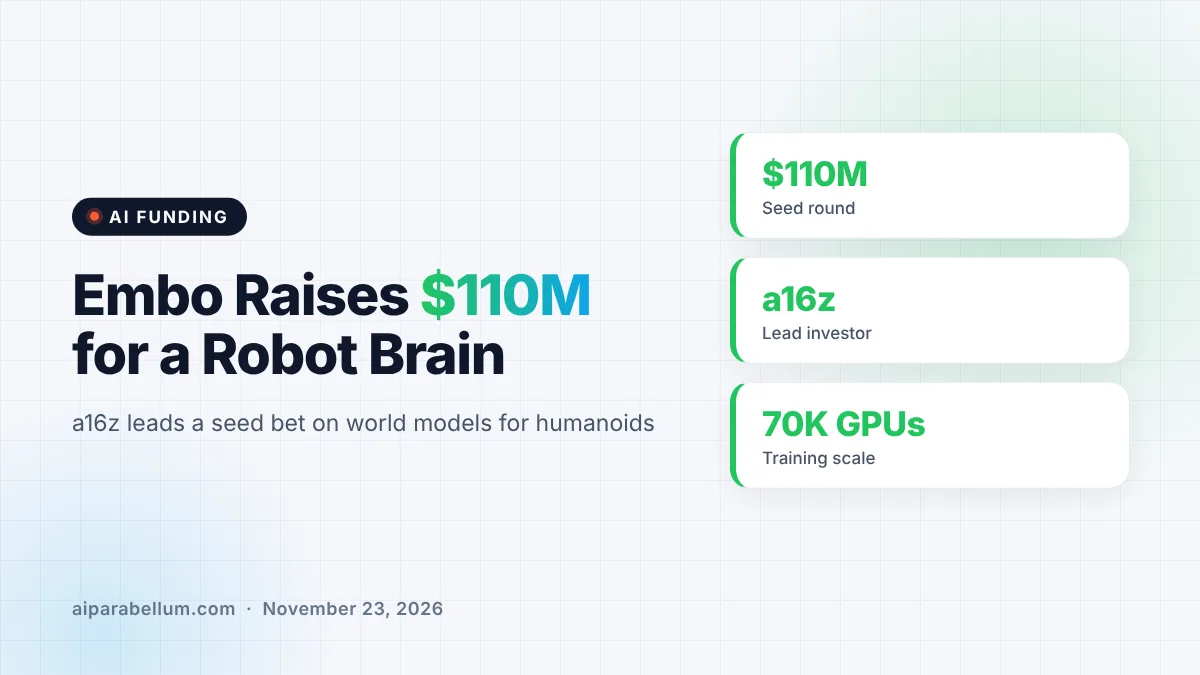
Embo, a new robotics AI startup led by former Google DeepMind researcher Danijar Hafner, says it has raised a $110 million seed round to build a robot brain that learns from video. Andreessen Horowitz led the round, which was announced on November 23, 2026. The company wants its Embo robot brain to control humanoid robots in places they have never seen before, without months of task-by-task training.
What Embo Announced
The seed round is one of the larger early-stage bets in robotics this year. Andreessen Horowitz published its own investment note confirming it led the deal and describing Embo as building “the brain for the humanoid workforce.” Khosla Ventures, DST Global and NVentures, Nvidia’s venture arm, also took part, along with other strategic investors.
Embo has not shared a valuation. It also has not announced a product launch date or named any customers yet.
| Detail | What we know |
|---|---|
| Round | $110 million seed |
| Lead investor | Andreessen Horowitz (a16z) |
| Other investors | Khosla Ventures, DST Global, NVentures and other strategic backers |
| Key people | Danijar Hafner and Wilson Yan |
| Goal | A general AI model that controls humanoid robots |
| Announced | November 23, 2026 |
How the Embo Robot Brain Is Supposed to Learn
Most robots today learn by copying human demonstrations. That works in a lab, but the skills often break when an object moves, the lighting changes or something new shows up. Embo is betting on a different idea called a world model.
A world model is an AI system that learns how the physical world behaves, such as how objects fall, slide or stack. Embo says it pretrains these models from scratch on huge amounts of internet video and text. The goal is to give a robot broad common sense about physics before it ever touches a real task.
Practice Inside an Imagined World
The next step is practice. Embo says its AI runs through thousands of imagined scenarios inside the world model and improves through reinforcement learning, including learning from its own failures. Only after that does it act in the real world, where a fleet of humanoid robots feeds back real data around the clock.
Here is the training plan in short:
- Pretrain one unified multimodal model on internet-scale video and text.
- Connect that model to real motors and sensors on Embo’s humanoid fleet.
- Let the AI practice skills inside the world model with reinforcement learning.
- Fine-tune on real robot experience so the skills hold up outside the lab.
Andreessen Horowitz frames this as a way for robot learning to scale with computing power. An agent can rack up far more practice in simulation than any physical robot could collect, including the rare mistakes that real demonstrations seldom capture.
The Team Behind Embo
Hafner is best known for Dreamer, a family of AI agents that learn to act by practicing inside a learned world model. His most recent version, Dreamer 4, learned to collect diamonds in Minecraft using only previously recorded data, training its behavior entirely through imagined experience. His doctoral thesis was titled Embodied Intelligence Through World Models.
He is joined by Wilson Yan, whose work includes VideoGPT and years of world model research with Hafner. The wider team has worked at Google DeepMind, Meta Superintelligence Labs, Nvidia’s Cosmos group, UC Berkeley and MIT. Embo says the team has also built infrastructure to train multimodal models across 70,000 GPUs.
Why the Embo Robot Brain Matters for Robotics
Money is pouring into so-called physical AI, and the race is now about which approach will make robots truly general. Some teams build vision-language-action models, while others adapt chatbots like the ones behind OpenAI’s robot plans. Embo joins companies such as Eka Robotics and Machenta that are chasing faster, more flexible robot learning.
Its world model focus also lines up with work from big players. Nvidia has been pushing its own Cosmos world models, and Google DeepMind recently showed off Genie 4. Nvidia backing Embo through NVentures shows how closely chipmakers watch this space.
The hard part is still ahead. Embo has to prove that knowledge learned from video and imagined practice can turn into reliable skills on real humanoids, outside of polished demos.
What This Means for You
You will not be buying an Embo-powered robot anytime soon. Still, this round is a useful signal about where robotics is heading over the next few years.
- Expect more robots trained on video and simulation rather than only hand-recorded demonstrations.
- Watch for “works out of the box” claims, and look for proof in new, messy environments.
- If you follow AI funding news, world models are quickly becoming a major category for investors.
- Businesses in manufacturing, logistics and services are the first likely users if the approach works.
Sources
Primary source: Andreessen Horowitz’s announcement on investing in Embo. Additional details from Embo’s website and reporting from Unite.AI.
Conclusion
Embo’s $110 million seed round puts serious money behind the idea that robots should learn physics from video and sharpen their skills through imagined practice. With Andreessen Horowitz leading and Nvidia’s venture arm on board, the startup has the backing and the research pedigree to try. What it has not shown yet is proof on real robots in unfamiliar settings. That will be the test that decides whether world models become the standard way to build a robot brain.