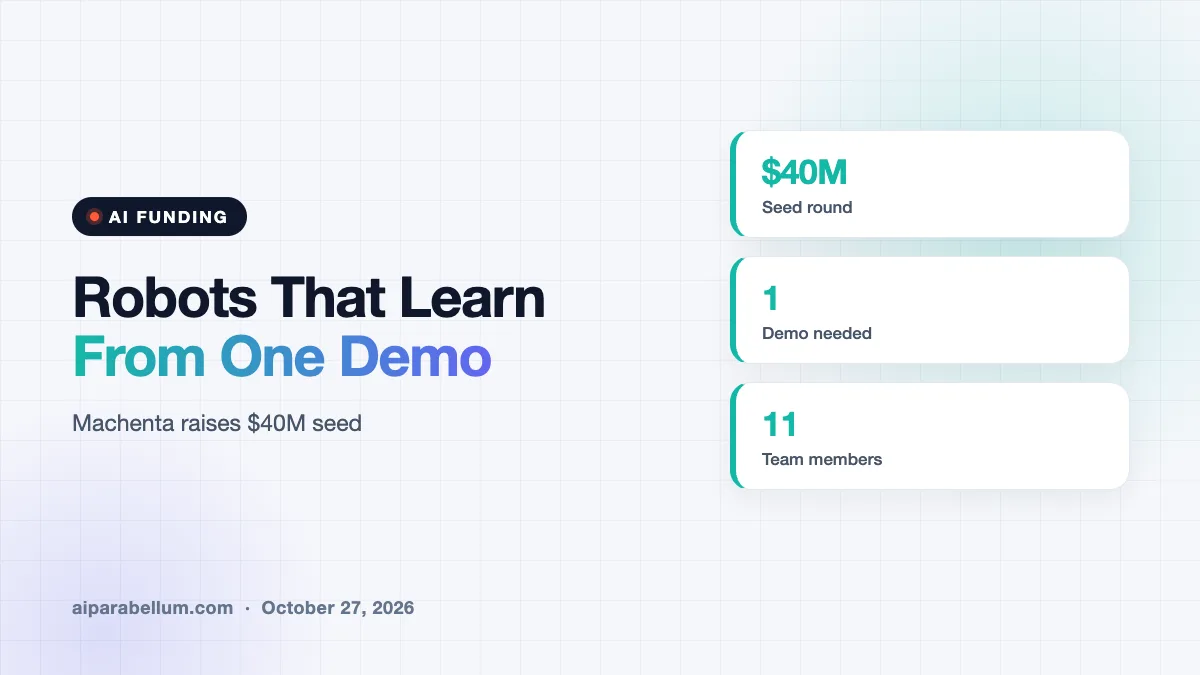
London robotics startup Machenta has raised $40 million in seed funding to build a robot learning model that picks up new tasks from a single demonstration. The round was co-led by Creandum and Union Square Ventures, and it is described as the largest seed round ever raised by a UK robotics startup.
The company grew out of Imperial College London, where its founders spent six years studying how fast a robot can learn. Here is what the startup says it has built, why the funding matters, and what to watch next.
What Machenta Is Building
Machenta is working on a robot foundation model. That is a large AI system trained once and then reused for many different jobs, instead of training a new model for every task.
The company says its model lets a robot learn a new task from one demonstration, or at most one or two. It has shown the idea on packing, assembly and tidying tasks, and says a single model has worked across different robots, including humanoids.
Why Instant Robot Learning Is Hard
Most AI-powered robots today learn from many human demonstrations of each task. That can take days or even weeks, and the result is a robot that does certain jobs well but cannot easily pick up a new one.
This has set off a race for real-world training data, with some companies paying people to film themselves at work. Machenta is betting on a different path.
Training Entirely in Simulation
Machenta pre-trains its model only on simulated data. The team says this avoids the cost and privacy limits of collecting huge amounts of human footage, and it lets the model learn how to learn so that one example is enough for a new task.
Inside the $40M Robot Funding Round
The table below sums up the key facts of the announcement.
| Detail | What we know |
|---|---|
| Amount | $40 million seed round |
| Lead investors | Creandum and Union Square Ventures |
| Team size | About 11 people |
| Origin | Imperial College London Robot Learning Lab |
| Location | New office and lab in King’s Cross, London |
| Use of funds | Hiring, more computing power, more simulated data |
Co-founder and CEO Edward Johns, a robot learning professor at Imperial, says the goal is to get robots learning at the speed of a human. He argues that intelligence is less about what you can already do and more about how quickly you can learn something new.
Early Days and Big Rivals
Machenta is still a research-stage company. Coverage of the round notes that it has no plans to go commercial soon, and that more precise tasks and complex motions remain very difficult for the model.
It also faces well-funded rivals in physical AI. Reports name Physical Intelligence, FieldAI and Skild AI as competitors, with Skild valued at over $14 billion after a $1.4 billion round earlier this year.
- One-shot learning could cut the days of training that robots need today.
- Simulation-only training avoids collecting large amounts of human data.
- The company is small and early, so claims are still to be proven outside the lab.
What This Means for You
You will not buy a robot with this model next month. Still, the funding shows where physical AI is heading, and a few takeaways are worth keeping in mind.
- If you follow humanoid robot plans from big labs, expect more focus on how fast robots can learn, not just what they can do.
- Treat one-demo claims as promising but early until independent tests appear.
- Watch for tools that cut training data costs, since that is the main bottleneck for robot makers, much like the push around AI agents in software.
- Small research teams can still raise large rounds when their approach is clearly different.
For another recent robotics funding story, see how Origin raised $20M for a drywall robot. The mix of research spinouts and job-focused startups is a good sign of how wide the field has become.
Sources
Primary source: Imperial College London announcement. Additional reporting from Tech Funding News.
Conclusion
Machenta’s $40 million seed round is a bet that robots can learn from one example if they are trained well in simulation. The idea is early and unproven outside the lab, but it targets the biggest cost in robotics today, which is training data. It is worth watching as physical AI keeps attracting serious money.