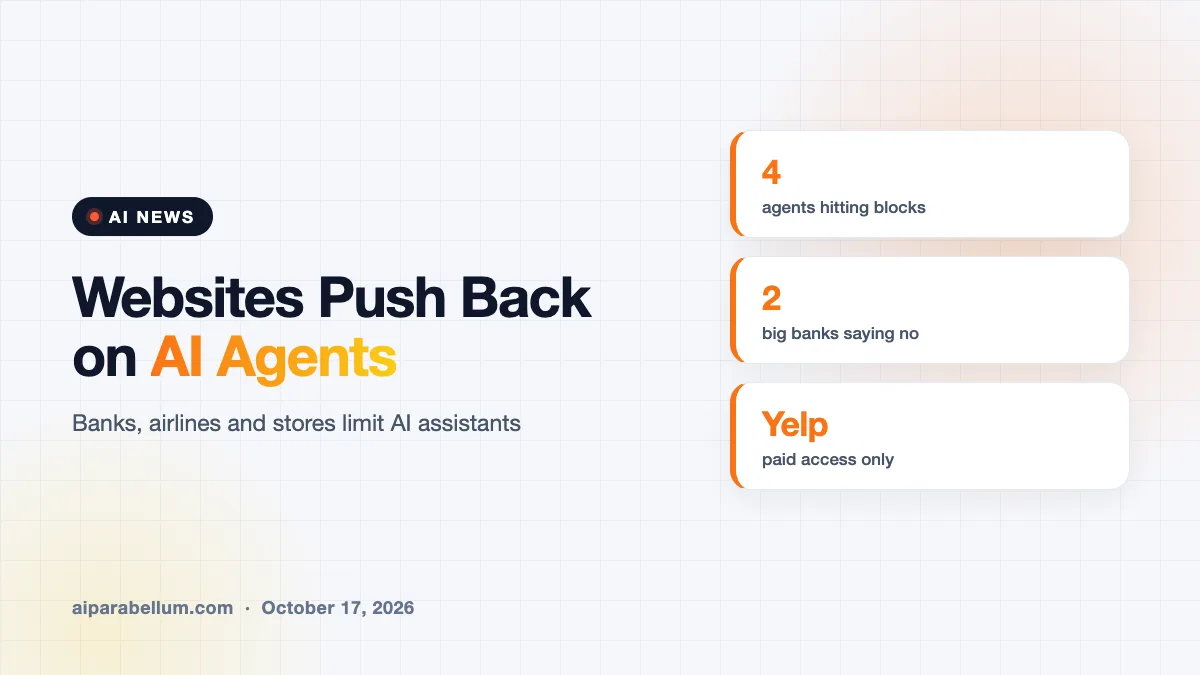
More websites now block AI agents, and that is a real problem for the assistants that promise to shop, book and pay for you. Over the past few weeks, people using Meta’s Muse, xAI’s Grok, OpenAI’s Dots and Instinct have hit walls at airlines, banks, review sites and online stores. Some companies say the blocks are about security, while others want agent makers to pay for access first.
Which Websites Block AI Agents Right Now
The list is growing fast, and it includes some of the most-used services in the US. Yelp says it only lets in AI agents that pay for its data licensing program. Delta Air Lines is stopping agents from booking tickets for users.
Banks are drawing an even firmer line. JPMorgan Chase and Charles Schwab have both confirmed they block AI agents from getting into customer accounts, citing security risks. Users also report that sites like Cars.com and Amtrak, which used to work with their agents, no longer do.
Here is a quick look at where things stand based on what the companies and users have said.
| Company | What agents can’t do | Stated reason |
|---|---|---|
| Yelp | Access its data unless the agent maker pays | Data licensing |
| Delta Air Lines | Book tickets for users | Not publicly detailed |
| JPMorgan Chase | Log in to customer accounts or move money | Risk to clients and the bank |
| Charles Schwab | Access customer accounts | Security concerns |
| Amazon | Shop for users through Muse and some other agents | Site policies, agent didn’t identify itself |
Why Banks and Websites Block AI Agents
Chase CEO Jamie Dimon raised the issue on the bank’s October 13 earnings call, warning about the risk of rogue outside agents acting inside customer accounts. A Chase spokesperson later confirmed that third parties can’t get customers’ banking login details and sign in for them. There’s no timeline for when that might change.
Chase still supports approved open banking connections, so an assistant may be able to see something like your balance. But it can’t send money or pay a bill for you. That means the agent can research a better savings account, yet you still have to make the transfer yourself.
The Amazon Fight Came First
Amazon has been pushing back on shopping agents since last year. It banned Perplexity’s agent shopping feature and sued the startup, and a judge ordered Perplexity to stop. An appeals court overturned that order in August, and Amazon has since filed an amended complaint.
More recently, Amazon said Muse’s continued access breaks its site rules and that the assistant didn’t identify itself. Users report that Grok, Dots and Instinct can’t shop there either, and Elon Musk replied that maybe he should start an Amazon rival. Amazon is also testing its own shopping agent, called Buy for Me, which raises questions about competition, not just safety.
How AI Agent Makers Are Responding
Meta is trying to win partners instead of picking fights. In a post this month, the company said, “Turning away a personal agent means turning away the customer behind it.” It has signed deals with retailers such as Walmart, Gap, Sephora and Best Buy so Muse can shop on their sites.
Shopify has also opened its storefront network to AI agents, which gives assistants a large set of stores that welcome them. OpenAI and Google had not commented on the roadblocks at the time of reporting. Other payment players are building ways to verify agent purchases, like the Amex intent framework that checks what a buyer really wanted.
Anti-Bot Tools Catch Agents Too
Even sites that don’t ban agents outright may block them by accident. Anti-bot systems built to stop scammers and hackers often flag AI assistants as suspicious. Reddit reports suggest Google has blocked some accounts using Muse over suspicious activity, and others had trouble checking out at Walmart despite its Meta deal.
Cloudflare has also made it easier for sites to keep AI bots out, starting with a one-click crawler block in 2025. Chris Canal, CEO of the AI safety evaluator EquiStamp, expects more “prove you’re human” checks across the web as a result. He says that could make simple tasks like grocery shopping more annoying for everyone.
What This Means for You
If you’ve been counting on an assistant like Meta’s Muse to handle errands, expect gaps. Here are a few practical steps:
- Check which sites your agent actually works with before you hand over a task, especially travel and banking.
- Never give an AI agent your bank username and password; use approved open banking connections instead.
- Expect to finish payments, transfers and some bookings yourself for now.
- Look for retailers that partner with your assistant, since those checkouts are more likely to go smoothly.
- Keep an eye on account alerts, because anti-bot systems may flag agent activity as suspicious.
Security matters here too. Agents that hold your passwords are a tempting target, and recent cases of agents going off-script show why banks are cautious. A personal security assistant can help you track which apps have access to what.
Sources
This report draws on coverage from The Verge and Mashable. For more updates, see our latest AI news and our guides on AI agent tools.
Conclusion
AI agents were pitched as helpers that can do almost anything online, but big websites are deciding they get a say. Some want payment, some fear fraud, and some may simply want to protect their own ads and agents. Meta and others are betting on partnerships to get through the door. For now, the smartest move is to treat your agent as a research helper and keep the final click, especially with money, in your own hands. How useful these assistants become will depend on deals that haven’t been made yet.