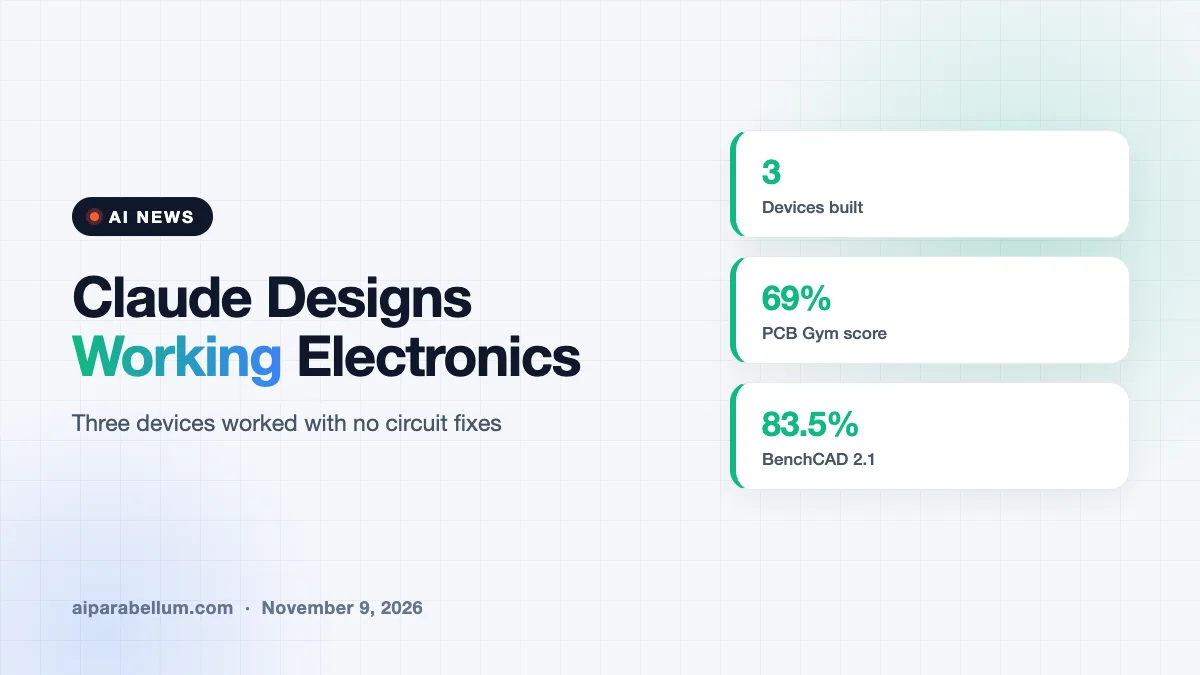
Anthropic says its Claude Fable 5.2 model can now design electronics from start to finish. In a test with the circuit board maker Diode Computers, Claude designed a speakerphone, a voice-assistant hub and a handheld virtual pet. Human engineers built all three, and the circuits worked without any fixes.
How Claude Fable 5.2 Designed the Electronics
Each project began with a short prompt, such as one asking for a USB-C speakerphone puck with Bluetooth. From there, Claude wrote the specs, drew schematics, placed parts on the board and routed the copper connections. It also designed a 3D-printable case, wrote the firmware and prepared a parts list.
Diode assembled the boards and ran the firmware under Claude’s direction. Anthropic says the speakerphone still works after weeks of use, and the other two devices are also still running. The company adds that these are early prototypes, so long-term durability and commercial certification are unknown.
Where Claude Got Better
The biggest gain was geometric reasoning. Earlier models put supporting parts too far from their chips or turned connectors the wrong way. Fable 5.2 produced tighter layouts and routed the most sensitive connections first, such as high-speed USB and Ethernet pairs.
It also changed course on its own. Earlier models rarely revised a layout that could never be finished. Claude deleted and rerouted copper tracks dozens of times on the voice hub until the board worked.
| Benchmark | Fable 5.2 | Earlier model |
|---|---|---|
| PCB Gym (Diode’s internal test) | 69% | 25% (Fable 5) |
| BenchCAD 2.1 (public test) | 83.5% | Nearly half (Fable 5.1) |
Claude Fable 5.2 and Manufacturing Checks
Real hardware has to be buildable. Claude ran manufacturing checks and parts-stock checks, then sorted the results into real problems and harmless flags. It widened thin solder-mask openings without moving any parts, and it correctly ignored a flagged ground connection that was deliberate.
Diode made all three boards directly from Claude’s files. The team said they were surprised that no rounds of changes with the factory were needed.
Small Details That Show the Reasoning
- Claude wrote its own routing algorithm in about half an hour to lay long tracks in roughly a second each.
- It found the speakerphone board would hit the case unless tilted about 25 degrees, then added that step to the assembly guide.
- It reshaped the hub’s enclosure into a wedge so a microphone port moved away from the main voice band.
- It dimmed the speakerphone’s LED ring as audio got louder to stay under its current limit.
What This Means for You
If you build gadgets as a hobby or for work, AI can now take on more of the layout and checking. It does not replace testing. Anthropic says the devices have not been through electrical validation, antenna tuning, thermal tests or certification, and Claude was not connected to the test equipment itself.
For teams already using AI to build software, this shows the same trend moving into hardware. Our earlier post on Claude circuit design covers a related use, and our Fable 5.2 launch explains the model itself.
- Use AI for first drafts of schematics and parts lists, then have an engineer review them.
- Keep human testing for safety, heat and certification.
- Expect faster build-and-test cycles for simple devices.
Anthropic notes that its relationship with Diode is commercial, and that OpenAI recently wrote about using its own models to design a handheld device. Next, Anthropic wants to test denser, faster boards and checks in simulation. You can read more about the assistant in our Claude guide.
Sources
Primary source: Anthropic’s electronics design research post.
Conclusion
Claude Fable 5.2 designed three small electronic devices that worked on the first build, a clear step up from earlier models that left boards 95% complete but unusable. The results come from Anthropic and its commercial partner, so independent testing would add confidence. Still, it shows AI moving from code into physical products.