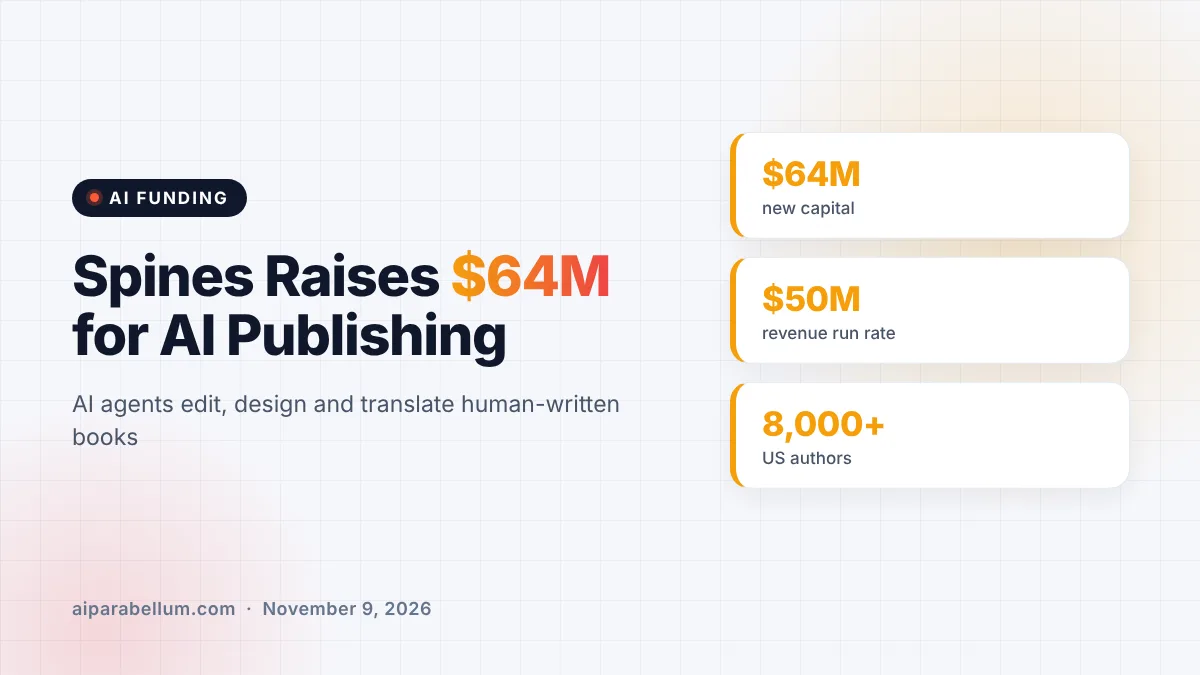
Spines, a startup that uses AI agents to turn finished manuscripts into published books, has raised $64 million in new growth capital. The AI book publishing company says the money will help it add more languages, build out marketing tools and reach more first-time authors around the world.
The deal mixes two kinds of money. It includes a $29 million Series A-1 equity round led by Zeev Ventures, plus a $35 million non-dilutive growth financing facility from a debt fund called Twelve.
Inside the $64 Million Spines Funding Deal
Zeev Ventures, the firm run by investor Oren Zeev, led the equity side of the round. Aleph, NordStar, M-Fund, LionTree and angel investor Dan Senor also took part. Aleph has backed Spines since its seed round and joined the earlier Series A as well.
The other $35 million is a credit facility, not a stake in the company. That means Spines can draw on the cash to grow without handing out more ownership. The valuation was not disclosed, though one Israeli business outlet reports it is understood to be below $1 billion.
| Detail | What Spines Announced |
|---|---|
| Total new capital | $64 million |
| Equity round | $29 million Series A-1, led by Zeev Ventures |
| Debt facility | $35 million from Twelve |
| Revenue run rate | $50 million, with 400% year-over-year growth |
| Authors published | More than 8,000 in the US |
| New authors per month | About 400 |
Fast Growth Behind the Raise
Spines says it has hit a $50 million revenue run rate. Two years ago, around its first Series A, its annual recurring revenue was about $3.5 million, according to the same Israeli outlet. The company says roughly 400 new authors sign up every month.
How the AI Book Publishing Platform Works
Authors bring their own finished manuscript. From there, specialized AI agents handle the long list of jobs that usually come after the writing is done. The company says this cuts a process that often takes 12 to 18 months down to a matter of weeks.
Here is what the agents take on, according to Spines:
- Editing and proofreading the text
- Cover design, formatting and book metadata
- Translation into other languages
- Audiobook production, including narration in the author’s own cloned voice
- Distribution through more than 100 sales channels
- Royalty tracking and marketing campaigns
Authors can also pay for help from in-house human editors, proofreaders and designers. For children’s books, Spines says it built illustration tools that keep characters looking the same from page to page.
Humans Still Write the Books
Spines draws a firm line on authorship. The company says it does not accept books written by AI and uses detection tools to screen for machine-made manuscripts. CEO Yehuda Niv summed it up this way: “We don’t believe the future of publishing is AI writing books.”
That stance matters because the flood of AI-written books has become a sore spot for readers and online stores. Spines is betting that authors and readers will trust AI more when it handles the busywork, not the storytelling.
What Comes Next for AI Book Publishing at Spines
Translation is the clearest near-term goal. Today, the platform translates English books into seven languages: Spanish, Italian, French, German, Portuguese, Polish and Hebrew. Each AI translation gets a review from a native speaker.
Over the next six months, Spines plans to expand to 20 target languages. It is also pushing deeper into marketing, with campaign tools meant to help authors find readers after launch.
Founded in 2021, the company is based in Herzliya, Israel. It has about 350 employees spread across Israel, the US, Eastern Europe and South America.
What This Means for You
If you have a manuscript sitting in a drawer, this funding is a sign that AI-assisted self-publishing is growing up fast. Spines’ typical package reportedly costs $5,000 to $7,000, far less than the bills some first-time authors face elsewhere.
A few practical takeaways if you are weighing an AI publishing service:
- Read the rules on AI-written text first, since some services like Spines reject machine-made books outright.
- Check who owns your rights and how royalties are reported across stores.
- Compare costs against do-it-yourself tools for book editing and AI voice narration.
- Ask whether a human reviews translations and audio before your book goes live.
Writers who want to keep more control can still mix and match tools. Our roundup of content creation tools and our look at AI in creative writing are good places to compare options. You can also follow more startup rounds like the Tolan funding news on our AI news page.
Sources
Primary source: Spines’ funding announcement. Additional reporting from Globes.
Conclusion
Spines’ $64 million raise shows investors are willing to back AI that serves human authors rather than replaces them. With a $50 million revenue run rate and 8,000 published US authors, the company has real traction behind its pitch. The next test is whether it can keep quality high as it grows to 20 languages and adds more marketing tools. For aspiring writers, the bigger story is that getting a professional-looking book into stores is becoming faster and cheaper. Just make sure the words on the page are still your own.