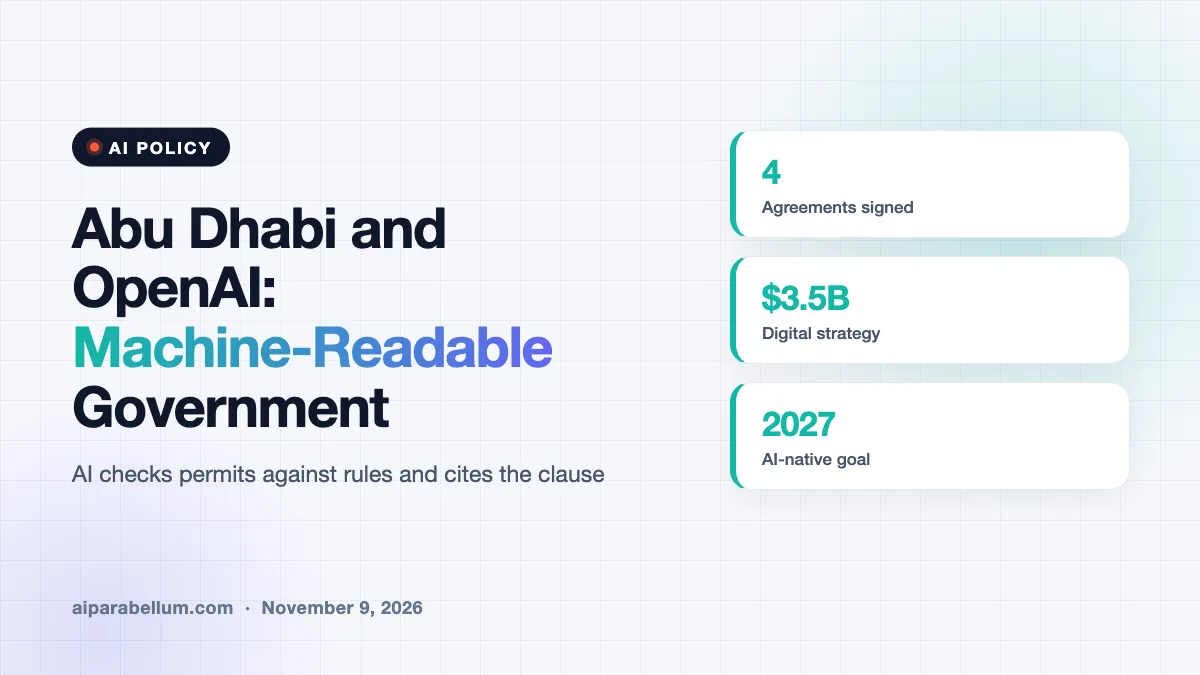
Abu Dhabi has launched Machine-Readable Government with OpenAI, a program that turns selected laws into a format AI can check permit applications against. The government says the system cites the exact clause behind every decision, and officials keep the final say. Food imports are the first service to use it.
What Machine-Readable Government Does
Machine-Readable Government, or MRG, converts a defined set of the emirate’s policies and regulations into code. An AI system then reads a permit or certificate application and compares it with those rules. It returns an assessment linked to the specific clause that shaped it.
Abu Dhabi says routine cases can now run around the clock. Some checks that once took days of manual review now take minutes, according to the government. That claim comes from the partners, and no independent assessment has been published yet.
The announcement was one of four agreements that Abu Dhabi entities signed with OpenAI, witnessed by Crown Prince Sheikh Khaled bin Mohamed bin Zayed Al Nahyan.
How Machine-Readable Government Starts
The Department of Government Enablement leads the project. The first pilot runs with the Abu Dhabi Agriculture and Food Safety Authority, built with Inception42, a company in the G42 group. It tested a tool called the Policy Adoption Engine, which turns written policies into automated checks that trace back to a rule.
The same tool can be reused for other services. Abu Dhabi plans to expand to the areas below.
- Construction permits
- Business and freelance licensing
- Procurement
- HR compliance
- Rules governing access to data
The government also plans to connect MRG to TAMM, its app for more than 1,200 public and private services.
Limits on AI Decisions in Government
Government teams still set the standards and review complex cases. They stay accountable for final decisions. The framework excludes autonomous decisions in high-stakes areas, including anything that materially affects a person’s rights, eligibility or access to essential services.
Officials also get a single view of where rules overlap or conflict across departments. They can test a proposed change against related rules before it takes effect.
Data Stays in the UAE
OpenAI’s GPT models run on GPUs in UAE data centers, under UAE cybersecurity standards and Abu Dhabi law. The system is designed to stop processing if its security requirements cannot be met.
Abu Dhabi owns all data the system generates, and that data is excluded from AI model training. The partners say the UAE is the first Middle Eastern country to run OpenAI’s GPT models on infrastructure inside its own borders.
| Detail | What was announced |
|---|---|
| Program | Machine-Readable Government (MRG) |
| Lead agency | Department of Government Enablement |
| First pilot | Food import checks |
| Budget context | AED 13 billion ($3.5 billion) digital strategy, 2025 to 2027 |
| Goal | First AI-native government by 2027 |
What This Means for You
If you live in or do business with Abu Dhabi, routine permits and certificates could get faster, with a clear reason attached to each result. For everyone else, this is a live test of how ChatGPT models can work inside public services. It also shows where agent governance matters most.
- Watch whether the speed claims hold up once independent reviews appear.
- Expect more governments to ask for traceable, clause-level AI decisions.
- Companies selling compliance tools may see similar demands for business AI tools.
Sources
Reporting from ITP.net and Tbreak.
Conclusion
Abu Dhabi is betting that AI works best in government when every answer points back to a written rule. The first pilot is narrow, and the speed gains are the partners’ own numbers. Still, a clause-level paper trail with humans keeping final authority is a model other governments will likely study.