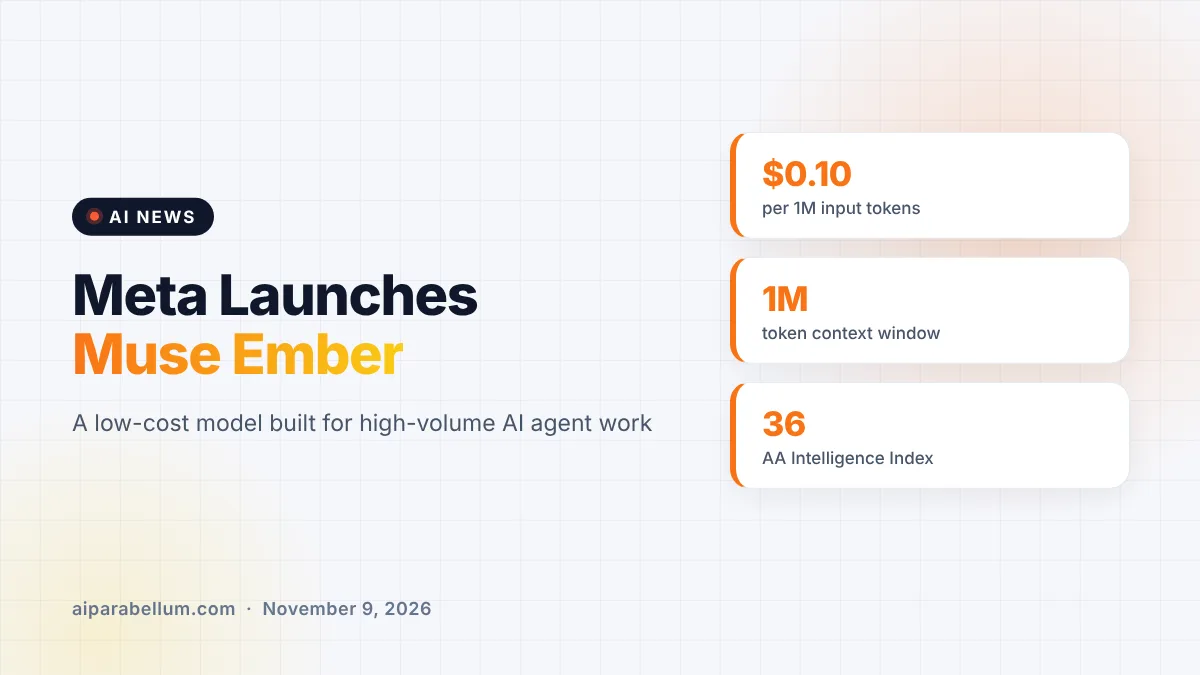
Meta just released Muse Ember, its smallest and cheapest AI model so far, and it is aimed squarely at the busy work AI agents do all day. The new low-cost model costs 10 cents per million input tokens and is pitched as the worker that handles tool calls, coding subtasks and document parsing while a bigger model does the planning. If you build with AI or pay for API usage, this release could change the math on what agent workflows cost.
What Meta Built Ember to Do
Meta Superintelligence Labs announced Muse Ember on Monday, November 9, 2026. The company describes it as an execution model for repeated, bounded work, rather than a model that tries to solve the hardest problems on its own.
Meta’s own summary of the split is simple: “Muse Wonder plans, Muse Ember handles the volume.” In practice, a larger model breaks a job into pieces, and many copies of Ember carry out those pieces in parallel.
Meta lists these as the main jobs Ember is built for:
- Tool calls and routing inside agent workflows
- Coding subtasks like reading files, running tests and making targeted fixes
- Extracting information from documents, including long ones
- Working with screenshots, charts, scanned pages, audio and video
Ember is the fourth model under the Muse name, after Spark, the open-weight Glimmer and the frontier-class Muse Wonder model. Unlike the open-weight releases, Meta is keeping Ember’s weights private.
Muse Ember Pricing and Availability
The headline here is cost. Meta set Ember at $0.10 per million input tokens and $0.50 per million output tokens, and those input and output rates match the standard short-context prices of GPT-6 Luna and Claude Haiku 5.5.
Ember is available today in Muse Code on all subscription plans and through Meta Model API under the model ID muse-ember-1.0. Meta says developers who already use an OpenAI-compatible client can switch by changing the base URL and model name.
| Detail | Muse Ember |
|---|---|
| Input price | $0.10 per million tokens |
| Cached input price | $0.004 per million tokens |
| Output price | $0.50 per million tokens |
| Context window | 1 million tokens |
| Maximum output | 512,000 tokens |
| Inputs | Text, images, audio and video |
| Where to use it | Muse Code and Meta Model API |
How Muse Ember Compares on Benchmarks
Meta says Ember scores 36 on the Artificial Analysis Intelligence Index, with an estimated cost of about 13 cents per index task at maximum reasoning effort. Coverage of the launch notes that Claude Haiku also reaches 36 on that index but at a much higher cost per task, while GPT-6 Luna scores 28.
Where it looks strong
On the OSWorld 2.1 computer-use test, Ember finished 33.8% of tasks outright, compared with 27.8% for Haiku and 17% for Luna. Its partial-credit score was nearly the same as Haiku’s, at 69.5% versus 68.9%.
Where it falls short
Ember is not the best at everything. On FrontierCode 2.0, which checks whether a project maintainer would merge an agent’s code changes, Ember scored 27.2% against 34.9% for Haiku. All of these figures come from Meta’s own comparisons, so independent tests will matter.
Small Models Doing the Heavy Lifting
Meta says Ember is the first model it trained with help from its larger Muse Wonder Full model. That approach mirrors how other labs build families of models, with a big model teaching a smaller, faster one.
To show the idea in action, Meta used Muse Code to port 16 code lexers from Python to Rust. Muse Wonder planned the job while 16 Ember agents did the ports in parallel, and Meta says the whole run cost about $3.96, with $1.84 of that going to Ember.
The real story is not one cheap model. It is the shift toward agent systems where a planner model hands routine work to many low-cost workers.
This mirrors the way many teams already run automation AI agents in their stacks, where the expensive reasoning happens once and the repeated steps run cheaply.
What This Means for You
If you run AI agents at scale, Ember gives you another option for the high-volume layer of your stack. A few practical points stand out:
- Test Ember on your own tasks before switching, since Meta’s benchmark numbers are self-reported.
- Use it for bounded work like extraction, routing and simple fixes, and keep a stronger model for planning.
- If you already use an OpenAI-compatible SDK, trying it should take little code change.
- Watch costs closely, because cheap per-token prices can still add up across thousands of agent calls.
For developers comparing tools, it is worth looking at how Ember fits next to Meta’s Muse Spark and other small agent models. You can follow more launches like this on our AI news page.
Sources
Primary source: Meta’s Muse Ember developer announcement. Additional reporting from TechCrunch and The New Stack.
Conclusion
Muse Ember shows Meta competing hard on price in the small-model race, with rates that match rivals like Claude Haiku and GPT-6 Luna. Its benchmark results are mixed but promising, especially for computer-use tasks, though it trails Haiku on code that maintainers would merge. The bigger shift is how Meta frames it: as one part of a team of models, not a solo assistant. If your work relies on agents that repeat the same steps thousands of times, Ember is worth a careful test.