
Meta has finally shipped the kind of AI model it has been promising for more than a year. On Monday, October 12, 2026, the company’s Superintelligence Lab released two new models, Muse Wonder and Muse Wonder Full, and called them its first true frontier models. That puts Meta in direct competition with the flagship systems from OpenAI and Anthropic for the first time since it rebuilt its AI team.
Here is what launched, what it costs, who can use it today, and what it means for you if you build with AI or simply use AI assistants every day.
What Meta Announced
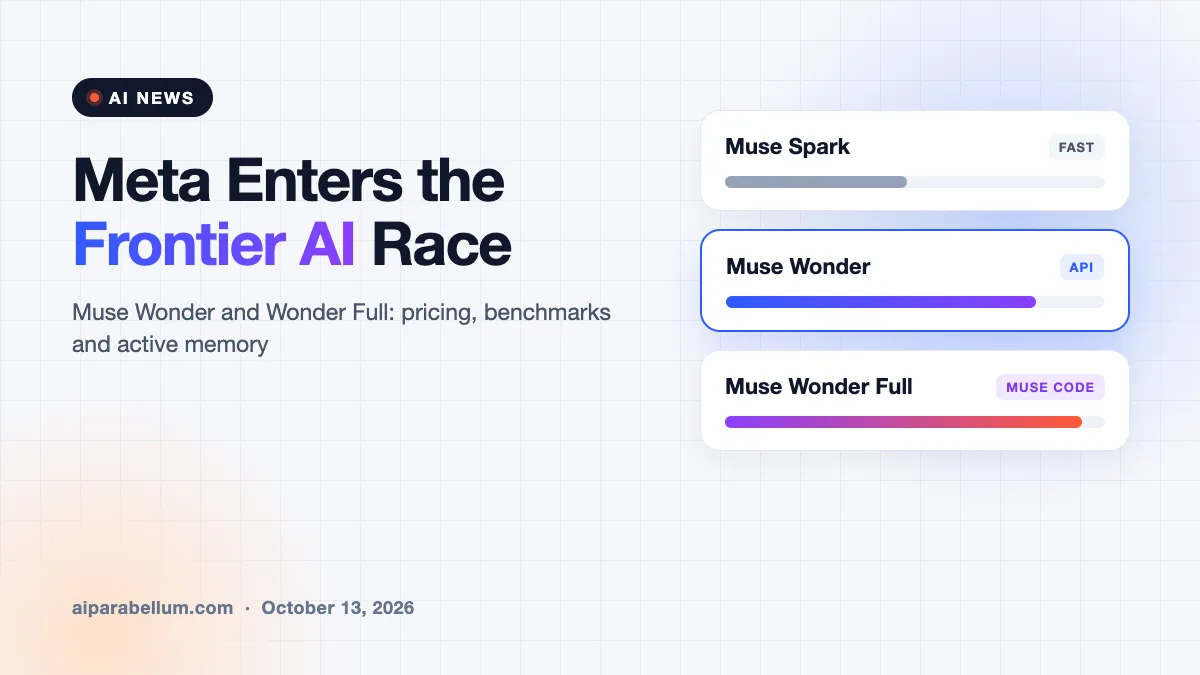
The release includes two models that share the same family name but serve different audiences. Muse Wonder is the version developers can reach through the Meta Model API. Muse Wonder Full is the larger sibling, and Meta is keeping it inside its own paid products instead of selling API access.
Both models are a big step up from Muse Spark, the lightweight model Meta released earlier. Spark was built for speed and low latency. Wonder is built for depth, with Meta pointing to stronger results on demanding work such as writing and fixing code.
| Model | Where You Can Use It | Main Focus |
|---|---|---|
| Muse Spark | Earlier Meta release | Fast, low-latency responses |
| Muse Wonder | Meta Model API and Muse Code | Frontier-level reasoning and coding |
| Muse Wonder Full | Muse Code subscribers only | Meta’s most capable model, no API access |
How Muse Wonder Stacks Up Against Rival Models
Meta says its own testing, published in the model card, puts Wonder and Wonder Full on par with the industry’s leading systems. The company named OpenAI’s GPT-6 Astra along with Anthropic’s Claude Opus 5.5 and Claude Fable 5.1 as the models it measured itself against.
Keep one detail in mind. These are Meta’s internal benchmark numbers, not independent results. Outside testers have not yet had time to confirm the claims, and it is still unclear how Wonder compares with Google’s Gemini 4 Argon.
Benchmarks published by the company that built the model are a starting point, not a verdict. The real test comes when developers put it to work on their own tasks.
The “Active Memory” Pitch
The feature Meta talks about most is memory. The company wants its assistants to hold onto what you tell them and use it over long stretches of time, a capability it calls active memory.
To back this up, Meta highlighted a benchmark called MemoryBench, which tests how well a system builds and recalls memories over time. By Meta’s account, Muse Wonder now scores higher on MemoryBench than Claude Fable, Claude Opus, and GPT-6 Astra.
For everyday users, this is the part worth watching. An assistant that reliably remembers your projects, preferences, and past conversations for weeks or months would feel very different from today’s chatbots, which often need the same context repeated in every session.
Muse Wonder Pricing and Availability
Meta is charging premium prices for its new model. Through the Meta Model API, Muse Wonder costs $4 per million input tokens and $20 per million output tokens, which places it in roughly the same price range as GPT-6 Sol and Claude Opus 5.5.
| Detail | Muse Wonder | Muse Wonder Full |
|---|---|---|
| API access | Yes, via Meta Model API | No |
| Input price | $4 per million tokens | Not sold separately |
| Output price | $20 per million tokens | Not sold separately |
| Who gets it now | Developers and Muse Code subscribers | Muse Code subscribers |
If you are comparing costs across providers, our breakdown of the changing AI pricing models explains why token-based pricing makes heavy output so expensive.
What Comes Next for the Muse Agent
Meta plans to put both new models to work inside Muse, its consumer AI agent, starting with paying subscribers. The company also says it will build more specialized models that it can bring to everyone who uses Muse. It has not shared a timeline or further details for either step.
This fits a wider shift across the industry. Big labs are moving beyond simple chat windows toward AI agent tools that can carry out tasks on your behalf. A model with strong long-term memory is a natural fit for that kind of assistant.
Why This Launch Matters for Meta
Meta has spent heavily on AI talent and infrastructure, yet until now it had not released a model built to compete at the very top. This is the first frontier release since Scale AI founder Alexandr Wang restructured Meta’s AI efforts in August 2025.
Since that overhaul, Meta has shipped the lightweight Muse Spark model and the Muse agent, and it has also grown its lineup with the image model Muse Image. Wonder is its clearest signal yet that it wants a seat at the same table as OpenAI and Anthropic. In its launch post, Meta described the pair as “a major leap toward personal superintelligence.”
The models were trained at Prometheus, Meta’s data center in central Ohio, which came online earlier this year.
What This Means for You
The practical impact depends on how you use AI today.
- If you are a developer, you now have another top-tier option to test. Run Wonder against your current model on your own real tasks before switching, since the benchmark claims come from Meta itself.
- If you write code with AI, Wonder’s coding focus makes it worth comparing with the tools on our list of AI tools for developers.
- If you mainly use assistants like ChatGPT or Claude, more competition at the top usually means faster upgrades and better pricing across the board.
- If you care about privacy, keep an eye on how active memory works in practice, including what Muse stores about you and how you can delete it.
For more developments like this one, visit our AI news hub, where we track the launches that matter most.
Sources
This report is based on Meta’s announcement as covered by TechCrunch and The Verge.
Conclusion
Muse Wonder is Meta’s first serious attempt to compete with the strongest models from OpenAI and Anthropic, and the company is backing it with premium pricing, a coding focus, and a bold bet on long-term memory. Developers can try Wonder today through the Meta Model API, while the larger Wonder Full stays exclusive to Muse Code subscribers. The benchmark claims are promising but still unverified, so the next few weeks of independent testing will show whether Meta has truly caught up or simply closed the gap.
