The way AI software companies charge for their products has changed dramatically over the past two years. What used to be straightforward monthly subscriptions has evolved into a complex landscape of usage-based pricing, token metering, outcome-driven billing, and hybrid models that mix several approaches together.
If you run a business that relies on AI tools, or if you are building one, understanding these pricing shifts is essential. The model you choose affects everything from customer acquisition to long-term profitability.
Why AI SaaS Pricing Is Shifting in 2026
Traditional SaaS pricing was simple. You picked a tier, paid a flat monthly fee, and got access to a set of features. That model worked when software costs were predictable and usage patterns were relatively uniform across customers.
AI changes that equation completely. The cost of running AI models depends heavily on how much compute each user consumes. A customer who runs thousands of AI queries per day costs significantly more to serve than one who uses the tool a few times a week. Flat-rate pricing either overcharges light users or loses money on heavy ones.
This is why the entire AI SaaS industry is rethinking how it bills customers. The shift is not just a trend. It is a structural response to the economics of running AI-powered tools at scale.
The Major AI SaaS Pricing Models in 2026
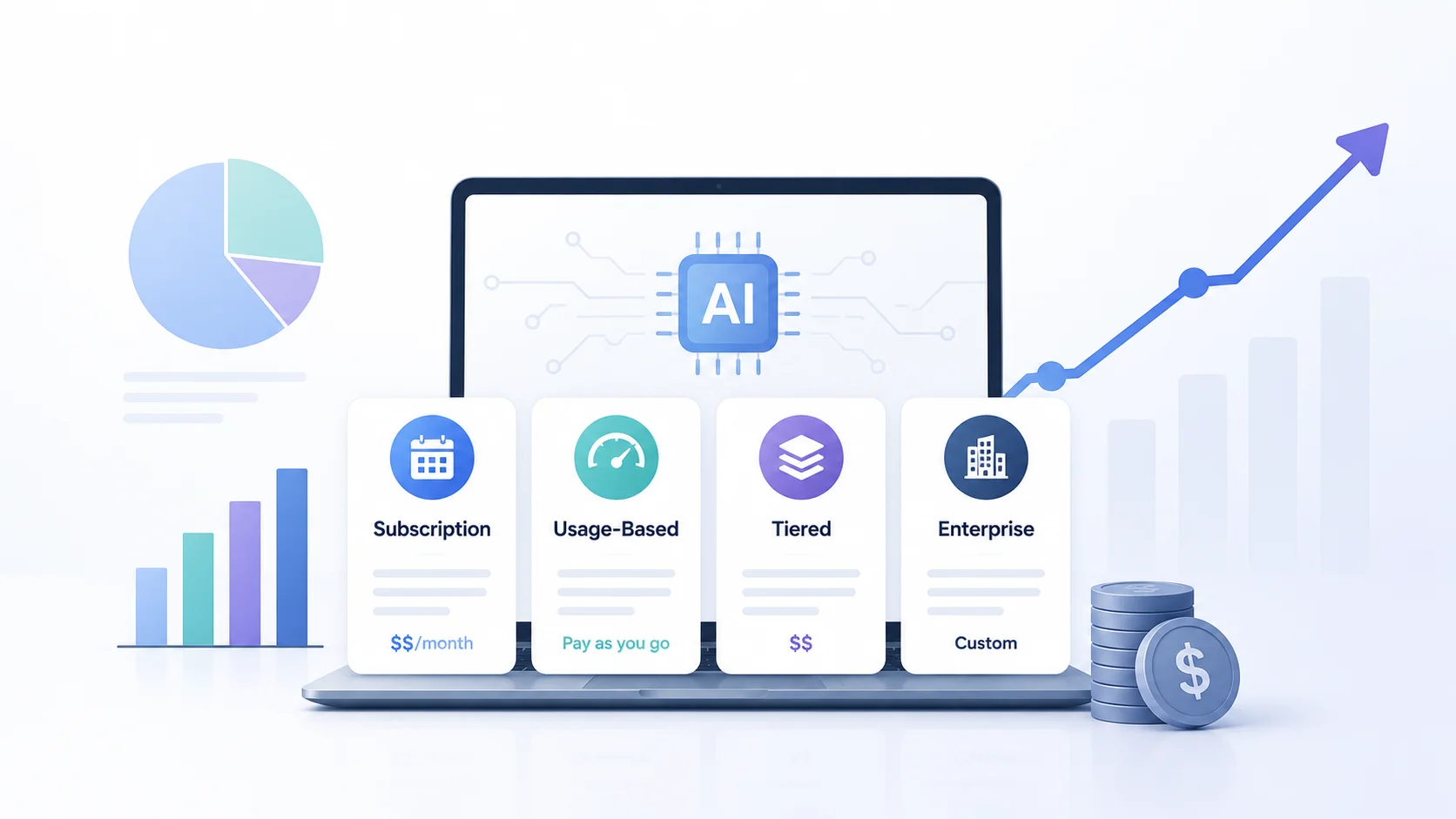
Several distinct pricing approaches have emerged as AI companies experiment with what works. Here is how each model operates and where it fits best.
Usage-Based Pricing
Usage-based pricing charges customers based on how much they actually use the product. In AI SaaS, this usually means billing per API call, per token processed, per minute of compute, or per generation.
OpenAI popularized this model with its API pricing, charging per token for input and output. Many AI companies have followed suit because it aligns costs directly with value delivered. Customers pay for what they use, and the provider covers their compute costs proportionally.
The downside is unpredictability. Customers often struggle to forecast their monthly bills, which can create friction during budget planning. This is especially challenging for businesses that need cost certainty.
Tiered Subscription With Usage Caps
This hybrid approach combines the simplicity of tiered pricing with usage limits at each level. You pick a plan that includes a set number of credits, generations, or API calls. If you exceed the limit, you either pay overage fees or upgrade to a higher tier.
Most consumer-facing AI tools use this model. It gives customers a predictable base cost while allowing the company to capture additional revenue from heavy users. Tools across image generation, writing, and code assistance commonly use this structure.
Outcome-Based Pricing
Outcome-based pricing is the newest and most disruptive model in AI SaaS. Instead of charging for access or usage, the vendor charges based on results delivered. A sales AI tool might charge per qualified lead generated. A customer support AI might bill per ticket resolved without human intervention.
This model requires deep confidence in the product’s ability to deliver measurable outcomes. It also demands robust tracking and attribution systems. But when it works, it creates a powerful alignment between vendor and customer because both parties benefit directly from better performance.
Seat-Based With AI Add-Ons
Many established SaaS companies are adding AI features to existing products and charging for them separately. The base product keeps its traditional per-seat pricing, while AI capabilities come as an add-on with its own pricing structure.
This approach lets companies monetize AI without disrupting their existing revenue model. It also gives customers the choice to opt in to AI features only when they see clear value, which reduces friction during the transition.
AI SaaS Pricing Models Compared
| Pricing Model | How It Works | Best For | Main Risk |
|---|---|---|---|
| Usage-based | Pay per API call, token, or generation | Developer APIs, enterprise integrations | Unpredictable customer bills |
| Tiered subscription | Fixed plans with usage caps | Consumer and prosumer AI tools | Cap frustration, plan complexity |
| Outcome-based | Pay per result delivered | Sales, support, and marketing AI | Hard to attribute outcomes |
| Seat + AI add-on | Per-user base plus AI feature fee | Established SaaS adding AI layers | Perceived as nickel-and-diming |
| Credit-based | Buy credits upfront, spend on any feature | Multi-feature AI platforms | Credit expiration concerns |
The Rise of Credit-Based Systems
Credit-based pricing has become one of the most popular models for AI platforms that offer multiple capabilities. Instead of billing per feature or per use, the platform sells credits that customers can spend across any tool or function.
This approach works well for platforms like design tools and content creation suites where users need flexibility. A marketer might use credits for image generation one day and text writing the next, without worrying about separate limits for each feature.
The challenge with credits is transparency. Customers need to understand how many credits each action costs, and those costs need to feel fair. Companies that hide behind complex credit tables risk losing trust.
How Compute Costs Drive Pricing Decisions
Behind every AI SaaS pricing decision is a hard reality: compute is expensive. Running large language models, generating images, and processing video all require significant GPU resources that cost real money per query.
In 2026, the cost of inference has dropped compared to 2024, but it is still the largest variable expense for most AI companies. This is why pure flat-rate pricing is increasingly rare. A company offering unlimited AI generations at $20 per month will lose money on power users unless it restricts quality or speed.
The companies winning the AI pricing game are the ones that align their revenue directly with their compute costs while keeping the billing experience simple enough that customers do not need a spreadsheet to understand their bill.
This tension between cost alignment and customer simplicity is at the heart of every pricing conversation in AI SaaS economics.
What Customers Actually Prefer
Research and market feedback consistently show that AI SaaS customers want three things from pricing: predictability, fairness, and simplicity. Unfortunately, most pricing models only deliver two of the three at best.
- Small businesses and solo creators prefer flat monthly plans with generous usage limits so they can budget confidently.
- Mid-market companies lean toward tiered plans that scale with team size and offer dedicated support at higher tiers.
- Enterprise buyers increasingly demand outcome-based or consumption-based pricing because they want to tie AI spend directly to business impact.
- Developers and technical users prefer transparent pay-as-you-go models where they control exactly what they spend.
The most successful AI companies in 2026 offer multiple pricing options that serve different customer segments. A one-size-fits-all approach rarely works when your user base spans from hobbyists to Fortune 500 companies.
Free Tiers and Freemium in AI SaaS
Free tiers remain a critical acquisition tool for AI SaaS companies, but they have evolved significantly. The generous free plans of 2023 and 2024 have been scaled back as companies realized that free AI usage carries real compute costs that cannot be subsidized indefinitely.
Today, most AI SaaS free tiers offer enough functionality to demonstrate value but not enough to replace a paid plan for any serious use case. This is a deliberate strategy to drive conversion. The question of whether free plans are enough for professional work comes up constantly across the industry.
Some companies have moved to free trial models instead, giving full access for a limited time rather than permanently restricted access. This approach tends to produce higher conversion rates because users experience the full product before deciding.
Enterprise AI Pricing Trends
Enterprise AI SaaS pricing is a world of its own. Large organizations negotiate custom contracts that often combine multiple pricing elements into a single agreement.
| Enterprise Pricing Element | What It Covers | Typical Structure |
|---|---|---|
| Platform fee | Base access and infrastructure | Annual flat rate |
| Consumption charges | Actual AI compute usage | Per-unit with volume discounts |
| Professional services | Implementation, training, customization | Fixed project fee or hourly |
| Support tier | SLA guarantees and dedicated support | Percentage of contract value |
The trend toward committed-use contracts is growing. Enterprise buyers agree to a minimum annual spend in exchange for discounted rates. This gives the AI vendor revenue predictability while giving the buyer cost savings, which is a structure borrowed from cloud infrastructure providers like AWS and Google Cloud.
The Impact on AI Startups
For AI startups, pricing strategy can make or break the business. Setting prices too low burns through funding on compute costs. Setting them too high slows adoption in a market where competitors offer similar capabilities at lower price points.
Many AI startups in 2026 are adopting a land-and-expand strategy. They offer competitive entry-level pricing to acquire customers, then grow revenue by expanding usage, adding seats, or upselling premium features. This is particularly common among AI SaaS companies targeting the mid-market.
The startup branding challenge also extends to pricing. How you price your product signals your market position. Premium pricing suggests enterprise-grade quality. Value pricing suggests accessibility. The signal needs to match the product and the target audience.
Pricing Transparency as a Competitive Advantage
One of the strongest trends in 2026 is the move toward pricing transparency. Customers are tired of “contact sales” pages and hidden pricing structures. Companies that publish clear, honest pricing are winning market share from those that do not.
Transparent pricing builds trust, reduces sales friction, and enables self-serve purchasing. It also forces companies to simplify their pricing, which benefits everyone. The leading AI tools in most categories now publish their pricing publicly, including enterprise tiers.
In a market where every AI tool claims to be the best, transparent and fair pricing is one of the few things that actually builds lasting customer loyalty.
Common Pricing Mistakes AI SaaS Companies Make
Several pricing mistakes keep showing up across the AI SaaS market. Avoiding these can save significant revenue and customer goodwill.
- Underpricing to compete and running out of runway before reaching profitability.
- Overcomplicating pricing with too many tiers, add-ons, and variable charges that confuse potential buyers.
- Failing to differentiate between customer segments and offering the same pricing to individuals, small businesses, and enterprises.
- Not testing pricing regularly. The market is moving fast, and pricing that worked six months ago may no longer be competitive.
- Ignoring the value of free trials in demonstrating product value before asking for commitment.
What the Future Holds for AI SaaS Pricing
The pricing landscape will continue to evolve as AI capabilities expand and compute costs decline. Several trends are likely to accelerate in the coming years.
Outcome-based pricing will become more common as AI products get better at delivering and measuring specific business results. The tools for tracking AI-driven outcomes are maturing, which removes one of the biggest barriers to this model.
AI-powered pricing itself will emerge as a category. Companies will use AI to dynamically optimize their pricing based on customer behavior, competitive positioning, and cost fluctuations. The same data analysis capabilities that power the products will power the pricing decisions.
Bundling will increase as AI platforms consolidate features that used to live in separate products. Instead of paying for five different AI productivity tools, customers will increasingly choose unified platforms that offer everything under one subscription.
Conclusion
The pricing models of AI SaaS in 2026 reflect a market that is still figuring out how to balance compute costs with customer expectations. Usage-based, tiered, outcome-based, and credit-based models each solve different parts of the puzzle, but no single approach works for every company or customer segment. The winners are the companies that match their pricing to the value they deliver, keep it simple enough that customers actually understand what they are paying for, and remain flexible enough to evolve as the market continues to shift. Whether you are buying or building AI software, paying close attention to how pricing models are changing will help you make smarter decisions in a rapidly moving market.