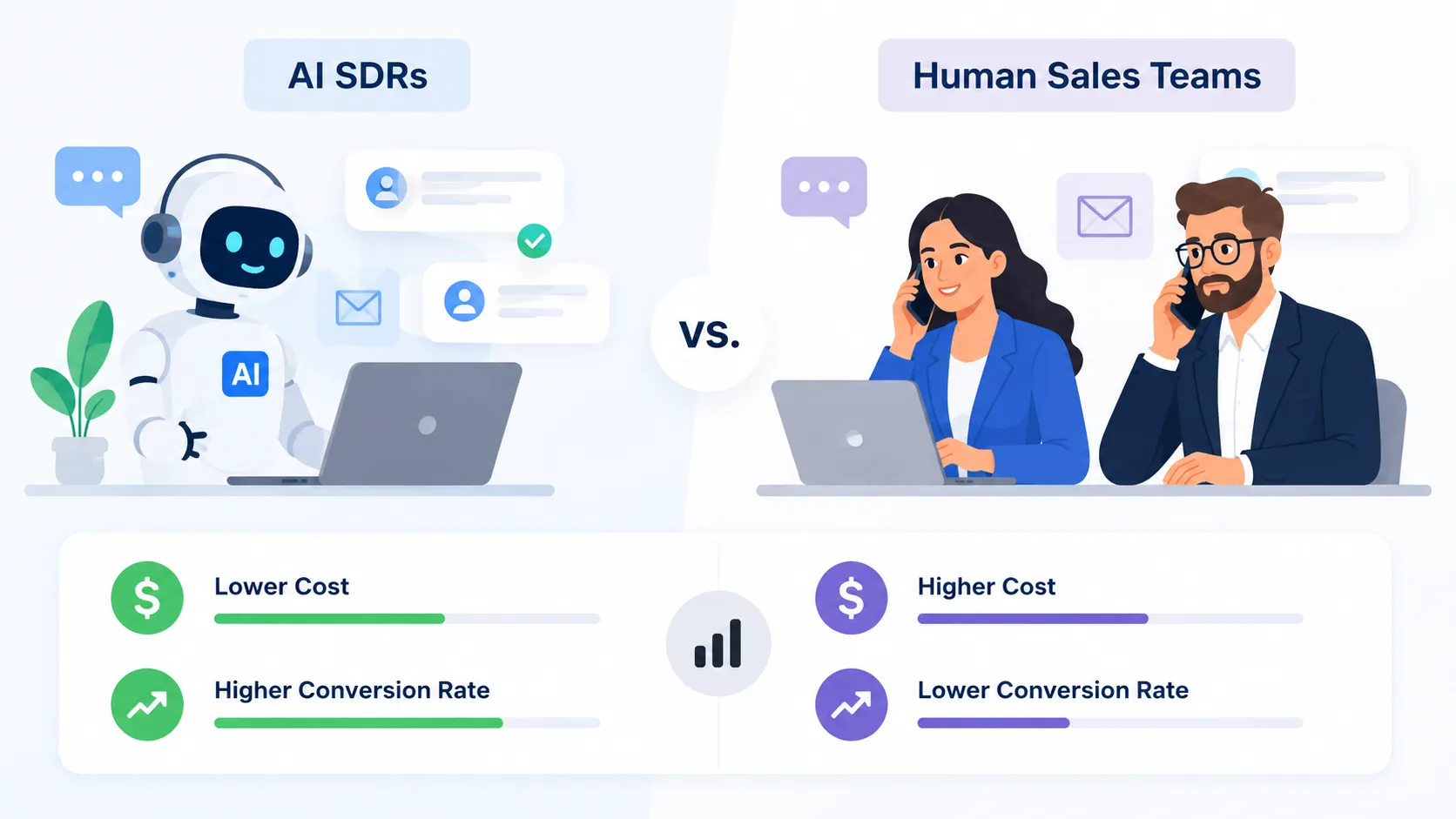
Sales development representatives are expensive. Between salary, benefits, training, and tools, a single SDR can cost a company over $100,000 a year. Now AI-powered SDR platforms promise to do the same job for a fraction of the price. But can software really replace the human touch that closes deals?
This is not a hypothetical question anymore. Companies like Relevance AI, Artisan, and 11x have launched AI SDR products that send outbound emails, qualify leads, and book meetings on autopilot. Some businesses are already replacing entire teams with these tools.
Let us dig into the real numbers. We will compare the fully loaded costs, conversion rates, and practical limitations of AI SDRs against human sales representatives so you can make a grounded decision for your organization.
The Fully Loaded Cost of a Human SDR
When you hire a sales development representative, the sticker price is just the beginning. The average base salary for an SDR in the United States sits around $50,000 to $55,000 per year according to Glassdoor data from 2025. Add on-target earnings and that climbs to $70,000 to $85,000.
But salary is only part of the equation. You also pay for benefits, payroll taxes, sales tools, CRM licenses, management overhead, and office space. These hidden costs add up fast.
Full Annual Cost Breakdown for One Human SDR
| Expense Category | Estimated Annual Cost |
|---|---|
| Base Salary + Commission | $70,000 to $85,000 |
| Benefits (health, dental, 401k) | $12,000 to $18,000 |
| Payroll Taxes | $6,000 to $7,500 |
| Sales Tools and CRM Licenses | $3,600 to $6,000 |
| Training and Onboarding | $4,000 to $8,000 |
| Management Overhead | $5,000 to $10,000 |
| Office/Equipment Costs | $2,000 to $5,000 |
| Total Fully Loaded Cost | $102,600 to $139,500 |
That means a team of five SDRs costs you somewhere between $500,000 and $700,000 per year. And that does not account for turnover, which runs at about 35% annually in sales roles according to the Bridge Group’s 2024 SDR Metrics Report.
“The average SDR stays in their role for just 14 months,” notes Trish Bertuzzi, founder of The Bridge Group. “By the time they’re fully ramped, you’re already looking at their replacement.”
The Fully Loaded Cost of an AI SDR
AI SDR platforms use a subscription model, typically charging between $2,000 and $10,000 per month depending on features and email volume. Some newer entrants offer plans starting as low as $500 per month for startups.
But the subscription fee is not the whole picture either. You need to factor in setup costs, contact data purchases, integration work, and the human time required to manage the system.
Full Annual Cost Breakdown for an AI SDR Platform
| Expense Category | Estimated Annual Cost |
|---|---|
| Platform Subscription | $24,000 to $120,000 |
| Contact Data Provider | $6,000 to $18,000 |
| Initial Setup and Integration | $2,000 to $10,000 (one-time) |
| Ongoing Management (part-time human) | $15,000 to $25,000 |
| Email Deliverability Tools | $1,200 to $3,600 |
| Total Fully Loaded Cost | $48,200 to $176,600 |
At the lower end, an AI SDR replaces one human rep at roughly half the cost. At the higher end with premium platforms, the cost savings narrow significantly. The sweet spot for most mid-market companies falls around $60,000 to $80,000 per year, which replaces roughly one and a half human SDRs in terms of output.
AI SDR vs Human SDR: Conversion Rate Comparison
Cost only matters if the output is comparable. So let us look at what each approach actually delivers in terms of meetings booked and pipeline generated.
A well-performing human SDR typically books 8 to 12 qualified meetings per month according to data from SalesLoft and Outreach. Top performers hit 15 to 20 meetings, while new reps in their ramp period average 3 to 5.
AI SDRs operate differently. They send far more outreach volume, often 1,000 to 5,000 personalized emails per month, but with lower reply and conversion rates. Industry case studies from 2024 and 2025 paint an interesting picture.
| Metric | Human SDR | AI SDR |
|---|---|---|
| Monthly Outreach Volume | 200 to 400 emails/calls | 1,000 to 5,000 emails |
| Reply Rate | 8% to 15% | 2% to 6% |
| Positive Reply Rate | 3% to 7% | 1% to 3% |
| Meetings Booked/Month | 8 to 12 | 5 to 15 |
| Meeting Show Rate | 75% to 85% | 60% to 70% |
| Cost Per Meeting Booked | $800 to $1,200 | $350 to $700 |
The numbers reveal a nuance most vendors gloss over. AI SDRs can match human reps in raw meeting volume, but the quality gap shows up in show rates and downstream conversion. A meeting booked by a human who had a genuine conversation tends to be stickier than one booked through automated sequences.
Where AI SDRs Genuinely Outperform Humans
AI sales agents shine brightest in specific scenarios. If you understand where they excel, you can deploy them strategically instead of trying to replace your entire team overnight.
Speed and Scale
An AI SDR never sleeps. It can research a prospect, personalize an email, and send it within seconds of a trigger event. When a company raises funding, changes leadership, or posts a job listing that signals buying intent, the AI acts immediately. A human rep might not get to that signal for days.
This speed advantage is particularly valuable in competitive markets where being first to reach a prospect matters. Companies selling business software in crowded categories have reported 2x higher response rates simply from faster outreach timing.
Consistency and Coverage
Human SDRs have bad days. They get sick, lose motivation, and cherry-pick the leads they think are most promising. AI SDRs work every lead in the queue with the same level of effort. No lead falls through the cracks.
For companies with large total addressable markets, this consistency is game-changing. An AI can methodically work through 10,000 accounts in a quarter while a human team might only touch 2,000.
Cost Per Qualified Meeting
Even accounting for lower show rates, AI SDRs deliver a lower cost per qualified meeting in most scenarios. When a company calculates cost per meeting including all the overhead of human reps, the AI advantage becomes clear.
“We reduced our cost per booked meeting by 58% after deploying an AI SDR alongside our human team,” says a VP of Sales at a mid-market SaaS company interviewed by Pavilion in their 2025 sales benchmark report.
Where Human Sales Teams Still Win
AI SDRs have real limitations that no amount of engineering has solved yet. Understanding these gaps is critical before you make any hiring decisions.
Complex and High-Value Deals
When your average deal size exceeds $50,000, the human touch becomes essential. Enterprise buyers expect a tailored, consultative approach. They want someone who understands their specific pain points and can speak to how your solution fits into their existing tech stack.
AI SDRs struggle with this level of nuance. They can personalize at a surface level, referencing a prospect’s company name, recent news, or job title. But they cannot navigate a complex buying committee or read between the lines during a discovery call.
Relationship-Driven Industries
In industries like financial services, healthcare, and professional services, relationships drive revenue. A prospect who receives an AI-generated email may respond, but the trust-building that happens over lunch, at a conference, or through a warm introduction cannot be replicated by software.
Sales teams in these sectors should view automation tools as support infrastructure rather than replacements. The AI handles research and initial outreach while humans handle the conversations that matter.
Phone-Based Outreach
Most AI SDR platforms focus on email and LinkedIn. Cold calling, which still accounts for 30% to 40% of meetings booked at many B2B companies, remains a human-dominated channel. While AI voice agents are emerging, they are not yet reliable enough for complex B2B sales conversations.
The Hybrid Model That Top Companies Are Using
The smartest sales organizations are not choosing between AI and humans. They are building hybrid teams where each handles what it does best.
Here is the model that is gaining traction across B2B companies with 50 to 500 employees.
- AI SDR handles all top-of-funnel outreach across email and LinkedIn
- Human SDR takes over once a prospect replies with interest
- AI continues nurturing non-responders with follow-up sequences
- Human SDR handles all phone outreach and live conversations
- AI scores and prioritizes inbound leads for the human team
This approach typically reduces headcount needs by 30% to 50% while maintaining or improving total meetings booked. A team that needed six SDRs can often achieve the same results with three humans plus an AI platform.
“The companies seeing the highest ROI are not replacing reps with AI. They are giving each rep an AI co-pilot that triples their effective reach,” observes Kyle Coleman, former CMO at Clari.
Industry-Specific Results From Real Deployments
Case studies from AI SDR vendors and independent research paint different pictures depending on the industry. Here is what the data shows across four common B2B segments.
| Industry | AI SDR Meeting Rate | Human SDR Meeting Rate | Recommended Approach |
|---|---|---|---|
| SaaS (SMB) | 10 to 18/month | 8 to 12/month | AI-heavy, minimal human |
| SaaS (Enterprise) | 3 to 6/month | 6 to 10/month | Human-led with AI support |
| Professional Services | 2 to 5/month | 5 to 8/month | Human-led with AI research |
| E-commerce/D2C Tech | 12 to 25/month | 8 to 15/month | AI-dominant |
The pattern is clear. AI SDRs dominate in high-volume, lower-ACV selling motions. Human reps maintain their edge in complex, relationship-heavy sales cycles. Most companies fall somewhere in between, which is why the hybrid approach keeps winning.
Hidden Costs and Risks to Consider
Before you sign up for an AI SDR platform, there are risks that do not show up in the vendor’s ROI calculator.
Email deliverability is the biggest one. AI SDRs send massive volumes of outreach, and if your domain reputation takes a hit, your entire company’s email communication suffers. This is not just a sales problem. Your email infrastructure supports customer success, support, and executive communications too.
Brand perception is another concern. Prospects who receive obviously automated outreach may form a negative impression of your company. In a world where buyers are increasingly skeptical of AI-generated communication, a tone-deaf automated email can do more harm than no email at all.
Data quality creates a third risk. AI SDRs are only as good as the data they analyze. If your contact database has outdated emails, wrong titles, or missing information, the AI will confidently send polished messages to the wrong people.
How to Evaluate Whether an AI SDR Is Right for You
Not every company should adopt an AI SDR platform right now. Ask yourself these questions before making the switch.
- Is your average deal size under $25,000? AI SDRs work best in high-volume, moderate-value sales motions.
- Do you have a proven outbound playbook? AI amplifies what already works. It does not create strategy from scratch.
- Is your contact data clean and enriched? Garbage in, garbage out applies tenfold to AI-driven workflows.
- Can your team manage the platform? Someone needs to monitor sequences, review replies, and refine messaging. Plan for 5 to 10 hours per week of human oversight.
- Are you comfortable with the deliverability risk? Multi-domain setups and proper warm-up protocols are non-negotiable.
If you answered yes to at least four of these, an AI SDR platform is likely worth piloting. Start with a 90-day trial focused on one segment of your market before rolling it out broadly.
The ROI Math: When AI SDRs Pay for Themselves
Let us run a simple calculation. Assume your average deal size is $15,000 and your close rate from SDR-booked meetings is 20%.
A human SDR booking 10 meetings per month generates $30,000 in closed revenue monthly, or $360,000 annually. Against a fully loaded cost of $120,000, that is a 3x return.
An AI SDR booking 10 meetings per month with a slightly lower close rate of 15% generates $22,500 monthly, or $270,000 annually. Against a fully loaded cost of $65,000, that is a 4.15x return.
The AI delivers a higher ROI even with lower close rates because the cost base is so much smaller. For companies tracking SaaS economics closely, this efficiency gain compounds as you scale.
What This Means for Sales Careers
If you are an SDR reading this, the takeaway is not doom and gloom. The role is evolving, not disappearing. The SDRs who will thrive are those who develop skills that AI cannot replicate: phone sales, strategic account research, and the ability to handle objections in real time.
Companies still need humans who can hop on a call and build rapport in 30 seconds. They need reps who can navigate buying committees and read the room during a demo. These skills are becoming more valuable, not less, as AI handles the repetitive prospecting work.
The reps most at risk are those who rely purely on email-based outreach and have not developed their phone or consultative selling abilities. Now is the time to level up.
Conclusion
AI SDRs vs. human sales teams is not actually an either-or decision for most companies. The data shows that AI SDRs deliver a lower cost per meeting and higher ROI in volume-driven sales motions, while human reps remain essential for complex deals, phone outreach, and relationship-based selling. The winning formula in 2025 is a hybrid model where AI handles top-of-funnel prospecting at scale and humans step in where judgment, empathy, and live conversation close the deal. Whether you deploy an AI SDR tomorrow or stick with your current team, understanding these economics is the first step toward building a sales operation that scales without burning through your budget.