For years, Integration Platform as a Service (IPaaS) has been the standard way businesses connect their apps, sync data, and automate workflows. Tools like Zapier, MuleSoft, and Workato built empires on the promise of drag-and-drop integrations that anyone could set up.
But something has shifted. AI agents are now doing what IPaaS platforms were built to do, except they do it faster, cheaper, and with far less manual configuration. The rigid, rule-based integration model is starting to look outdated next to AI systems that can reason, adapt, and handle complexity on their own.
What Is Traditional IPaaS
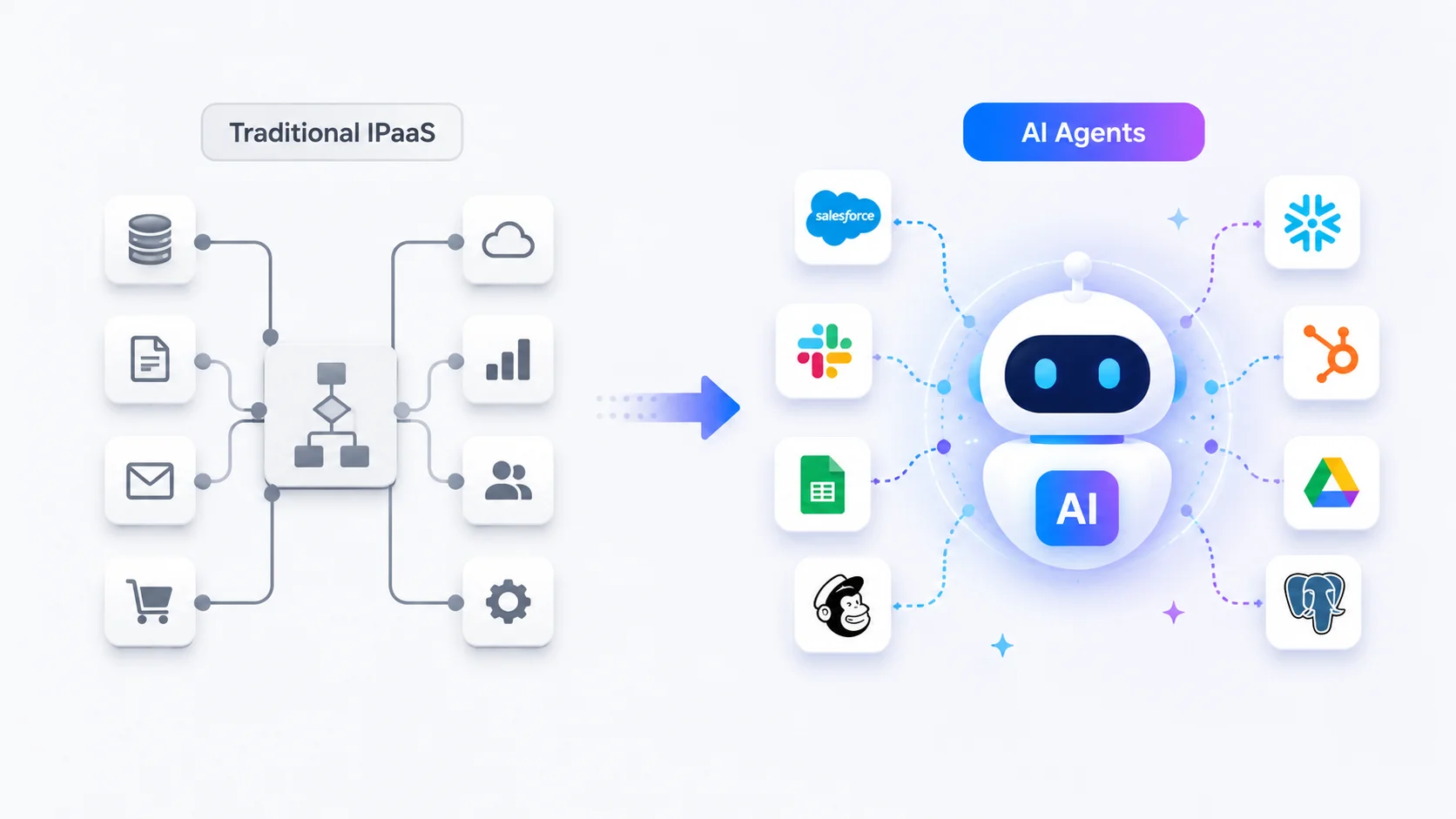
IPaaS platforms provide a cloud-based layer that connects different software applications. They let you build automated workflows, often called “zaps” or “recipes,” that trigger actions between apps based on predefined rules.
For example, you might set up an integration that creates a new row in Google Sheets every time a Stripe payment comes through. Or one that sends a Slack notification whenever a new lead enters your CRM. These are useful but fundamentally limited. Each workflow follows a strict if-this-then-that logic that cannot adapt when conditions change.
Traditional IPaaS works well for predictable, repetitive tasks. The problem arises when your business workflows involve nuance, exceptions, or decisions that require context.
What AI Agents Do Differently
AI agents are autonomous software systems powered by large language models that can understand instructions in plain language, make decisions, and execute multi-step tasks across applications. Unlike IPaaS workflows that follow static rules, AI agents reason through problems dynamically.
Instead of building a rigid workflow that says “when X happens, do Y,” you tell an AI agent what you want to accomplish. The agent figures out the steps, handles edge cases, and executes the task. If something unexpected happens, it adapts rather than failing silently or throwing an error.
This is a fundamental shift in how automation works. You move from programming integrations to instructing them.
Why Traditional IPaaS Is Hitting Its Limits
IPaaS platforms were revolutionary when they launched. But several pain points have become increasingly hard to ignore as business needs grow more complex.
- Workflow sprawl. Large organizations end up with hundreds or thousands of individual automations that become impossible to manage, debug, or audit.
- Brittle integrations. A single API change or field rename can break an entire workflow chain, often without anyone noticing until data is already lost.
- No decision-making ability. IPaaS tools execute logic but cannot interpret ambiguous data, prioritize actions, or handle exceptions gracefully.
- High maintenance cost. Someone has to build, test, monitor, and fix every integration manually, which creates a hidden operational burden.
- Limited context awareness. Each workflow operates in isolation with no understanding of what other workflows are doing or what the broader business goal is.
Traditional IPaaS is like giving someone a detailed recipe. AI agents are like hiring a chef who understands what you want for dinner and figures out how to make it.
AI Agents vs IPaaS Comparison
Here is a side-by-side look at how AI agents compare to traditional IPaaS platforms across key dimensions.
| Feature | Traditional IPaaS | AI Agents |
|---|---|---|
| Setup method | Drag-and-drop workflow builder | Natural language instructions |
| Error handling | Predefined error paths, manual fixes | Dynamic reasoning, self-correction |
| Adaptability | Rigid, breaks on unexpected input | Flexible, adapts to changing conditions |
| Context awareness | None (each workflow is isolated) | Understands broader goals and context |
| Maintenance | High (manual monitoring required) | Low (self-managing with oversight) |
| Decision-making | None (follows rules exactly) | Can interpret, prioritize, and decide |
| Learning curve | Moderate (visual builder) | Low (describe what you want) |
| Cost at scale | Increases linearly with workflows | Flattens as agents handle more tasks |
The cost structure is particularly telling. With IPaaS, every new integration adds complexity and cost. With AI agents, a single agent can often handle tasks that would require dozens of separate IPaaS workflows.
Real-World Use Cases Where AI Agents Win
The gap between IPaaS and AI agents becomes clearest in scenarios that involve judgment, variability, or multi-step reasoning.
Customer Support Ticket Routing
An IPaaS workflow might route tickets based on keywords in the subject line. An AI agent reads the entire ticket, understands the customer’s tone and urgency, checks their account history, and routes it to the right team with a suggested response. The difference in accuracy and speed is dramatic, which is why many companies are moving their customer support to AI-driven systems.
Data Enrichment and Cleanup
Traditional IPaaS syncs data between systems but cannot judge whether the data makes sense. An AI agent can look at incoming lead data, identify duplicates, flag inconsistencies, enrich records with missing information from external sources, and normalize formats, all without a predefined rule for each scenario. This kind of intelligent data analysis is beyond what rule-based systems can handle.
Invoice Processing
IPaaS platforms can move invoice data between accounting software and ERPs, but they choke on invoices with non-standard formats. AI agents read invoices like a human accountant would, extracting line items, matching them to purchase orders, flagging discrepancies, and routing exceptions for human review. The invoice processing workflow becomes intelligent rather than mechanical.
Multi-App Orchestration
Consider a task like “whenever a high-value deal closes in Salesforce, update the project in Asana, notify the delivery team in Slack, create a billing schedule in QuickBooks, and send a welcome email to the client.” In IPaaS, that requires building and maintaining five separate integrations. An AI agent handles it as a single instruction and adapts when any of those apps change their interface or API structure.
The Technology Making This Possible
Several advances have converged to make AI agents viable replacements for IPaaS platforms.
Large language models now have the reasoning ability to understand complex business instructions and break them into actionable steps. Function calling and tool use allow AI models to interact directly with APIs, databases, and external services. Memory systems let agents maintain context across long-running tasks and remember past interactions.
The emergence of agent frameworks like LangChain, CrewAI, and AutoGen has made it practical for developers to build production-ready AI agents that can replace entire integration stacks. These frameworks handle the orchestration layer that IPaaS used to own.
When IPaaS Still Makes Sense
AI agents are not the right choice for everything. There are scenarios where traditional IPaaS platforms remain the better option.
- Simple, high-volume data syncs that require no interpretation, like copying new rows from one database to another.
- Compliance-sensitive workflows where every step must be deterministic, auditable, and produce identical results every time.
- Organizations that lack the technical resources to deploy and manage AI agent infrastructure.
- Legacy system integrations where pre-built IPaaS connectors save significant development time.
For straightforward, predictable productivity automations, IPaaS tools like Zapier and Make still work perfectly well. The shift to AI agents is most compelling when workflows involve complexity that rule-based systems struggle with.
The Hybrid Approach
Most businesses will not replace their entire IPaaS stack overnight. The practical path forward is a hybrid model where AI agents handle the complex, judgment-heavy workflows while IPaaS platforms continue managing simple data transfers and triggers.
Some IPaaS vendors are already embedding AI capabilities into their platforms. Zapier has added AI-powered features. Workato has integrated language model capabilities. But bolting AI onto a fundamentally rule-based architecture is different from building with AI agents from the ground up.
The companies that will benefit most are not the ones that replace IPaaS with AI agents overnight. They are the ones that strategically shift their most painful integrations to agent-based systems while keeping simple automations where they are.
Security and Trust Considerations
One of the biggest concerns with AI agents handling integrations is trust. When an IPaaS workflow runs, it does exactly what it was programmed to do. When an AI agent runs, it makes decisions, which introduces the possibility of unexpected behavior.
Production-grade AI agent deployments address this with guardrails, approval workflows, and audit logs. Critical actions like financial transactions or data deletions require human approval before execution. Every decision the agent makes is logged for review, creating accountability that matches or exceeds what IPaaS platforms offer.
Data security is another consideration. AI agents need access to multiple systems, which means proper credential management and least-privilege access controls are essential. The same security practices that apply to IPaaS apply to agents, with the added requirement of monitoring for model-level risks.
Cost Implications of the Shift
The economics of AI agents versus IPaaS are shifting rapidly. IPaaS platforms typically charge based on the number of tasks or operations processed. As your automation needs grow, costs scale linearly. A mid-sized company can easily spend $50,000 to $200,000 per year on IPaaS subscriptions.
AI agent costs are primarily driven by compute and API usage, which tend to scale more favorably. A single AI agent can replace dozens of individual IPaaS workflows, reducing both the subscription cost and the human labor needed to build and maintain those workflows.
| Cost Factor | IPaaS | AI Agents |
|---|---|---|
| Setup time | Hours per workflow | Minutes per instruction |
| Maintenance labor | 1-2 FTEs for large deployments | Minimal oversight needed |
| Subscription model | Per-task or per-connection pricing | Usage-based compute pricing |
| Scaling cost | Linear increase | Sublinear increase |
For businesses with complex integration needs, the total cost of ownership often favors AI agents once the initial setup is complete.
What This Means for Integration Teams
If you work in IT operations, integration engineering, or business process automation, this shift directly affects your role. The skills that matter are changing from workflow building and connector configuration to agent design, prompt engineering, and orchestration strategy.
Integration specialists who learn to work with AI agents will become more valuable, not less. Someone who understands both the business logic and how to instruct AI agents effectively is a rare and highly sought-after combination. The same way AI workspace tools are changing how teams collaborate, AI agents are changing how teams build integrations.
The role shifts from building integrations to governing them. You spend less time connecting APIs and more time defining policies, setting guardrails, and ensuring that agents operate within business boundaries.
The Future of Integration
The direction is clear. Integration is moving from configuration-based to instruction-based. Instead of building workflows, you will describe outcomes. Instead of maintaining connectors, you will maintain agent policies. Instead of debugging broken automations, you will review agent decisions.
This does not mean IPaaS disappears entirely. It means the integration layer becomes intelligent. The platforms that survive will be the ones that evolve from static workflow engines into AI-powered orchestration systems that combine the reliability of rule-based execution with the flexibility of agent-based reasoning.
Conclusion
AI agents are replacing traditional IPaaS not by doing the same thing better, but by fundamentally changing what integration means. Instead of rigid workflows that break when conditions change, AI agents bring reasoning, adaptability, and context awareness to the automation layer. For simple data syncs, IPaaS still works fine. But for anything involving judgment, multi-step orchestration, or dynamic conditions, AI agents are the clear upgrade. The shift is already happening, and businesses that adopt early will spend less on integration infrastructure while getting more reliable, intelligent automation across their entire technology stack.