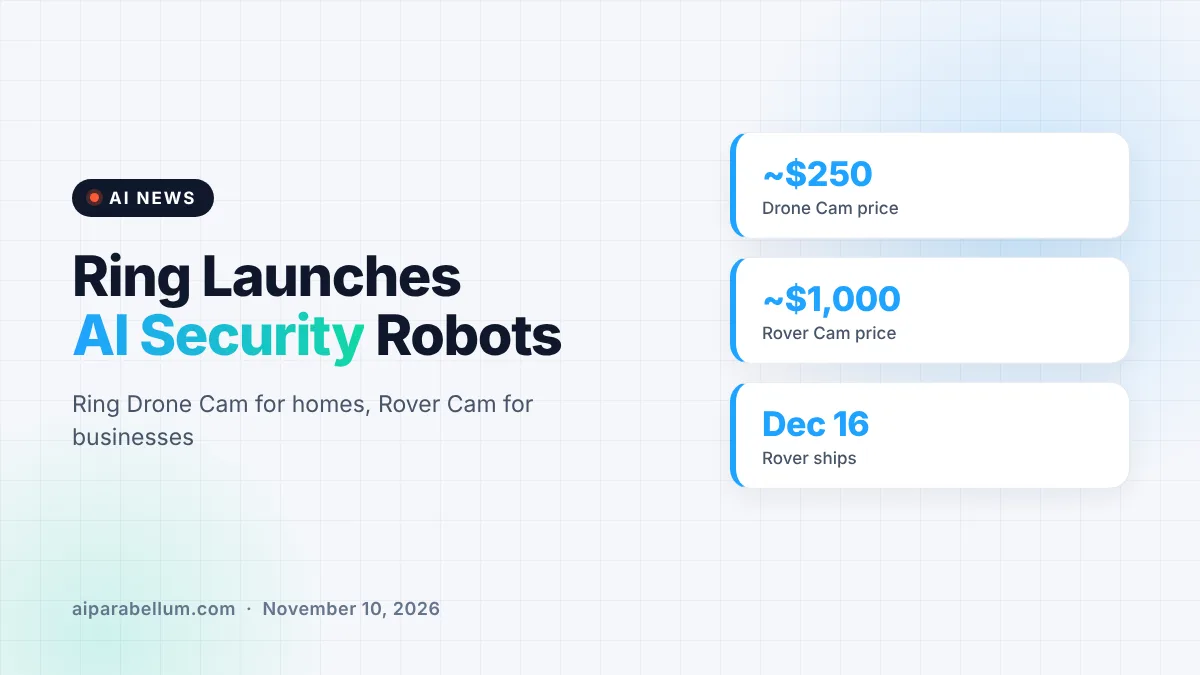
Ring, the Amazon-owned home security brand, just launched Ring Robotics, a new line of self-driving security devices. The first two products are the Ring Drone Cam, a flying indoor camera for your home, and the Ring Rover Cam, a rolling security robot for businesses. Both run on a new AI system called AI Pilot that maps a space and moves through it on its own.
What Ring Robotics Announced
Ring describes the new category as autonomous, mobile security: devices that patrol, investigate and respond without you steering them. Instead of adding more fixed cameras to every corner, the idea is to send one camera to wherever something is happening.
The launch came on Tuesday, November 10, alongside other Ring news such as new 4K cameras and a smart lock. The robots are the headline, though, because they mark Ring’s first real step into home and workplace robotics.
| Device | Who It’s For | Video | Price (approx.) | Ships |
|---|---|---|---|---|
| Ring Drone Cam | Homes | 2K, 148° view, 360° rotation | About $250 | January 27, 2027 |
| Ring Rover Cam | Businesses | Up to 4K, continuous while moving | About $1,000 | December 16, 2026 |
Reports differ slightly on the exact prices, with figures of $249 or $270 for the drone and $999 or $1,000 for the rover, so expect final pricing close to those amounts.
How the Ring Drone Cam Works
The Ring Drone Cam is an indoor drone that lives in a charging dock. You don’t fly it yourself. You set patrol points in the Ring app, like a back door, a window or a busy hallway, and it flies between them on a schedule or whenever you send it.
It also reacts to your other Ring gear. If a Ring camera, sensor or alarm is triggered, the drone can fly to the matching patrol point to check things out and stream what it sees to your phone.
Key Drone Features
- Custom flight routes you can schedule or launch on demand
- Automatic response when another Ring device is triggered
- 2K video with a 148-degree field of view and full 360-degree rotation
- Built-in LED lights for clear video in low light
- Control from the new Alexa Home Map
There are real limits. Early hands-on reports say it can only stay airborne for about five to eight minutes before returning to its dock, and that it’s loud enough for everyone in the house to hear.
Ring Rover Cam Brings Robot Patrols to Businesses
The Ring Rover Cam is a wheeled robot aimed at stores, offices and warehouses. Owners can schedule patrols for after closing or before opening, or tap once in the app to send it to a saved spot, where it does a 360-degree scan.
It streams and records up to 4K video the whole time it moves, not only at its stops. An adjustable periscope camera lets it see over counters and shelves, and a siren, light tower and two-way audio let an owner speak to whoever is on site.
Even while docked, the rover watches for people moving in its view and can start recording and send an alert. Ring says the design grew out of feedback from customers of Amazon Astro, the home robot Amazon later pitched to small businesses before dropping it.
Inside AI Pilot, the Brain Behind the Robots
Both devices share AI Pilot, Ring’s own navigation system. According to Ring, it combines specialized vision models, onboard sensors and cloud processing so the robots can map a space, suggest patrol points and steer around obstacles on their own.
That makes this launch less about hardware and more about applied computer vision in everyday products. It’s the same kind of shift we’re seeing across the AI video security market, where cameras are expected to understand what they see rather than just record it.
Privacy Questions Remain
Ring has faced long-running criticism over how police and others can access footage from its cameras. A camera that roams your home or workplace raises those questions again, and some reviewers expect pushback.
Ring says both robots were built with privacy and security in mind, and that their video is protected by TAKE, which Ring calls its strongest default encryption yet. It isn’t yet clear whether the devices will offer local storage instead of the cloud.
What This Means for You
If you already use Ring cameras, the drone is designed to plug into your existing setup, so you may not need to add fixed cameras to every room. Still, a first-generation flying camera with short flight time is best treated as an experiment, not a full security system.
- Wait for real-world reviews on noise, battery life and reliability before preordering the drone.
- Small business owners can preorder the rover now, but should compare it with fixed cameras plus monitoring.
- Review the privacy, encryption and video-sharing settings if you buy either device.
- Think about pets, guests and roommates before letting a camera patrol shared spaces.
Amazon keeps adding AI features to its devices, from Alexa shopping agents to AI wearable devices. Robots that move around your home are the next step, and the wider race toward home robot plans shows Ring isn’t alone. For more daily updates, browse our latest AI news page or read up on a personal cybersecurity assistant.
Sources
Primary source: Amazon’s Ring Robotics announcement. Additional reporting from TechCrunch and ZDNet.
Conclusion
Ring Robotics turns Ring from a camera maker into a company that sends cameras on patrol. The Ring Drone Cam and Ring Rover Cam both lean on AI Pilot to map spaces and move on their own, with the rover shipping December 16 and the drone following on January 27, 2027. Short flight time, noise and privacy worries are real hurdles. If Ring can solve them, mobile AI security could become a normal part of homes and small businesses.