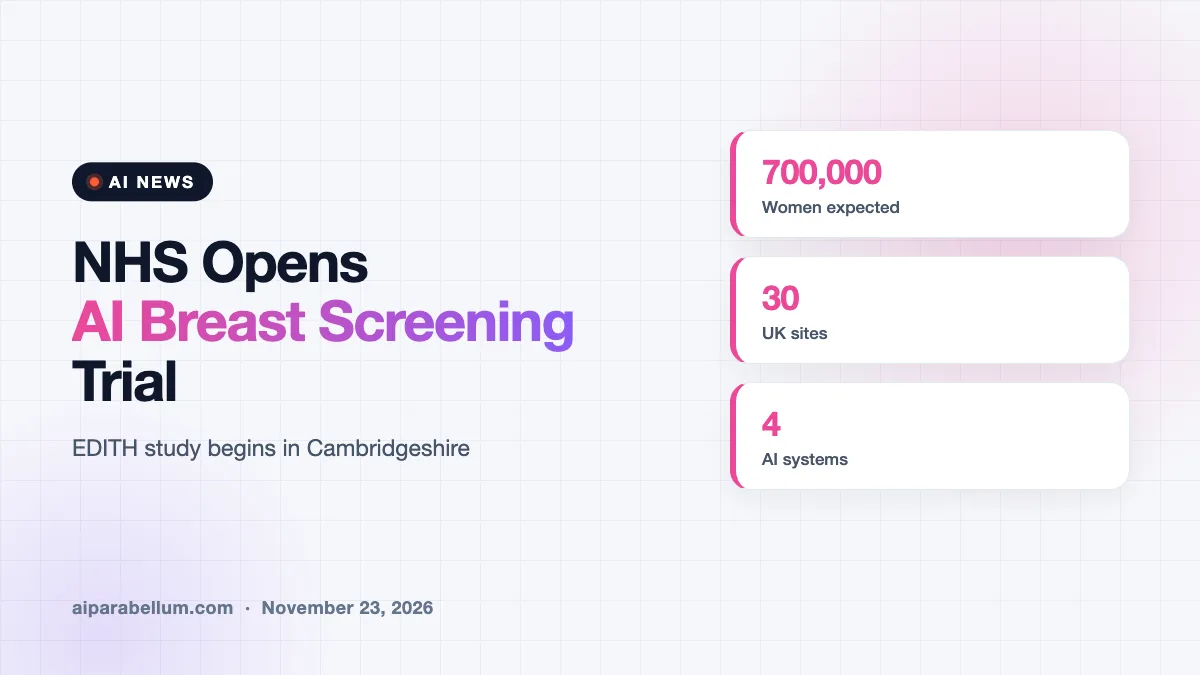
The first women have joined a huge AI breast screening trial in the UK, and nearly 700,000 are expected to take part. The study, called EDITH, will test whether software can safely help specialists read mammograms. It opened in Cambridgeshire and will soon run at 30 screening sites across the country.
The hospital trust that launched it describes EDITH as the largest trial in the world to use an AI-assisted tool in breast cancer screening. If you have ever waited for scan results, the question behind it is easy to understand. Can AI take some of the load off a stretched team without missing cancers or causing false alarms?
How the AI Breast Screening Trial Works
In the UK, women aged 50 to 71 are invited for a mammogram every three years. Today, two specialists review each set of images. That is a lot of expert time, because fewer than 1 in 100 mammograms lead to a cancer diagnosis.
EDITH tests whether an AI tool can do the work of one of those two readers. At least one human radiologist will still review every mammogram. Nothing changes during the appointment itself, since the AI only comes in after the images have been taken.
Two Ways to Use the Software
The trial looks at more than one way of working. In one arm, the AI grades the images before they reach the specialists. In another, it checks the images afterward, according to the BBC.
Four AI systems are part of the study. Sian Taylor-Phillips, a University of Warwick professor who co-leads the trial, said her team has rigorously tested all four for accuracy. She also said every clinical decision stays with NHS staff.
Key Facts About the Breast Screening Trial
| Detail | What we know |
|---|---|
| Women expected to take part | Nearly 700,000 |
| Screening sites | 30 across the UK, starting in Cambridgeshire |
| Length | Around three years |
| Funding | £10 million from the National Institute for Health and Care Research, per the hospital trust |
| AI systems | Four |
| Leaders | University of Warwick, University of Cambridge and Cambridge University Hospitals |
The trial will also use a research platform named AIR-SP. NHS England built it with nearly £6 million of government money to make it easier for hospitals to join AI screening studies.
Why the NHS Wants Help Reading Mammograms
About 2.1 million women in the UK are screened each year, and the program is credited with preventing around 1,300 deaths annually. Demand keeps rising while the number of specialists grows slowly. The Royal College of Radiologists says more than a fifth of the breast radiology workforce is due to retire by 2030.
Freeing up one reader per scan could give radiologists more time with patients who do have cancer. It is the same pressure that has drawn investors toward radiology AI tools for reporting and image review.
Not a Quick Fix
Stephen Harden, president of the Royal College of Radiologists, welcomed the study but warned that it will not solve the immediate staff shortage. Patients, he said, are still facing long waits for scan results. New software can take years to prove, while the gaps in clinics exist today.
The Risk Researchers Are Watching
Smaller studies have already suggested that AI can raise detection rates. Finding more is not always better, though. Taylor-Phillips said the team wants to avoid overdiagnosis, which means picking up mild disease that would never have caused symptoms.
There is also the problem of women being called back for tests they never needed. Those recalls bring worry, extra appointments and cost. A trial this size is meant to show whether the benefits hold up once the tool is used in everyday clinics.
That is a step many health AI products have yet to take. We have seen strong lab-style results before, such as when a diagnosis tool from Microsoft outscored doctors in a peer-reviewed test. Proving that a system works inside a national program, with real patients, is much harder.
What AI Mammogram Reading Means for You
If you live in the UK and are due for screening, details of the trial will come with your invitation letter. If you live in the US, nothing changes for now, but the findings could shape how clinics everywhere use image analysis software. Here is what to keep in mind:
- You can say no. The letter explains how to opt out, and you can still be screened as usual.
- A person stays in charge. At least one radiologist reviews every mammogram in the trial.
- Do not expect instant results. The study is expected to run for around three years.
- Ask questions. Wherever you get scanned, you can ask whether AI helps read your images and who makes the final call.
- Keep your appointments. Trial or no trial, about a third of UK breast cancers are found through routine screening.
Also remember that a tested screening tool is very different from typing symptoms into a chatbot. A recent medical advice lawsuit involving ChatGPT shows why that line matters.
What Happens Next
Invitations will go out from more sites in the coming months. The NHS says it will change how screening works only if the evidence shows AI-assisted reading is as safe and effective as the care women get now. You can follow similar stories in our AI news section.
Sources
Primary source: Cambridge University Hospitals announcement. Additional reporting from BBC News and The Independent.
Conclusion
EDITH will not settle the debate over AI in medicine overnight, but it asks the right question at a scale that is hard to ignore. Nearly 700,000 women, 30 sites and four AI systems should give the NHS a much clearer view of whether one specialist plus software can match two specialists. Until the results arrive, human experts keep the final say, and turning up for a routine mammogram remains the most useful step you can take.