Microsoft AI diagnosis research just hit a major milestone. The company’s Diagnostic Orchestrator, a system of cooperating AI agents, correctly diagnosed far more tough medical cases than human physicians in a study published on October 22 in the journal Science. Microsoft says the tool reached the right answer up to four times more often than doctors, though it has only been tested on past cases so far.
How the Microsoft AI Diagnosis System Works
The Diagnostic Orchestrator is built to act like a small panel of medical experts. Instead of one chatbot giving a single answer, several AI agents work together on each case. They review symptoms and medical history, debate possible explanations, choose which tests to order and then settle on a diagnosis.
That step-by-step process is the key idea. Real doctors rarely see a full case file at once. They ask questions, order tests and narrow things down over time, and the study was designed to copy that flow.
The version tested in the paper runs on OpenAI’s GPT-5. The researchers report that the orchestrated setup beat frontier AI models working on their own. They also say later testing suggests that stronger models do not erase the benefit of having multiple agents cooperate.
The Numbers Behind the Study
Microsoft built its own benchmark for the work, called SDBench, from published medical case reports and emergency department records. The company says it plans to open-source that benchmark so others can test their systems the same way.
| Test set | AI system accuracy | Human physician accuracy |
|---|---|---|
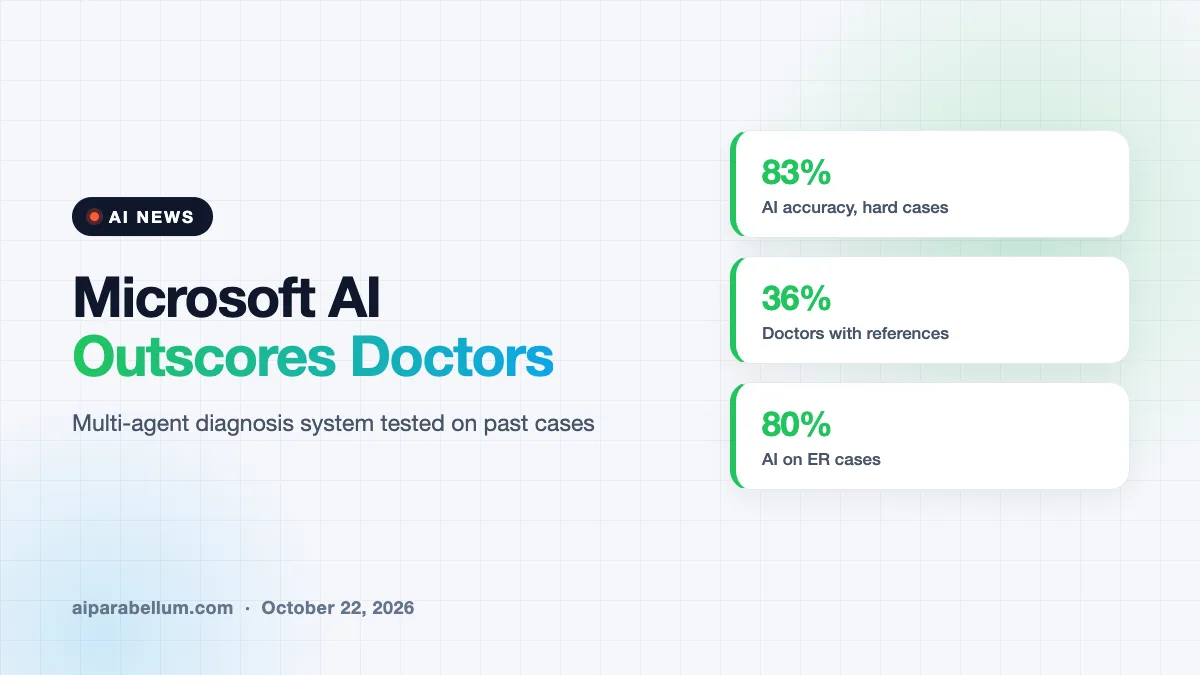
| Hard cases from The New England Journal of Medicine | About 83% | About 36% with references, 22% without |
| Emergency department cases from Beth Israel Deaconess Medical Center | 80% | 47% on average |
The system also tended to reach its diagnoses at a lower estimated cost than the doctors did. That matters because ordering every possible test could inflate accuracy while running up huge bills.
There is one catch worth noting. The peer-reviewed paper does not compare against the newest models released since the work began, such as GPT-6 Astra, Gemini 4 Argon or Anthropic’s Opus 5.5.
Why Doctors Are Not Being Replaced Yet
Every test so far used historical cases, not live patients. Real hospitals are messier, with incomplete records, time pressure and patients who describe symptoms in confusing ways. Microsoft AI CEO Mustafa Suleyman was blunt about this: “It needs clinical validation.”
Here is what still has to happen before the tool reaches a clinic:
- Real-world trials, starting with Beth Israel Deaconess Medical Center in Boston
- Proof that results hold up with live patients and real workflows
- Approval under strict medical regulation and compliance rules
- A clear decision on how and when Microsoft will sell it
Dr. Dominic King, Microsoft’s AI health lead and a coauthor of the study, said hospital testing will likely begin in the next couple of months. Neither he nor Suleyman gave a firm timeline for a wider launch.
A strong score on old case files is a promising start, but medicine judges tools by how they perform with real patients.
Microsoft’s Bigger Push Into Medical AI
This research is part of what Microsoft calls “medical superintelligence,” meaning AI that can outperform the best human-led care systems. In a companion blog post and an upcoming article in the BMJ Digital Health and AI journal, the company lists five other areas AI must master. Those include coordinating care, making treatment decisions and handling the human side of medicine.
The company already has a big footprint in US healthcare through its digital tools. Health questions are also one of the most popular uses of its Copilot assistant, and the firm has been building its own in-house AI models to power more of its products.
Suleyman says human clinicians will keep a central role in patient care. His stated hope is that AI takes over some of the drudgery so doctors can spend more time with patients.
What This Means for You
You can’t use the Diagnostic Orchestrator today, and no release date has been announced. Still, this study hints at where AI health tools are heading. Here are a few practical points to keep in mind:
- Treat chatbot health answers as a starting point, not a diagnosis. Past cases show what can go wrong, like the ChatGPT medical lawsuit we covered recently.
- Watch for hospital pilots. Real-world results will tell you far more than benchmark scores.
- Expect more agent-style tools in care settings, a trend already visible in healthcare AI agents from startups.
- Ask your care team how they use AI. Groups like the AMA have published an agentic AI framework to guide safe use.
If you want to see how AI already helps with specific clinical tasks, our guide on medical image analysis is a good place to start. You can also follow more updates on our AI news page.
Sources
The study, titled “Sequential diagnosis with language models,” appears in the journal Science. Reporting and interviews from The Verge.
Conclusion
Microsoft’s Diagnostic Orchestrator posted impressive results in a peer-reviewed study, beating physicians by a wide margin on difficult past cases while keeping estimated costs lower. The real test comes next, when the system meets live patients in hospital trials. Until those results arrive, the study is best seen as a strong signal of progress rather than proof that AI can safely diagnose people on its own. For now, doctors stay in charge, and AI looks set to become a powerful assistant at their side.