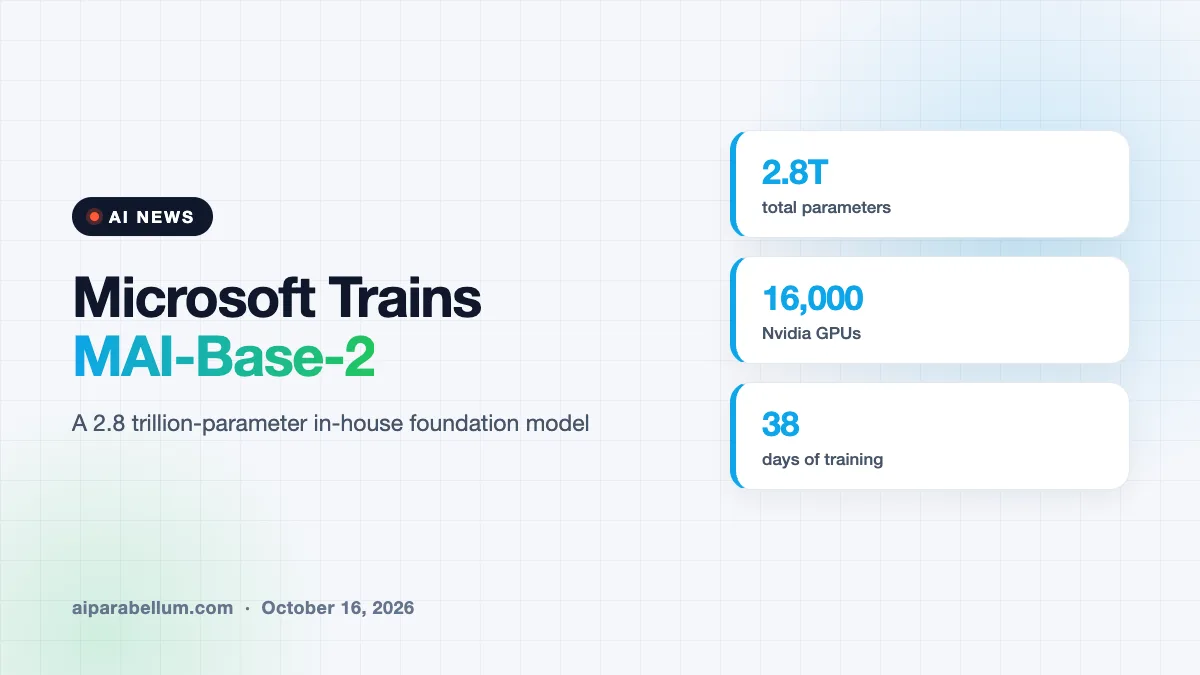
Microsoft has finished pre-training MAI-Base-2, a new in-house AI foundation model with 2.8 trillion total parameters. The company says the model beat every open-weight model it tested and needed far less computing power than a leading rival to get there. It is the clearest sign yet that Microsoft wants frontier AI of its own, not just the models it gets through partners.
What Microsoft Says MAI-Base-2 Can Do
MAI-Base-2 is a base model, which means it is the raw foundation before it learns to follow instructions or chat. Microsoft says it is now in post-training, and more results will come later.
Even at this early stage, Microsoft is making bold claims. It says the model outperformed every open-weight model it compared against, though it has not yet shared a full public report.
Built for Efficiency
The model uses a mixture-of-experts design. Out of 2.8 trillion total parameters, only about 80 billion are active for each task, which keeps it cheaper and faster to run than its size suggests.
Microsoft says its training approach was 4.2 to 12.3 times more compute-efficient than DeepSeek-V4-Pro-Base across four tests. It also says the recipe was 6.3 to 12.7 times more efficient than its own previous model, MAI-Base-1.
How MAI-Base-2 Was Trained
Microsoft trained the model on 16,000 Nvidia GB200 GPUs over 38 days in August and September. The training data held roughly 50 trillion tokens.
| Detail | MAI-Base-2 |
|---|---|
| Total parameters | 2.8 trillion |
| Active parameters | About 80 billion |
| Hardware | 16,000 Nvidia GB200 GPUs |
| Training time | 38 days |
| Training data | About 50 trillion tokens |
| Image share of training mix | 18% |
For the first time, vision was built in from the start, with image material making up 18% of the training mix. Microsoft credits the gains to better data, a better design, and better training systems.
No Copying From Other Models
Microsoft says it trained MAI-Base-2 on original data rather than distilling knowledge from other AI systems. That matters because the company wants to license the model weights to trusted partners through Azure AI Foundry, and clean training data makes that easier.
Why Microsoft Is Building Its Own Models
Microsoft has long relied on OpenAI for its most powerful AI. Its in-house group, Microsoft AI, led by Mustafa Suleyman, went public with a lineup of seven models at Microsoft Build in June 2026.
The first base model, MAI-Base-1, sits under MAI-Thinking-1, Microsoft’s flagship reasoning model. MAI models already power parts of Copilot across Windows and Office.
- MAI-Base-1 arrived in June 2026 as the first in-house foundation model.
- MAI-Base-2 has now finished pre-training and is in post-training.
- Microsoft says work on MAI-Base-3 is already underway.
Hardware is part of the plan too. Microsoft is building out its own Maia chips, including the Maia 300 chip, which could one day carry this kind of training.
What This Means for You
You cannot use MAI-Base-2 yet, and Microsoft has not shared release dates or pricing. Still, the work could shape the AI you meet inside Microsoft products over the next year.
- Expect future versions of Copilot to lean more on Microsoft’s own models.
- If your company uses Azure, watch Azure AI Foundry for licensed MAI models.
- Treat the benchmark claims as company-reported until independent tests appear.
- Keep an eye on the post-trained version, since that is what people will actually use.
The race for big models is crowded this week, with Meta’s Muse Spark Open and Nvidia’s Nemotron open model both landing. Microsoft’s research team also recently shared its weather forecasting tool, and you can follow more stories on our AI news page.
Sources
This article draws on reporting from Investing.com via Yahoo Finance and background from Crypto Briefing.
Conclusion
MAI-Base-2 is a 2.8 trillion-parameter foundation model that Microsoft trained in 38 days on 16,000 Nvidia GPUs. The company claims it beats every open-weight model it tested while using far less computing power than a top rival. It is still in post-training, with no launch date or price yet. The bigger story is Microsoft’s push to own its AI future, with MAI-Base-3 already in the works. For Copilot and Azure users, that could mean more homegrown AI in the tools you use every day.