
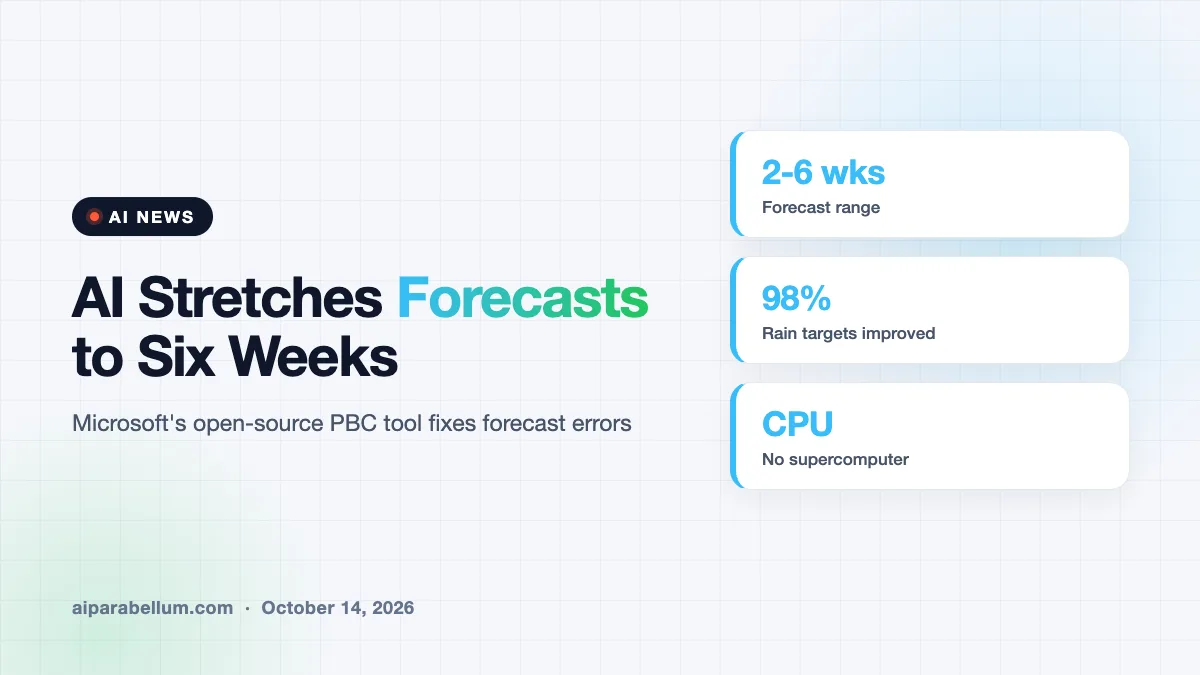
Most weather apps lose their nerve after about ten days, and for good reason. Now Microsoft researchers say AI weather forecasting can push useful outlooks out to two to six weeks, not by building a new model, but by fixing the mistakes that existing models keep making. The method was published in the journal Nature on October 14, and the code is free for anyone to use.
The tool is called Probabilistic Bias Correction, or PBC. It was built by researchers at Microsoft, MIT, the European Centre for Medium-Range Weather Forecasts (ECMWF) and other institutions. And unlike most cutting-edge forecasting systems, it does not need a supercomputer or a rack of GPUs to run.
How This AI Weather Forecasting Tool Works
Forecasts that look two weeks or more ahead fall into what scientists call the subseasonal range. That window is hard because tiny differences in today’s atmosphere can lead to very different weather a month from now. Both physics-based models and newer AI models struggle there.
Part of the problem is built-in bias. Models fill gaps, like regions with few weather stations or processes scientists still do not fully understand, with approximations. Those shortcuts create systematic errors that grow the further out a forecast goes.
PBC acts as a wrapper that sits on top of an existing forecast. It uses machine learning to spot those repeating errors and correct them. One example from the team is climate change itself: a model trained on older records may lean colder than today’s warmer world, and PBC can adjust for that.
Light enough for smaller agencies
Lester Mackey, a senior principal researcher at Microsoft Research New England, says the tool runs on ordinary CPUs. That matters because the compute needed for modern forecasting has kept many weather agencies in developing countries out of the race. The researchers say PBC is easy to train and tune for a specific region.
The Results Behind the Six-Week Forecast Claims
The numbers in the study are striking, though they come from the research team’s own analysis. Here is what they reported when PBC was applied to ECMWF’s systems and tested against real events.
| Test | Reported result with PBC |
|---|---|
| ECMWF physics model, precipitation targets | Improved for 98% |
| ECMWF physics model, temperature targets | Improved for 92% |
| ECMWF physics model, pressure targets | Improved for 91% |
| ECMWF’s AI forecasting system | Subseasonal accuracy doubled |
| Real floods over the past decade | Prediction skill up 76% to 92% |
| Severe floods (100+ deaths or 80,000+ displaced) | Prediction skill up 86% to 150% |
The tool also performed well in competition. In ECMWF’s 2025 real-time forecasting contest, PBC produced the most accurate global forecasts for every weather variable and time period. It beat models from six operational forecasting centers, ECMWF’s own AI model and 34 competing teams.
Extreme weather is the big win
MIT climatologist Judah Cohen, who built PBC with Mackey over more than a decade, called the extreme weather results the most important finding. Earlier bias correction methods actually made extreme event forecasts worse. For three-week forecasts, PBC improved predictions of extreme heat, heavy rain and unusually high pressure.
Where AI Weather Forecasting Goes From Here
Microsoft is far from alone here. Google, Google DeepMind and Nvidia have all built AI forecasting systems, and startups are getting in too, as seen with WindBorne’s Air Force deal earlier this month. What sets PBC apart is that it improves other models instead of replacing them.
Real-world testing has already started. Rhiza Research, a nonprofit led by former Microsoft intern and paper co-author Genevieve Flaspohler, is working with Kenya’s national weather agency with funding from the Gates Foundation. They are testing PBC ahead of a rainy season expected to be more extreme because of a record-breaking El Niño.
ECMWF’s machine learning lead, Matthew Chantry, welcomed the work but added a note of caution. He said turning new ideas into a working operational system is always the hardest step.
What This Means for You
You will not see a six-week forecast in your phone’s weather app tomorrow. But tools like this tend to reach you through the agencies and services that feed those apps. Here is what to watch:
- Better long-range warnings could give cities, utilities and farmers more time to prepare for heat waves, floods and storms.
- Because PBC is open source and cheap to run, smaller countries may get better forecasts without buying a supercomputer.
- Expect weather agencies to test AI add-ons like this before trusting them for official alerts.
- If you follow science and climate tools, our roundup of AI research tools is a good place to explore what is already available.
Takeaway: the smartest move in AI forecasting may not be a bigger model, but a smarter fix for the ones we already trust.
For more coverage like this, browse our AI research section or the latest AI news.
Sources
This article is based on reporting from The Verge and Gizmodo, covering the PBC study published in Nature.
Conclusion
Microsoft’s PBC tool takes a practical approach to one of forecasting’s hardest problems. Instead of competing with existing models, it cleans up their systematic errors and, in the team’s tests, delivers big gains for floods and other extreme events. Its low cost and open-source release could matter most for countries that have been priced out of advanced forecasting. The real test now is whether weather agencies can turn these research results into everyday warnings people rely on.
