
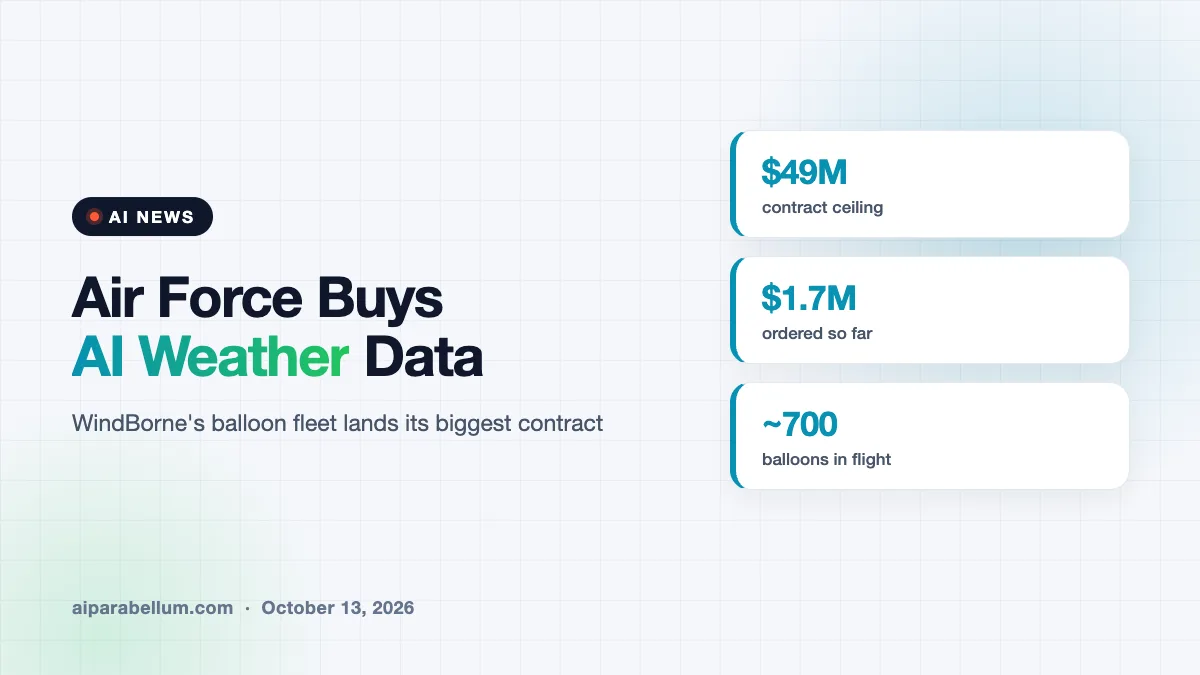
The U.S. Air Force has signed a contract to buy weather data from WindBorne Systems, a startup that flies a global fleet of autonomous balloons and runs its own AI forecasting model. The deal could be worth up to $49 million, making it the largest contract the company has been part of. It is another sign that AI weather forecasting has moved from research labs into real government operations.
Here is what the deal covers, how WindBorne’s system works, and why it matters even if you never think about weather balloons.
What the Air Force Is Buying
The contract is not a single lump-sum payment. The Air Force pays only when it needs data, and it can order readings for specific regions at specific times. So far, it has placed orders worth about $1.7 million, and WindBorne executives expect more to follow.
The award was made without competitive bidding. WindBorne co-founder and CTO Andrey Sushko told TechCrunch the government decided that WindBorne was the only company able to collect global data in the way it needed. He also described the contract as a way to support the growth of the balloon fleet, plus research to improve the hardware.
Key Numbers at a Glance
| Detail | WindBorne Systems |
|---|---|
| Contract ceiling | Up to $49 million |
| Orders placed so far | About $1.7 million |
| Balloons in flight | Roughly 700 worldwide |
| Recent funding | $37 million Series B, announced in August |
| AI model | WeatherMesh 6, released this summer |
| Founded | 2015, based in Redwood City, California |
How WindBorne’s Balloons and AI Work Together
WindBorne’s balloons drift through the atmosphere collecting sensor readings. The company sells that data to customers and also feeds it into its own deep-learning forecasting model. It is one of the first groups to plug real-world measurements straight into an AI weather model.
The balloons have no engines. Instead, WindBorne steers them by changing their altitude to catch winds blowing in the right direction.
- Letting air out to drop lower.
- Dumping sand carried as ballast to rise higher.
- Using wind forecasts to pick which layer of air will carry a balloon where it needs to go.
In August, the company says it became the first to send an unpowered flight system into the eye of a typhoon. Sushko called it one of the first times a deep-learning model was used to make real operational decisions.
Why AI Weather Forecasting Is Taking Off
For decades, forecasters depended on huge supercomputers running physics equations that approximate how the atmosphere behaves. That approach works, but it is slow and expensive. AI models take a different path by learning patterns from decades of past weather data and then producing forecasts much faster.
WindBorne says WeatherMesh 6 beats the physics-based model run by the European Centre for Medium-Range Weather Forecasts, one of the most respected forecasts in the world. That is a company claim, and the field is still uneven. Experts generally see AI and traditional models working side by side rather than one fully replacing the other.
Takeaway: AI is not just writing emails and summarizing meetings. It is quietly becoming part of the systems that decide where planes fly and how the government prepares for storms.
Big tech is in this race too. Google DeepMind’s weather and cyclone tools are playing a growing role in how the U.S. government prepares for hurricane season.
What This Means for You
You probably will not buy balloon data yourself, but this shift will shape the forecasts you check every day. Here is what to watch for.
- Better storm warnings: More real-world data from hard-to-reach places, like the middle of oceans, can sharpen hurricane and typhoon tracking.
- Faster updates: AI models can run in minutes instead of hours, so forecast apps may refresh more often.
- Smarter business planning: Companies in farming, shipping, energy, and retail can tie sharper forecasts into tools for demand forecasting and scheduling.
- Healthy skepticism: Accuracy claims come from the companies making the models, so look for independent comparisons before relying on one source.
If you want to try AI weather tools today, our review of Tomorrow.io AI is a good place to start. Teams that want to turn weather and other data into decisions can also explore data analytics tools built on AI.
What Comes Next for WindBorne
With fresh Series B money and a large government contract, WindBorne plans to keep growing its balloon fleet. Sushko said the two keys to missions like the typhoon flight are good wind models and enough balloons in the right places.
If more Air Force orders arrive as expected, the startup could become a bigger part of how the U.S. military and agencies see the weather. For more stories on AI moving into the real world, browse our AI news hub.
Sources
This report is based on reporting by TechCrunch.
Conclusion
WindBorne’s Air Force contract, worth up to $49 million, shows how quickly AI weather forecasting is becoming part of real government operations. The startup pairs about 700 steerable balloons with its own AI model, which it says outperforms a leading physics-based forecast. Only $1.7 million has been ordered so far, so the full value depends on future demand. For everyday users, the payoff could be faster and more accurate forecasts, especially for big storms. It is a useful reminder that some of the most important AI work happens far from your chat window.
