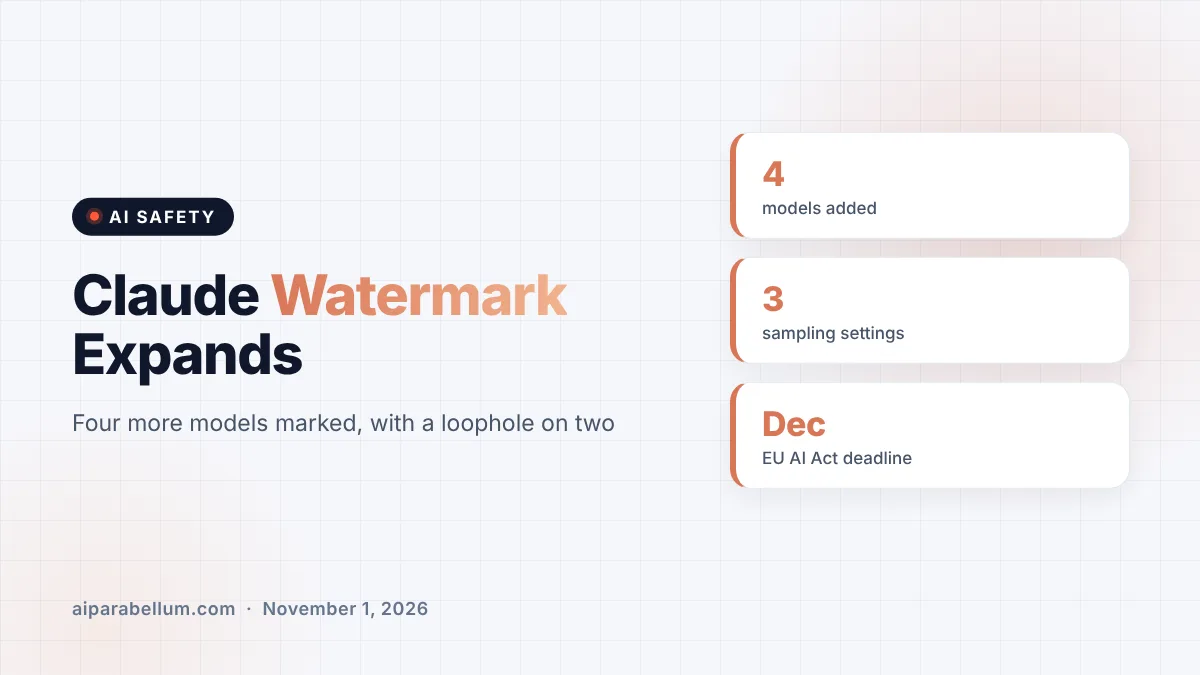
Anthropic is adding its hidden Claude watermark to four more models, including Claude Mythos 5 and Claude Opus 4.7. But on two older models, Opus 4.6 and Sonnet 4.6, developers can skip the mark entirely by changing a single sampling setting. If you build with the Claude API or rely on AI labeling for compliance, this change is worth a close look.
Which Models Get the Claude Watermark Now
According to an email Anthropic sent to API customers, the watermark is coming to Claude Mythos 5, Claude Opus 4.7, Claude Opus 4.6 and Claude Sonnet 4.6. Newer models, such as Claude Opus 5.5, already carry it. The company says the rollout on Amazon Bedrock may take a few extra days.
Anthropic describes the mark as an invisible pattern in word choice. It says the pattern adds no extra characters or tokens, does not change pricing or request formats, and only slightly affects output speed. The company also says the watermark holds no information about the user, their organization or their chats.
| Model | Watermark status | Default-settings caveat |
|---|---|---|
| Claude Opus 5.5 and newer | Already marked | Not mentioned |
| Claude Mythos 5 | Being added now | Not mentioned in the email |
| Claude Opus 4.7 | Being added now | Not mentioned in the email |
| Claude Opus 4.6 | Being added now | Only at default sampling settings |
| Claude Sonnet 4.6 | Being added now | Only at default sampling settings |
The Sampling Loophole on Opus 4.6 and Sonnet 4.6
On the two older models, the mark only applies when three sampling parameters stay at their default values. Those are temperature, top_p and top_k, which control how much randomness the model uses when it picks each word. Change any one of them, even a little, and the output comes back without the watermark.
Anthropic is upfront about this in its note to customers. “If you rely on the watermark for your own compliance, keep these settings at their defaults,” the company wrote. The email does not list the same caveat for Mythos 5 or Opus 4.7, which suggests those two are marked no matter how you set them.
Why the gap matters
A watermark only helps if it is hard to remove by accident or on purpose. On these two models, a routine tweak that many developers already make for creative or varied output will switch the mark off. That means text from Opus 4.6 or Sonnet 4.6 that shows no mark tells you very little about where it came from.
How Claude Watermarking Works Behind the Scenes
Anthropic uses a version of Google DeepMind’s SynthID text method. It nudges the randomness behind word selection so the final text carries a statistical pattern that a detector can spot. Because it is built in at the model level, the mark applies across Claude apps, Claude Code, the API and partner clouds like AWS, Google Cloud and Microsoft Foundry, and customers cannot turn it off.
Text is only half the story. When Claude creates files like PNG or JPEG images, Anthropic attaches signed Content Credentials based on the C2PA standard. Anyone can check those files with the free Claude Content Checker.
Detection for text is more limited. Anthropic’s watermark detector is in private preview and open to groups the EU law names, such as regulators, journalists, fact-checkers, researchers and schools, plus companies that must verify marks for their own compliance.
The EU AI Act Deadline Driving the Rollout
Anthropic has signed the EU AI Act’s Code of Practice on transparency for AI-generated content. Every Claude model launched on or after August 2, 2026 ships with marking from day one. Older models get a transition period, and Anthropic is pointing to the December deadline as the reason it is retrofitting them now.
Other labs are taking different paths. OpenAI launched its own text watermark, called textGrain, in October, but it is on by default only for ChatGPT and Codex users in the EU, and API customers can toggle it. Google has built SynthID into Gemini and open-sourced the text version.
Not everyone is sold on the idea. Some writers argue that picking words by a watermark key instead of the best fit must cost a bit of precision. Legal commentators have also raised concerns for law firms whose clients have banned AI use, since a hidden mark could reveal it later.
What This Means for You
The change touches developers, compliance teams and anyone checking text for AI use. Here is how to respond:
- If you need marked output for compliance, keep temperature, top_p and top_k at their defaults on Opus 4.6 and Sonnet 4.6, or move to a newer model.
- Do not treat a missing mark as proof that a human wrote something. Short, translated or heavily edited text can lose the signal.
- Do not treat a found mark as full proof either. Claude may have only edited or translated text someone else wrote.
- If you use Claude through Bedrock, expect the change a few days later than on Anthropic’s own API.
- Law firms and agencies should check client rules on AI use, since marked drafts may be detectable down the line.
If you are new to the model lineup, our Claude AI guide covers the basics. Anthropic has also been tightening other protections, such as its recent distillation defenses and election safeguards. For a wider view of AI checks, see this AI content detector, and browse more stories on our AI news page.
Takeaway: Anthropic is closing its labeling gaps ahead of the EU deadline, but on two older models the watermark is opt-out by accident, so a clean result proves less than you might think.
Sources
Primary source: Claude Help Center on how Claude marks AI-generated content. Additional reporting on the customer email from The Decoder.
Conclusion
Anthropic is bringing its invisible text watermark to Mythos 5, Opus 4.7, Opus 4.6 and Sonnet 4.6 as the EU AI Act’s December deadline nears. The mark is free, adds no tokens and cannot be disabled, but on Opus 4.6 and Sonnet 4.6 it only works at default sampling settings. If you count on the Claude watermark for compliance, lock those settings or choose a newer model. And whatever side of detection you sit on, treat any result as a signal rather than a verdict.