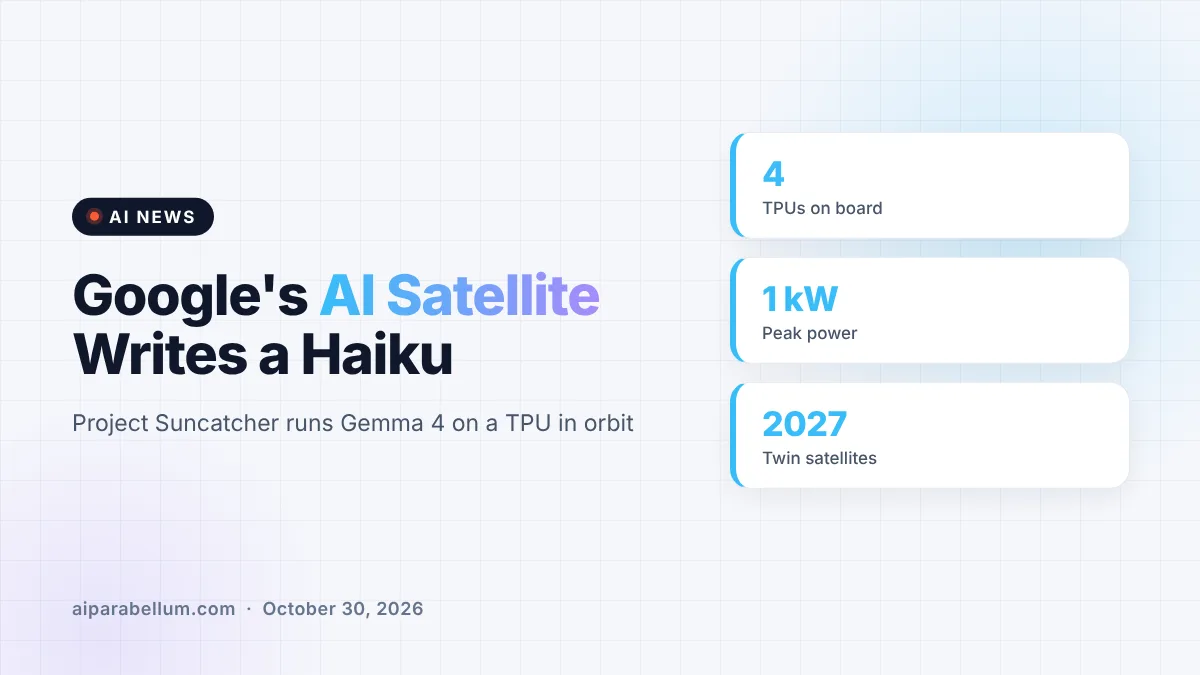
Google says its Project Suncatcher prototype satellite has sent back its first AI-generated answer from space. The onboard Gemma 4 open model, running on a Google Tensor Processing Unit (TPU), wrote a short haiku about life in orbit after engineers beamed up a prompt. It is a small poem, but it is also the first real proof that Google’s data center chips can do AI work above the atmosphere.
What Project Suncatcher Just Achieved
During a pass over a ground station, the Suncatcher team uplinked a prompt asking the model to write a haiku about being in space. When the satellite flew over Svalbard, Norway, the downlinked reply came through: “Blue marble below / Data streams in silent grace / Starlight feeds my core.”
Google called the chips’ arrival in orbit an important early win on a long road. Travis Beals, a senior director on Google’s Paradigms of Intelligence team, wrote that the company’s chips “have officially earned their space wings.”
After the haiku, the team kept going with a few more checks:
- Space-themed limericks to confirm the model kept responding reliably.
- Telemetry prompts that asked the model to report the technical status of the payload systems.
- Confirmation from a Google spokesperson that the satellite is operating normally.
Inside the Suncatcher Prototype Satellite
The prototype rode to orbit earlier this month on a SpaceX Falcon 9, sharing the trip with more than 100 other spacecraft. It carries four TPUs and can generate up to 1 kilowatt of electricity.
That power budget is tight for AI hardware. Only one TPU can run at a time, and only for about 20 minutes per session, which makes timing the conversation with ground stations a real puzzle.
| Detail | What we know |
|---|---|
| AI model on board | Gemma 4 (Google’s open model) |
| Chips | Four Google TPUs, one active at a time |
| Power | Up to 1 kW from solar panels |
| Active run time | About 20 minutes per TPU session |
| First output | A haiku about being in space |
| Next milestone | Two linked satellites in 2027 |
Why Google Wants AI Data Centers in Space
On Earth, AI data centers are running into limits on power, land, and cooling. In orbit, solar panels can soak up sunlight almost constantly, which is the core bet behind Suncatcher. The long-term vision is a network of close-flying satellites packed with TPUs that handle large inference jobs together.
Energy is quickly becoming the biggest constraint in AI. Companies are racing to secure power for new facilities, and some, as we saw in an Anthropic IPO filing, now list data center energy as a business risk. Google is also expanding its ground-based hardware lineup, from new cloud instances to better developer support for PyTorch on TPUs.
Radiation Is the Big Unknown
The next round of tests will look at how the TPUs hold up under thermal stress and space radiation. Radiation can cause “bit flips,” where a stored value in memory changes on its own and quietly corrupts data.
Ground tests in particle accelerators suggested the effect would be small for inference, meaning running a trained model. It looked like a bigger problem for training new models. Now Google gets to measure what actually happens in orbit instead of relying on simulations.
What Comes Next for Project Suncatcher
If the chips perform well, Google plans to launch two more TPU satellites in 2027. Those spacecraft are expected to generate more power and test optical links between satellites, which matter for splitting one big AI workload across several machines.
Google is not alone in chasing orbital computing. Startups such as Starcloud and Cowboy Space expect to run inference on individual satellites, while SpaceX is also working on space-based data centers. Google’s plan stands out because it aims to link satellites tightly enough to share processing.
Cost is the other hurdle. Suncatcher researchers have estimated that SpaceX would need to fly its Starship rocket about 1,800 times to reach the kind of cost drops it saw with earlier rockets. That ties the project closely to SpaceX’s progress, and Google treats Suncatcher as a moonshot aimed at the 2030s.
What This Means for You
Nothing changes in the tools you use today, and Gemma or Gemini models are not suddenly running from space. Still, this milestone hints at where AI infrastructure could head over the next decade.
- If space-based compute works, it could ease the power crunch that drives up AI costs on the ground.
- Open models like Gemma are small enough to test in unusual places, from phones to satellites.
- Watch the 2027 twin-satellite launch; that is when Google tests whether satellites can share AI workloads.
- For more AI infrastructure updates, follow our AI news coverage.
The haiku is a fun headline, but the real story is that a data center class AI chip is working in orbit, and the hard tests on heat and radiation start now.
Sources
Primary source: Google’s Project Suncatcher update. Additional reporting from TechCrunch.
Conclusion
Google’s Project Suncatcher satellite has passed its first real test by running a Gemma 4 model on a TPU in orbit and sending back a haiku. The satellite is healthy, but it can only power one chip for about 20 minutes at a time. The coming months of heat and radiation testing will show whether Google’s chips can do steady AI work in space. If they can, two linked satellites in 2027 will be the next step toward orbital AI data centers.