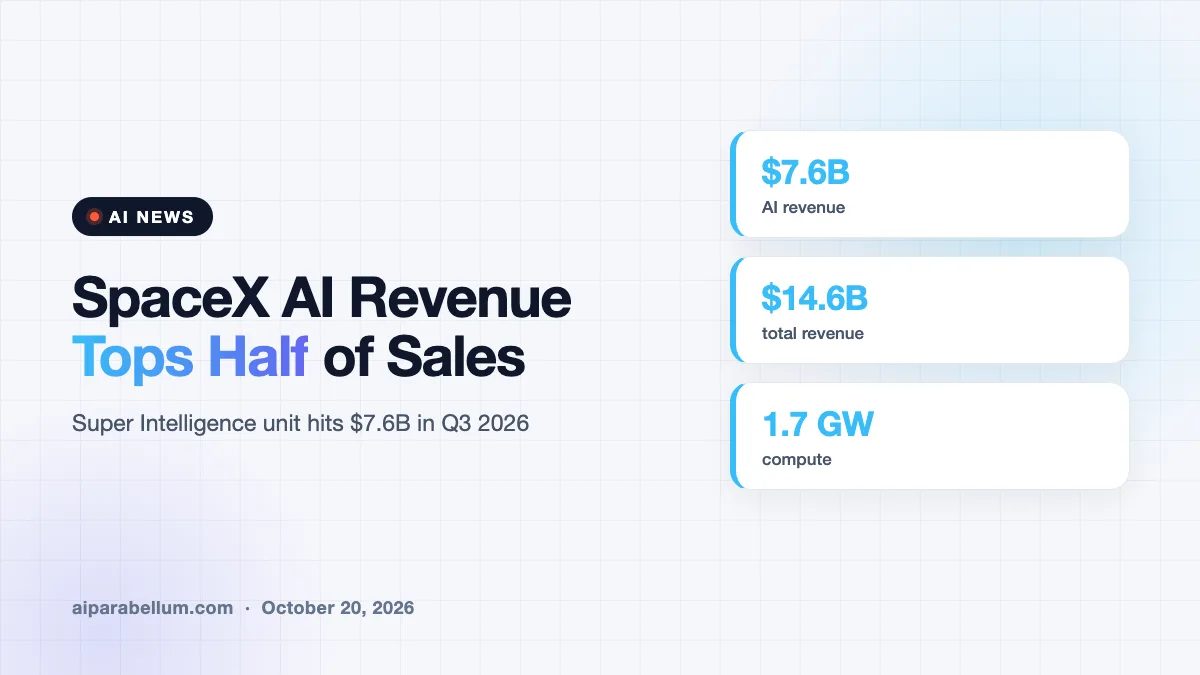
SpaceX AI revenue hit $7.6 billion in the third quarter of 2026, making artificial intelligence more than half of the company’s total sales for the first time. The company reported $14.6 billion in overall revenue on October 20, up 161% from a year earlier. If you use Grok or the Cursor coding tool, this is the business that now pays the bills at Elon Musk’s rocket company.
SpaceX AI Revenue by the Numbers
SpaceX now reports its AI work as a segment called Super Intelligence, or SI. It was previously labeled simply Artificial Intelligence. The renamed unit covers Grok, the Cursor coding app, advertising on X, and a fast-growing business that rents computing power to other companies.
Here is how the quarter breaks down, based on the company’s own earnings update:
| Metric | Q3 2026 | Comparison |
|---|---|---|
| Total revenue | $14.6 billion | Up 161% from $5.6 billion |
| Super Intelligence revenue | $7.6 billion | Up 830% year over year |
| Connectivity (Starlink) revenue | $5.2 billion | Up 69% year over year |
| Space (launch) revenue | $1.8 billion | Up 6% year over year |
| Net income | $4.4 billion | Versus a $1.1 billion loss a year ago |
| Nameplate compute | 1.7 GW | Up from 0.6 GW a year ago |
That AI figure is roughly 52% of the company’s revenue. A year ago, the same segment brought in just $813 million. Analysts surveyed before the report had expected about $6.5 billion from SI, so the unit beat forecasts by a wide margin.
What Drove the AI Surge
SpaceX points to three main reasons for the jump. Each one tells you something about where the company is heading.
- New cloud services deals: SpaceX is leasing data center capacity to outside customers, and several new agreements switched on during the quarter.
- The Cursor acquisition: SpaceX closed its purchase of the AI coding tool on August 14 at an implied equity value of $60 billion. Cursor added $608 million in revenue through September 30.
- More Grok use: the company says enterprise and consumer adoption of Grok grew, and it introduced Grok Bot, which it calls an always-on agentic system.
The compute side is the quiet giant here. SpaceX grew its nameplate capacity to 1.7 gigawatts, up from 1.4 GW at the end of June, as it keeps building the Colossus II data center in Memphis. During the earnings call, Musk said he spends four days a week at that site.
Who Is Renting the Compute
According to Fortune, the leased capacity serves customers that include Anthropic, Google, and Grok itself, along with X. SpaceX signed more cloud agreements during the quarter, which it says grows its pipeline of capacity for third parties.
The Cost of Building SpaceX’s AI Business
All this growth is expensive. Capital spending for the SI segment alone reached $16.4 billion in the quarter, and total capital spending came to about $19.6 billion. Through the first nine months of 2026, the company still posted a net loss of $413 million despite the strong third quarter.
The SI unit made $431 million in operating income for the quarter. That number includes $1.2 billion in stock-based pay tied to the Cursor deal, so the underlying business looks healthier than the headline profit suggests. SpaceX also reported a second-quarter net loss before this rebound, which makes the swing to profit more notable.
The takeaway: SpaceX is now as much an AI cloud company as a rocket company, and it is spending heavily to keep it that way.
Musk was bold about the future on the call. He predicted the company’s annual recurring revenue could land somewhere between $500 billion and $1 trillion by the end of 2027. Treat that as a CEO forecast, not a company guarantee.
What This Means for You
You may never buy a rocket launch, but this report still touches the AI tools you use. Here is what to watch:
- Cursor is now part of a much bigger company. If you rely on the Cursor coding editor, expect closer ties to Grok and the wider Musk ecosystem over time.
- Grok is getting real investment. Products like Grok Voice 3.0 and Grok Bot show the company wants Grok to compete in business settings, not just on X.
- Bundles may keep coming. SpaceX has already tied products together, like the recent X subscription that packs Grok and Cursor into one plan.
- Compute is the new battleground. When even Anthropic rents capacity from SpaceX, it shows how scarce AI computing power has become for every major lab.
If you are a developer, it is a good time to review how you work with Cursor. Our Cursor codebase guide covers the basics. For more updates like this one, check our latest AI news coverage.
Sources
Primary source: SpaceX Reports Third Quarter 2026 Results. Additional reporting from TechCrunch and Fortune.
Conclusion
SpaceX’s third quarter marks a turning point, with AI now bringing in more money than Starlink and launches combined. The Super Intelligence unit grew more than ninefold in a year, powered by cloud deals, Cursor and Grok. The bill is steep, with billions flowing into data centers like Colossus II every quarter. Whether Musk’s huge revenue forecast comes true is an open question. For now, the numbers show that the AI race is reshaping even a company built to go to space.