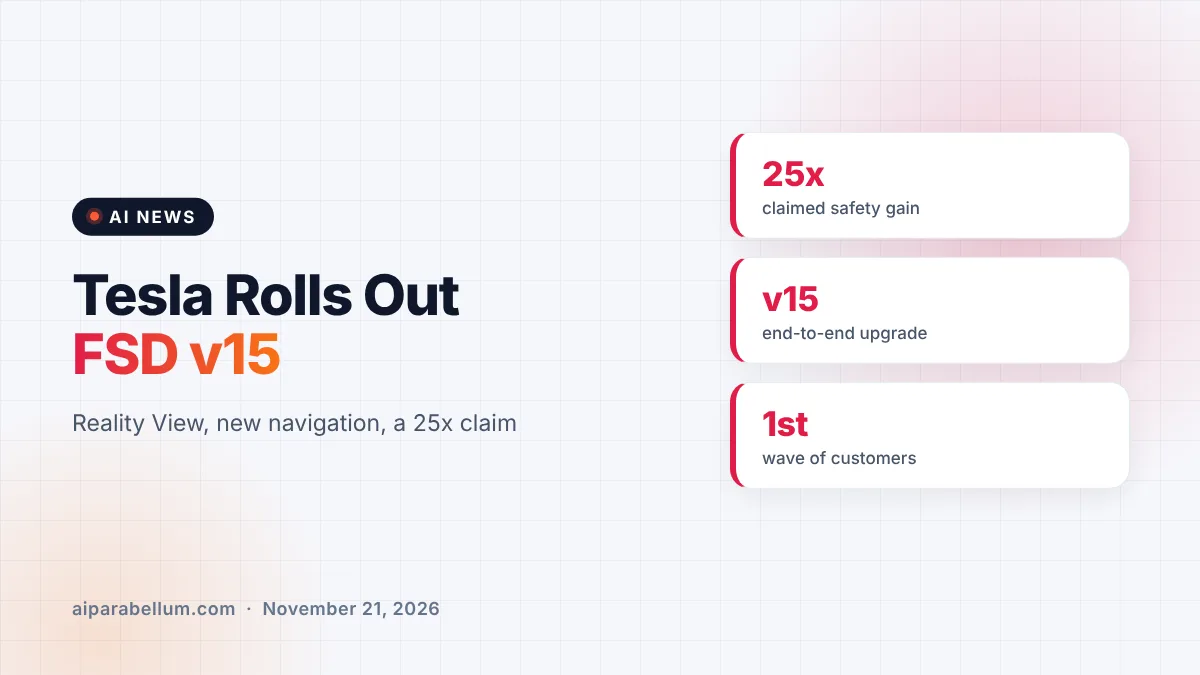
Tesla FSD v15 began reaching its first wave of drivers on November 21, and Tesla says it upgrades every part of its end-to-end driving network. The update adds a new live visualization called Reality View, smarter navigation, and better detection of things like potholes and road signs. Tesla also claims “25x better handling of safety critical cases,” a big number that comes without the data needed to check it.
What Tesla FSD v15 Brings to the Road
Tesla announced the rollout in a post on its official X account. The company framed v15 as a full upgrade to the neural network that handles driving, rather than a small point release. It is still FSD (Supervised), so drivers must stay alert and ready to take over at any time.
Here are the headline changes Tesla listed:
- Reality View, a live visualization that shows what the car sees and what FSD plans to do next
- Navigation that learns from fleet route preferences at the start and end of each trip
- Better detection of signs, animals, debris, potholes and standing water
- More natural speed handling in school zones and bad weather
- The ability to slow down for speed cameras
- A Bike Rack Mode that lets FSD run with a bike rack or similar hitch accessory
Tesla says later v15 releases will expand the learned navigation from trip endpoints to the whole route. The company did not say how many cars are getting the update first or which regions are included.
Reality View Shows What the Car Plans to Do
Reality View is the flashiest part of the update. Instead of the simple lane lines and car outlines drivers see today, it renders a detailed overhead view of the street from a virtual camera above the vehicle. Tesla says drivers can watch and control what FSD is planning, and switch between a full-screen view, the map, or a split layout.
According to release notes from Tesla’s AI team, this view replaces many separate model signals with a single end-to-end visualization that uses less total compute. If it works as promised, it could make supervising the system easier. Drivers would get a clearer sense of why the car is about to turn, slow down or change lanes.
The Vision Model Behind the Update
The release notes credit an upgraded vision encoder that is shared across FSD, Robotaxi and Tesla’s Optimus robot. Tesla says it was trained on millions of internet videos to help the system generalize better. That kind of shared perception model is a growing trend in computer vision work and robotics.
Unpacking the Tesla FSD v15 Safety Claim
The release notes tie the “25x” figure to Tesla’s critical intervention rate, meaning how often a driver has to step in to prevent a problem. That is a useful metric for self-driving progress, but Tesla shared only the multiplier, not the actual rate. Without a baseline, testing conditions or method, the claim cannot be checked independently.
Tesla’s track record adds reason for caution. Earlier major versions brought real gains but also new problems, and some point releases went backward on things the previous version handled well. The release notes also say Tesla is relaxing driver-monitoring strictness in higher-speed driving profiles, while making attention checks work with hats and sunglasses.
| Area | What Tesla says changes in v15 | What is still unknown |
|---|---|---|
| Safety | 25x better critical intervention rate | The underlying rate and how it was measured |
| Visualization | New Reality View with planned path | How much drivers can control from it |
| Navigation | Learned routing at trip start and end | When whole-route learning arrives |
| Rollout | First wave of customers now | Regions, car count and wider schedule |
Why This Update Matters for Self-Driving AI
Many of the listed fixes target long-standing complaints, such as misread speed limits, potholes and school-zone speeds. Regulators have also scrutinized how Tesla’s driving software follows traffic laws. If v15 really improves those areas, it would be one of Tesla’s more meaningful steps in years.
The wider robotaxi race keeps heating up too. Rivals like Waymo face their own limits, as seen when California’s DMV restricted Waymo robotaxis on freeways. Meanwhile, more AI companies are pushing into physical machines, including OpenAI’s humanoid robot plans.
What This Means for You
If you own a Tesla with FSD, here is how to approach v15:
- Do not expect it right away, since Tesla is sending it to a first wave of customers only
- Treat the 25x claim as Tesla’s own number until independent data shows up
- Keep your hands ready and eyes on the road, because this is still supervised driving
- Watch closely in school zones, construction areas and bad weather, where Tesla says behavior changed
If you are just curious about driving AI, Reality View is worth watching as a sign of how cars may explain their decisions in the future. You can follow more updates like this on our AI news page.
Sources
Primary source: Tesla’s FSD v15 announcement. Additional reporting from Electrek and TeslaNorth.
Conclusion
Tesla FSD v15 is a big swing, with a striking new Reality View and fixes aimed at some of the system’s most common weak spots. The 25x safety figure grabs attention, but Tesla has not shared the numbers behind it, so real-world results will matter more than the headline. For now, the update is reaching only a first group of drivers, and it still requires full driver supervision. The next few weeks of owner reports should show whether v15 lives up to the promise.