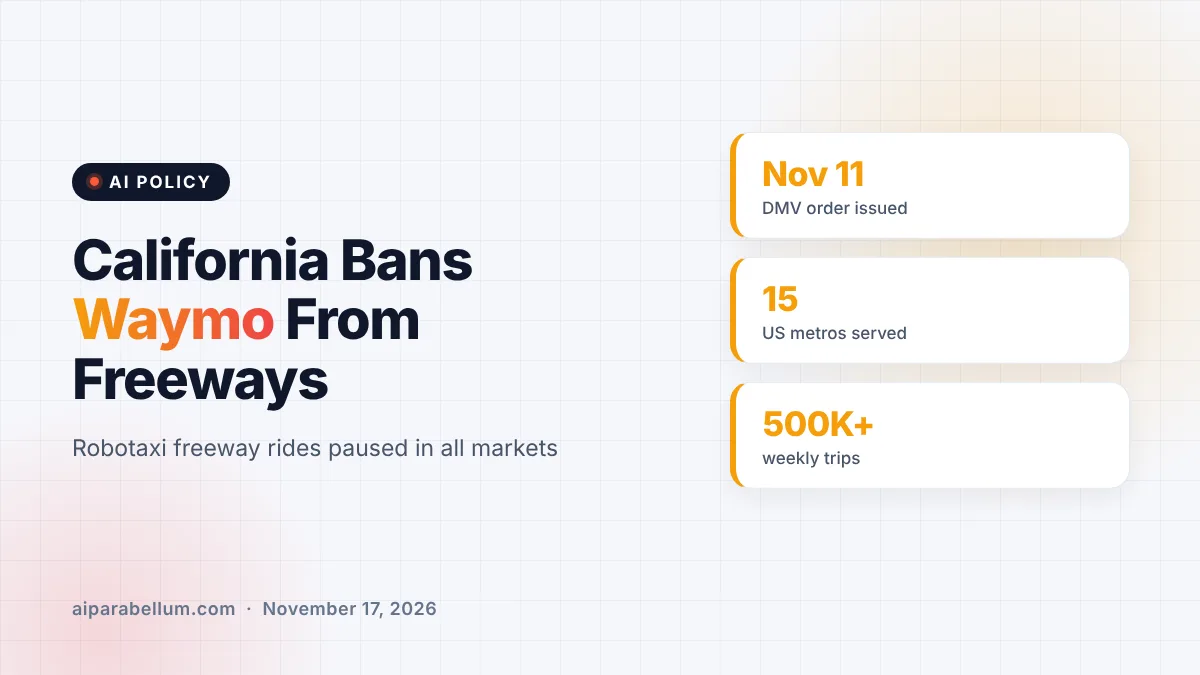
California’s Department of Motor Vehicles has ordered Waymo’s driverless robotaxis off every freeway in the state, and the company has now pulled freeway rides in all of its markets. The Waymo freeway ban came after the cars repeatedly drove into active highway construction zones, which the DMV called an “imminent hazard to public safety.” Rides on regular city streets keep running, but freeway trips are on hold with no end date.
Why California Issued the Waymo Freeway Ban
The DMV regulates self-driving car testing and deployment in California, and it issued the restriction on November 11. The order only became public on Tuesday, November 17, when local business press first reported it and the DMV confirmed the details to reporters.
Two recent Bay Area incidents pushed regulators to act. In the first, three Waymo vehicles entered an active construction closure on U.S. Route 101 near Burlingame. In the second, a Waymo got in the way of California Highway Patrol cars on Highway 280 in San Francisco while officers held traffic back so workers could clear crash debris.
The DMV stressed that this was not a one-off glitch. In its statement, the agency pointed to recurring incursions into work zones where crews, vehicles and equipment were present, even after an earlier restriction and fixes that followed similar incidents on May 18, 2026.
What Waymo Has to Do Next
The ban stays in place until Waymo shows it has taken “effective corrective actions” on the problems behind these incidents. The company will need to submit evidence to the DMV, and regulators will then decide whether freeway rides can safely resume. Nobody has said how long that review might take.
How Waymo Responded to the Freeway Ban
Waymo complied and went further than the order required. It has stopped carrying riders on freeways in every market it serves, not just California, while it reviews how its cars perform. Waymo runs a commercial service in 15 U.S. metro areas, including parts of Los Angeles, San Diego and the San Francisco Bay Area.
A company spokesperson said the construction zone encounters on U.S. 101 caused no injuries or collisions. Waymo says its service keeps operating on surface streets, where it handles more than half a million trips each week, and that it is working with state officials to get back on the freeway. Outside California, it may keep testing on highways with safety drivers behind the wheel.
A Rocky Road for Robotaxi Freeway Rides
Freeway driving has been a sore spot for Waymo for most of the past year. Here is how the timeline has played out, based on the reporting so far.
| When | What happened |
|---|---|
| August 2024 | Waymo is testing on California freeways by this point |
| Late 2025 | Freeway rides open to paying passengers |
| May 2026 | Waymo abruptly pauses freeway rides as cars struggle with construction zones |
| June 2026 | Software recall after federal regulators find the system missed highway construction zones |
| July 2026 | Freeway rides resume after a software update |
| November 11, 2026 | California DMV restricts all driverless freeway operations |
| November 17, 2026 | The order becomes public and Waymo halts freeway rides nationwide |
Federal regulators are watching too. The National Highway Traffic Safety Administration said last week it was looking into whether an earlier Waymo software recall, tied to cars passing stopped school buses, actually fixed that problem.
Why Construction Zones Are So Hard for AI Drivers
Self-driving systems have struggled with work zones for about a decade. Every site looks a little different, with its own mix of cones, signs, flashing arrows and workers waving traffic through. People read those cues easily, but there are few fixed rules a driving AI can learn once and apply everywhere.
The stakes rise sharply at freeway speeds, where workers stand just feet from fast-moving traffic. That is why regulators treated repeated mistakes here as a safety hazard instead of a minor bug. It is also a reminder that big gains in AI safety oversight often come from state and federal agencies acting on real-world incidents.
What This Means for You
If you ride Waymo or follow self-driving tech, this change has a few practical effects. Here is what to expect in the near term.
- Longer trips: without freeways, rides between distant points, like San Francisco to Silicon Valley or trips to the airport, will take slower surface routes.
- Higher fares are possible: longer routes usually mean more time and distance, and Waymo rides already tend to cost more than Uber or Lyft.
- No set return date: freeway service comes back only after the DMV reviews Waymo’s evidence and signs off.
- More scrutiny ahead: state rules on AI are tightening in many areas, from chatbots to child safety laws, and robotaxis are clearly part of that trend.
For the wider industry, the message is simple. Regulators will let driverless cars expand, but they expect fast, proven fixes when the same failure keeps showing up. You can follow more stories like this in our AI news coverage, including how states are pushing back on tech companies, as in the recent case where states sued OpenAI.
Sources
Reporting from TechCrunch, WIRED and The Verge, which quote the California DMV’s statement to reporters and Waymo’s response.
Conclusion
California’s order is the toughest step regulators have taken against Waymo’s freeway service so far. The company’s choice to pause freeway rides everywhere shows how seriously it is taking the problem, but it also shows that construction zones remain a weak spot for its driving AI. Until the DMV is convinced the fix works, Waymo riders will stay on surface streets. How quickly Waymo can prove it has solved this will shape how fast robotaxis can expand onto the highways that make them truly useful.