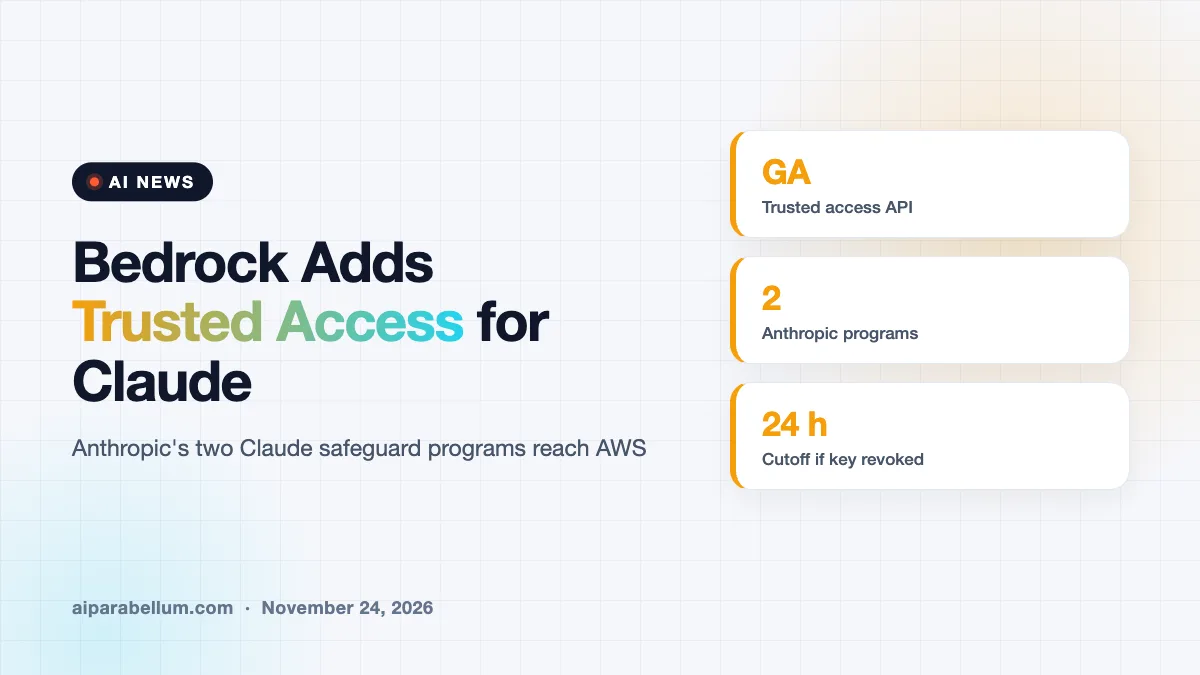
Amazon Bedrock now has a trusted access API that lets companies find, request and join special safety programs run by AI model makers. The first two programs come from Anthropic: Enterprise Frontier Safeguards and a new option called Enterprise Data Controls, both in public preview for Claude’s most capable models. If your team runs Claude on AWS and has strict rules about who can see your data, this is the setup AWS wants you to use.
What the Amazon Bedrock Trusted Access API Does
AWS says the trusted access program API is now generally available. It gives you one place to see which provider programs your account can join, check your status and enroll. Each program comes with its own terms, approvals and settings, but the steps to join look the same for every provider.
The status check returns a simple answer. “Eligible” means you can enroll right away, while “requestable” means you need approval first, and the response explains how to ask for it. The model provider, or AWS acting for that provider, approves eligibility.
Enrolling is a separate step where you accept the provider’s terms. You can enroll a single account, every account in an AWS organization, or one Bedrock project, and you can opt out at any time. Because every step is an API call, admins can control who opts in with the IAM and service control policies they already use.
The First Bedrock Trusted Access Programs Come From Anthropic
AWS and Anthropic built both programs together. They cover Claude Fable, Claude Mythos, and Claude Opus 5.5 and Sonnet 5.5 when used through the Cyber Verification Program. In both, automated safety monitoring looks for risky patterns across many requests and opens a “Safety Case” for your own team to review.
Anthropic first opened Enterprise Frontier Safeguards to a public beta on its own platform, which we covered in our report on the zero retention beta. The Bedrock launch adds the second option and brings both into AWS’s own enrollment flow.
Enterprise Frontier Safeguards
With this option, retained prompts and responses go into an S3 bucket in your own AWS account, encrypted with your own KMS key. AWS says neither AWS nor Anthropic humans read that data, AWS reviewers do not look at it, and it is never used for training. Only automated monitoring inside AWS scans it.
There is one catch worth knowing. If you remove Bedrock’s access to your key or bucket, Bedrock stops serving the covered models 24 hours later. AWS also says EFS was designed with more than 100 customers, including a quarter of the Fortune 100.
Enterprise Data Controls
This is the simpler path. Retained data sits in Amazon-managed storage with AWS-managed keys, so you skip the bucket and key setup. Anthropic still does not keep the prompts and responses, and your team still handles review of anything flagged.
How the Claude Options Compare
Here is a quick look at the main ways to run Claude Fable models on Bedrock, based on AWS’s description.
| Option | Where retained data lives | Who reviews flagged activity | Status |
|---|---|---|---|
| Enterprise Frontier Safeguards | Your own S3 bucket, your KMS key | Your team | Public preview |
| Enterprise Data Controls | Amazon-managed storage, AWS keys | Your team | Public preview |
| aws_review retention mode | Kept by Bedrock for up to 30 days | Reviewed within AWS | Available now |
| Zero data retention | Not retained | Not applicable | Eligible customers, through at least June 30, 2027 |
AWS calls EFS the long-term path once zero data retention ends. It also notes that joining the preview turns off zero data retention for the accounts you add.
Why Anthropic’s Top Models Need This
Frontier labs apply stricter monitoring to their strongest models, and those rules follow the models onto Bedrock. AWS says the monitoring hunts for misuse that only shows up across many requests, such as offensive cyber operations. It also flags agents that go beyond what a user asked for, like using a software exploit to reach an internal system.
That matters as more companies hand real work to agents. We have seen Anthropic lean hard on safety tooling lately, from its election safeguards to its distillation defenses. This launch is the enterprise side of that same push.
What This Means for You
If you only use Claude through the chat apps, nothing changes for you. If your company runs Claude models on AWS, here is what to keep in mind:
- Check your status first with the new list command AWS mentions,
aws bedrock list-trusted-access-programs. - Pick EFS if your policy says retained data must stay in your own bucket under your own key.
- Pick EDC if Amazon-managed storage is acceptable and you want less setup.
- Plan for your own reviewers, since flagged cases land with your team, not with AWS or Anthropic.
- Set up a storage configuration in every region where you call covered models, because each region is configured on its own.
- Talk to your AWS account team to join the preview, which is open to customers already enrolled in EFS zero data retention.
Security teams should also read up on broader AI agent security practices, since the review work now sits with them.
Sources
Primary source: AWS announcement of the Amazon Bedrock trusted access API. Background from Anthropic’s Enterprise Frontier Safeguards article.
Conclusion
The Amazon Bedrock trusted access API gives companies one standard way to join model makers’ safety programs, and Anthropic’s Claude safeguards are the first to use it. Enterprise Frontier Safeguards keeps retained data in your own account, while Enterprise Data Controls trades some control for an easier setup. Both put the review of flagged activity in your team’s hands. For businesses that want Anthropic’s strongest models without giving up control of their data, this is the path AWS is now pointing to. Expect more providers to add their own programs to the same API over time.