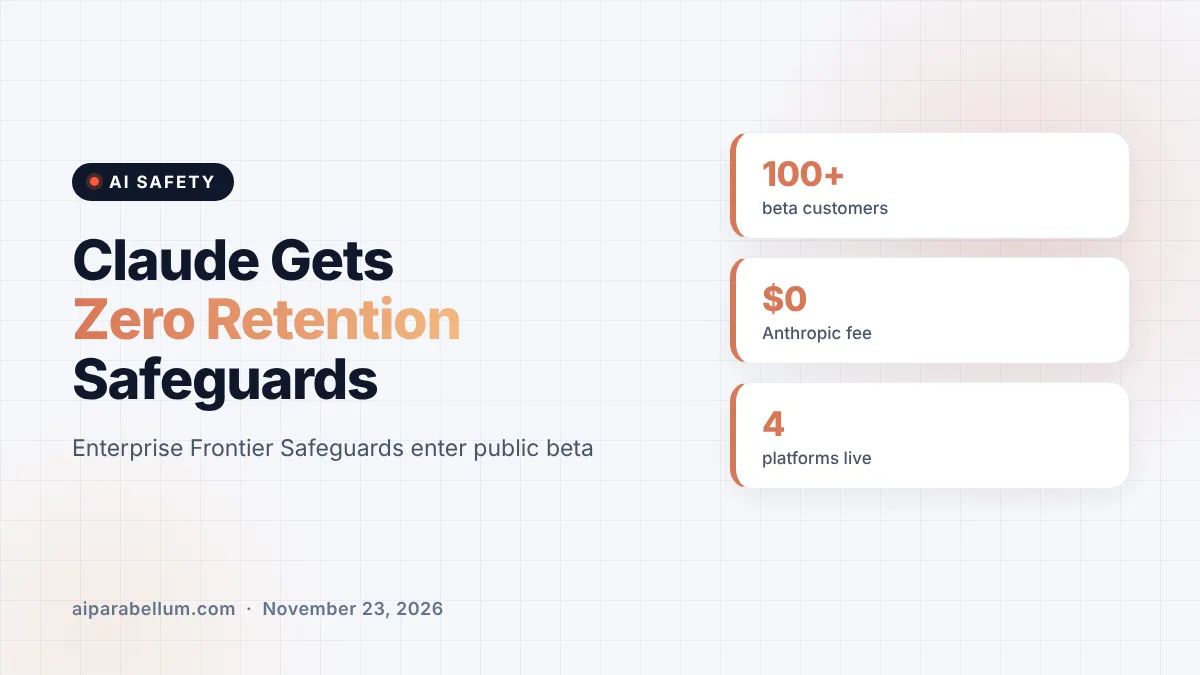
Anthropic has opened Enterprise Frontier Safeguards, or EFS, to a public beta. The program lets businesses use Claude with zero data retention while Anthropic still watches for serious misuse across many requests. Your prompts and responses land in storage your company owns, not on Anthropic’s servers.
The company first announced EFS in September and has spent the months since testing it in a private beta. Anthropic says more than 100 customers took part, including a quarter of the Fortune 100. Bridgewater, Salesforce and Stripe are among the firms named as early testers.
What Enterprise Frontier Safeguards Actually Does
Many companies in healthcare, finance and law cannot let a vendor keep copies of their data. Until now, Claude customers on zero data retention were protected mainly by real-time classifiers that check one request at a time. That works for obvious abuse, but it can miss attacks that are spread across many small, harmless-looking steps.
Anthropic points to a case from its September threat report. An attacker used an AI agent to split a campaign against roughly fifty organizations into many parallel tasks, saving stolen credentials between sessions. Looked at request by request, each step seemed fairly benign.
EFS adds a second layer called automated safety monitoring. It looks for patterns across many requests, but it reads the data from infrastructure the customer controls. When it spots a risk, it creates a Safety Case for the customer’s own team to review.
How Safety Cases Reach Your Team
Safety Cases can be read from your cloud storage or pulled through an API. They can also feed into security information and event management tools. Anthropic says the cases do not include the actual inputs and outputs.
According to the developer docs, Anthropic’s own human review is always off under EFS. People at your organization handle flagged cases instead of reviewers at Anthropic.
Zero Data Retention Promises in Plain Terms
Anthropic lists three main guarantees for the zero data retention setup. Here is what each one means:
- No retained copies: neither Anthropic nor your cloud provider keeps your data after it is written to your own bucket, and you hold the encryption keys.
- No operator human review: staff at Anthropic and your cloud provider do not access your inputs and outputs. Only the automated monitor can.
- No training: the data is used only for safety monitoring, never to train models or classifiers.
The docs add a detail worth knowing. The data in your bucket is stored as “Sealed Safety Data,” encrypted in Anthropic’s format, so even your own team cannot read it directly.
Where Frontier Safeguards Work and What They Cost
EFS is available on several platforms at launch, with one more on the way. Storage runs on Amazon S3 or Google Cloud Storage in your own account, depending on where you use Claude.
| Platform | EFS status | Who operates it |
|---|---|---|
| Claude Platform | Public beta | Anthropic |
| Claude Platform on AWS | Public beta | Anthropic |
| Amazon Bedrock | Public beta | AWS |
| Claude on Google Cloud | Public beta | Google (Google Managed setup) |
| Microsoft Foundry | Coming soon | Not yet available |
Anthropic does not charge for EFS itself. The docs say it does not change model behavior, API pricing or rate limits, but your cloud provider bills you for storage, reads, writes, key operations and any network transfer.
Limits to Watch
On the Claude Platform, EFS applies to a whole workspace, covering every request to every model in it. If you only want it for some traffic, Anthropic suggests using separate workspaces. EFS also does not cover data that platform features store for their own use, such as code execution containers, Files API uploads, Batch API results and Claude Managed Agents sessions.
What This Means for You
If your company has held back on frontier models because of data rules, this beta is aimed squarely at you. It pairs well with other recent moves like self-hosted Managed Agents, which also keep more of the stack inside your walls.
- Check eligibility: Anthropic says eligible customers will be notified with setup steps.
- Plan your storage: you will need your own S3 or Google Cloud Storage bucket and keys.
- Staff the review: your security team, not Anthropic, will act on Safety Cases.
- Separate workspaces: keep EFS traffic apart if only some projects need it.
For a broader look at how the assistant works, see our Claude AI overview. Security teams may also want to read about AI threat detection, since Safety Cases are built to plug into those workflows.
Anthropic has been adding guardrails on several fronts lately, from distillation defenses to new deployment options on Google Cloud. You can follow every update on our AI news page.
Sources
Primary source: Anthropic’s Enterprise Frontier Safeguards announcement. Additional details from Anthropic’s EFS developer documentation.
Conclusion
Enterprise Frontier Safeguards tries to solve a real tension between privacy and safety. Companies get zero data retention and keep their logs under their own keys, while Anthropic’s automated monitor still hunts for multi-step attacks. The public beta is free from Anthropic, though storage costs fall on you. If it works as described, it could open Claude’s top models to many regulated businesses that have been waiting on the sidelines.