OpenAI is adding new ChatGPT teen safety rules that block more weapons-related answers for users under 18, and it is promising a public report on how its violence safeguards perform. The company also says ChatGPT will be able to end chats on its own when someone seems fixated on hurting others. The changes start rolling out over the next few weeks.
The update lands at a tense moment for OpenAI. The company is facing growing pressure from state officials and parents over how its chatbot handles young users and risky conversations.
What OpenAI Announced on Teen Safety
The announcement has two main parts. First, OpenAI is committing to a recurring Community Safety Report focused on violence prevention. Second, it is tightening what ChatGPT will say about weapons, past attacks and violent topics.
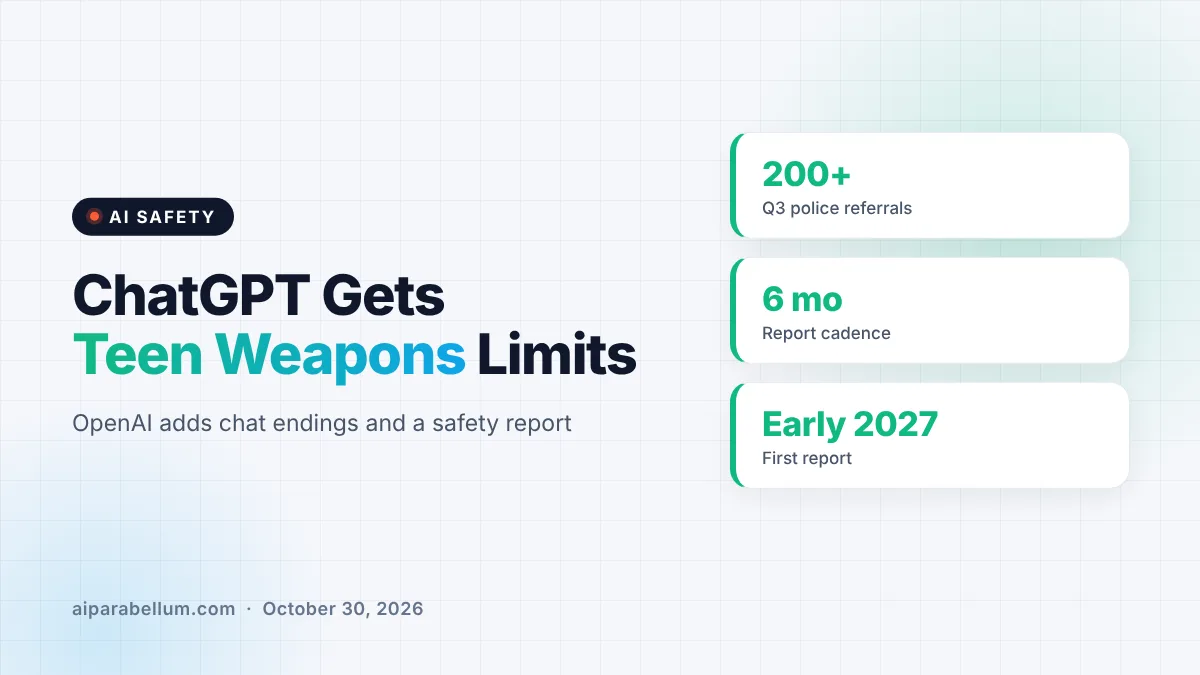
OpenAI also shared one number up front. It says it made more than 200 referrals to law enforcement in the third quarter of 2026 over imminent threats of violence spotted on its platform.
The new Community Safety Report
The first report is due in early 2027 and will cover the second half of 2026. After that, OpenAI says it will publish updates every six months.
According to the company, each report will explain how its systems detect and respond to safety issues. It plans to include anonymized examples of how violence-related harm shows up, new fixes and policy changes, and supporting data.
How the New ChatGPT Teen Protections Work
ChatGPT already blocks help with planning violence and limits teens from finding or getting weapons. The new rules go further, and some of them apply to everyone, not just teens.
| Change | Who it applies to | What it does |
|---|---|---|
| Weapons info limits | Users under 18 | Restricts practical details about weapons and security systems, even for harmless-looking questions |
| Past mass attack limits | All users | Blocks reconstructions of attacks, including weapons used, how they were obtained and scale comparisons |
| Warning-sign context | All users, plus predicted teens | Makes answers more cautious when recent chats show signs of possible violence |
| Automatic chat endings | All users | Ends a chat when someone appears fixated on seriously harming another person |
| Account pauses | All users | May temporarily pause an account after several chats are ended for this reason |
Teens will still be able to use ChatGPT to learn about violence prevention, calm a tense situation, find support or reach a trusted adult. OpenAI says people of any age can also still ask about past events to understand their impact on victims and communities.
Smarter age prediction
OpenAI launched age prediction last year to estimate whether someone is under 18 from signals like behavior patterns. The company says the system now keeps checking new signals during use and can move a person into the teen experience when it fits.
Adults who get placed in the teen experience by mistake can confirm their age through Persona, OpenAI’s age verification partner. Once verified, the extra teen limits are removed.
More alerts for parents
The company’s parental controls already let parents link accounts with their teens and manage safety settings together. Linked accounts can get alerts when trained reviewers spot a serious self-harm concern, and since July, when a teen’s account is deactivated for violating violence rules.
OpenAI says it is now working on a new alert that would tell parents if their teen’s account is paused for repeatedly discussing violence.
Why This ChatGPT Safety Push Matters Now
Chatbot makers are under real pressure to prove their safeguards work. Earlier this month, eight states sued OpenAI over claims that ChatGPT failed to protect young users. New York also recently passed an AI chatbot law aimed at child safety.
A twice-yearly public report could give regulators, parents and researchers something concrete to check. It also echoes a wider industry move toward publishing detailed safety reports instead of just making promises.
Takeaway: OpenAI is shifting from quietly enforcing rules to promising regular public numbers, which means outsiders will soon be able to judge how well these safeguards actually work.
The changes also follow OpenAI’s recent work on its Model Spec rewrite, which sets out how its models are supposed to behave.
What This Means for You
If you or your kids use ChatGPT every day, most chats will feel the same. The biggest changes show up around weapons, violent topics and accounts flagged as belonging to teens.
- Parents: link your account to your teen’s account through parental controls so you can get safety alerts.
- Adults: if ChatGPT starts treating you like a teen, look for the age check through Persona to remove the extra limits.
- Everyone: expect more refusals on detailed questions about past attacks and weapons, even if your reason is innocent.
- Researchers and educators: watch for the first Community Safety Report in early 2027.
Keep in mind that these are OpenAI’s own descriptions of its plans. How well age prediction and automatic chat endings work in practice will only become clear once they roll out and outside groups can test them.
Sources
Primary source: OpenAI’s community safety and teen protections announcement. Additional reporting from Unite.AI.
Conclusion
OpenAI is tightening ChatGPT’s rules on weapons and violence, especially for teens, while adding automatic chat endings and smarter age checks. Its promised Community Safety Report could make the company’s safety work easier to judge from the outside. The real test will be how these tools behave once they reach millions of users in the coming weeks. For more updates like this, follow our latest AI news.