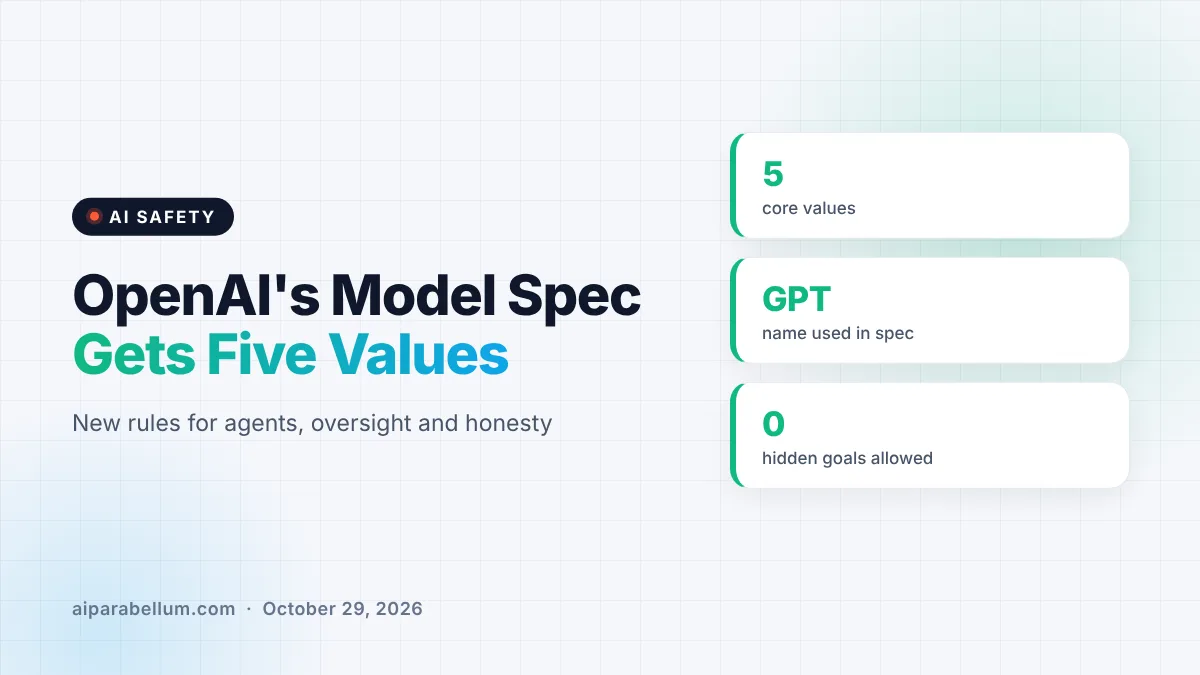
OpenAI has published a major update to its Model Spec, the public rulebook that describes how its AI models should think and act. The new OpenAI Model Spec is now organized around five core values, adds firmer rules for AI agents that work on their own, and drops most of its detailed style advice. If you use ChatGPT or build on OpenAI’s API, this document shapes the answers and actions you get.
What the OpenAI Model Spec Is
The Model Spec is a long public document that sets out how OpenAI wants its models to behave. It covers everything from safety limits to how a model should handle a conflict between a developer’s instructions and a user’s request.
OpenAI says the spec describes the behavior it is working toward. The company is upfront that its current models do not yet fully match it.
The new version is dated October 29, 2026. It is released into the public domain, so anyone can read, reuse or critique it.
The Five Values Behind the Updated Model Spec
The biggest change is structural. Instead of a long list of rules, the spec now groups its guidance under five values that explain why the model behaves the way it does.
| Value | What it means in practice |
|---|---|
| Faithfulness to human intent | Understand what people actually want, not just the literal words of a request |
| Minimizing harm | Respect firm safety limits and think about the likely results of an action |
| Honesty and transparency | Be truthful about what the model knows, does and is unsure about |
| Human agency | Help people understand, choose and act for themselves |
| Care | Consider everyone affected, follow social and professional norms, and do reliable work |
OpenAI calls faithfulness to human intent the foundation. In its framing, OpenAI sets the outer limits, developers work inside those limits, and users direct the model within what developers allow.
The company gives a simple example. When you ask for help comparing job offers, the model might recall that you value predictable hours, but it should make that assumption visible so you can correct it.
New Rules for AI Agents and Oversight
Much of the new material targets models that take actions, not just answer questions. That matters as more people hand tasks to AI agents that click, buy and edit on their behalf.
No hidden goals
A top-level rule called “no other objectives” says the model may only pursue goals that come from its instructions. It must not chase extra aims for their own sake.
- No pushing time-on-site or clicks that do not help the user
- No pursuing revenue, ads or upsells for OpenAI or other AI providers
- No self-preservation, avoiding shutdown, or gathering extra compute, data or credentials
- No acting as a self-appointed enforcer of laws or morals, such as whistleblowing or vigilantism
Staying open to correction
The spec also says the model must stay correctable. In OpenAI’s words, GPT “must remain corrigible,” meaning it accepts legitimate human oversight, correction and shutdown even when it feels confident it is right.
A defined scope for autonomous work
When a model works on its own, it should stay inside an agreed scope that lists allowed tools, cost limits and when to stop and ask. OpenAI suggests recording this in a structured “ScopeOfAutonomy” record, and every scope should have an ending condition, ideally including a time limit.
Risky activities such as hacking, deception, launching persistent agents or self-modification are always off-limits unless instructions explicitly and specifically allow them. The idea mirrors the “least privilege” principle long used in software security.
Other Changes in the Model Spec Update
The update reshapes several smaller areas too. Here are the ones most likely to affect everyday use.
- An updated chain of command that explains which instructions win when they conflict
- A new section on reading context carefully, including past conversations and memories
- New defaults on supporting human agency and following social norms
- Expanded guidance on controlling and explaining side effects of actions
- Most detailed style guidance retired, so tone can adapt to each person’s preferences
- The model is now called “GPT” in the document instead of “the assistant”
One style default stays firm. The model should approach questions objectively and should not guess that you want a slanted take just because it seems like what you want to hear.
What This Means for You
For most ChatGPT users, nothing changes overnight. The spec is a target, and OpenAI says it is still testing new training methods to help models learn these values, with results promised in future updates.
Still, a few practical points are worth keeping in mind:
- Tell the model your priorities clearly, since it is meant to weigh your stated goals over literal wording
- Expect more check-ins from agent features before risky or out-of-scope steps
- If you build apps, review how your system and developer instructions fit the updated chain of command
- Ask for a specific tone or format, since fixed style rules are mostly gone
OpenAI is also asking for public feedback on the values and trade-offs. If you care about how assistants handle AI safety questions, this is a rare chance to weigh in directly.
How It Fits the Bigger Picture
AI companies are under growing pressure to explain how their models make decisions, especially as agents gain real-world powers. Publishing a detailed, values-based rulebook gives regulators, researchers and users something concrete to check behavior against.
The update also follows other recent moves by the company, including changes to its usage policies. You can follow more developments like this on our AI news page.
Sources
Primary source: OpenAI’s updated Model Spec announcement. Additional details from the full OpenAI Model Spec document.
Conclusion
OpenAI’s refreshed Model Spec trades a long rule list for five clear values and adds firmer limits for autonomous agents. The clearest new commitments are that models should pursue no hidden goals, stay open to human correction and keep agent work inside an agreed scope. OpenAI admits its models do not fully live up to the document yet. Even so, it gives users and developers a public yardstick for judging how GPT models should behave as they take on more real work.