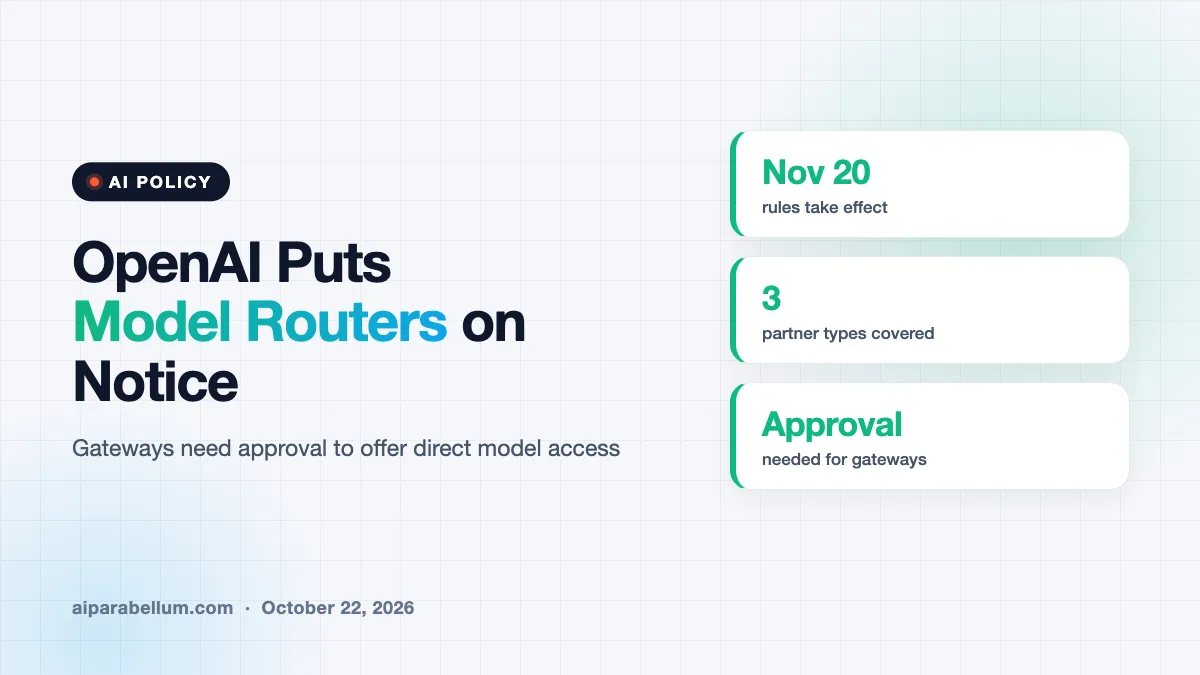
OpenAI is tightening its usage policies so the same safety rules follow its models wherever you use them. From November 20, 2026, services that pass along direct access to OpenAI models, like model routers and AI gateways, will need OpenAI’s review and approval before they can offer that access.
The company framed the change as a way to keep safeguards consistent, whether you call its models through OpenAI itself, a cloud host, or a reseller. For developers who rely on third-party gateways, it could change how and where they get access to the newest models.
What Changes in the OpenAI Usage Policies
OpenAI says it spent the past few months working with customers and partners to line up safety policies across every service that offers its models. The updated rules put that work in writing. Here are the main points the company laid out:
- Partners that provide access to OpenAI models must keep safeguards consistent with OpenAI’s own.
- Those partners must investigate possible violations and take action when they find problems.
- Partners must coordinate with OpenAI on enforcement, so a restriction in one place can’t be dodged somewhere else.
- Model routers and AI gateways that give direct access must be reviewed and approved by OpenAI before offering it.
- The rules apply equally to direct OpenAI access, hosting partners and reseller partners.
OpenAI also says the updated text will clarify rules for safe model development and sensitive uses of AI. The changes take effect November 20, 2026, which gives partners roughly a month to adjust.
Why OpenAI Is Updating Its Usage Policies
The reasoning is simple. Some safeguards live inside the model, like training it to refuse harmful requests, but others depend on the systems around it, such as monitoring for abuse patterns. If a reseller skips those outer layers, a user who got blocked on OpenAI could just switch doors.
OpenAI points to its more capable models, including GPT-6 Astra, as the reason this matters now. It already uses trusted access programs that set eligibility rules for its most powerful features, and it watches for cyber misuse across interactions. The new policy aims to make sure those protections hold up no matter which service you use.
The timing fits a busy stretch for the company. OpenAI recently brought its models to a rival cloud, which we covered in our story on OpenAI Google Cloud, so its models now reach people through more partners than ever.
How Enforcement Will Work
OpenAI says it will base enforcement on documented conduct and risk, apply rules consistently, and respond in proportion to what happened. When it restricts access, it promises to revisit that decision if a customer’s behavior, commitments or safeguards meaningfully change.
The company also notes that misuse can come from a customer’s own end users, hacked accounts or leaked API keys. It says it works with customers to sort out those cases rather than treating every incident as bad intent. A recent API key breach showed how quickly leaked credentials can become a problem.
Who the New OpenAI Rules Affect
| Type of service | What the update means |
|---|---|
| Direct OpenAI customers | Same usage rules, with clearer wording on sensitive uses |
| Hosting partners (clouds) | Must match OpenAI’s safeguards and coordinate enforcement |
| Resellers | Same safeguard and investigation duties as hosts |
| Model routers and AI gateways | Need OpenAI review and approval before offering direct access |
OpenAI also mentioned Private Safety Processing, a program it built with customers and partners. It says the effort shows safeguards can work while giving customers more control over sensitive data.
What This Means for You
If you only use ChatGPT or the OpenAI API directly, not much changes day to day. The bigger impact lands on developers and teams who reach OpenAI models through a third-party service.
- Check whether your gateway or router is approved by OpenAI before November 20, 2026.
- Ask your provider how it handles misuse reports and enforcement requests.
- Keep a fallback plan, such as direct OpenAI access, in case a service loses approval.
- Lock down your API keys, since leaked keys count as a misuse risk OpenAI watches for.
Teams building with AI agent pipelines should pay close attention, since agents often route requests through several services at once.
Takeaway: OpenAI wants one rulebook for its models, no matter whose storefront they are sold through.
Sources
Primary source: OpenAI’s announcement on consistent standards across providers.
Conclusion
OpenAI’s updated usage policies push its safety rules beyond its own platform and onto every service that sells access to its models. The headline change is that model routers and AI gateways will need approval before offering direct access, starting November 20, 2026. OpenAI says the goal is choice with consistent protection, not fewer options, and how strictly it reviews gateways will decide whether developers see this as a fair standard or a new gatekeeper. If you depend on a third-party service, confirm where it stands and follow more updates on our AI news page.