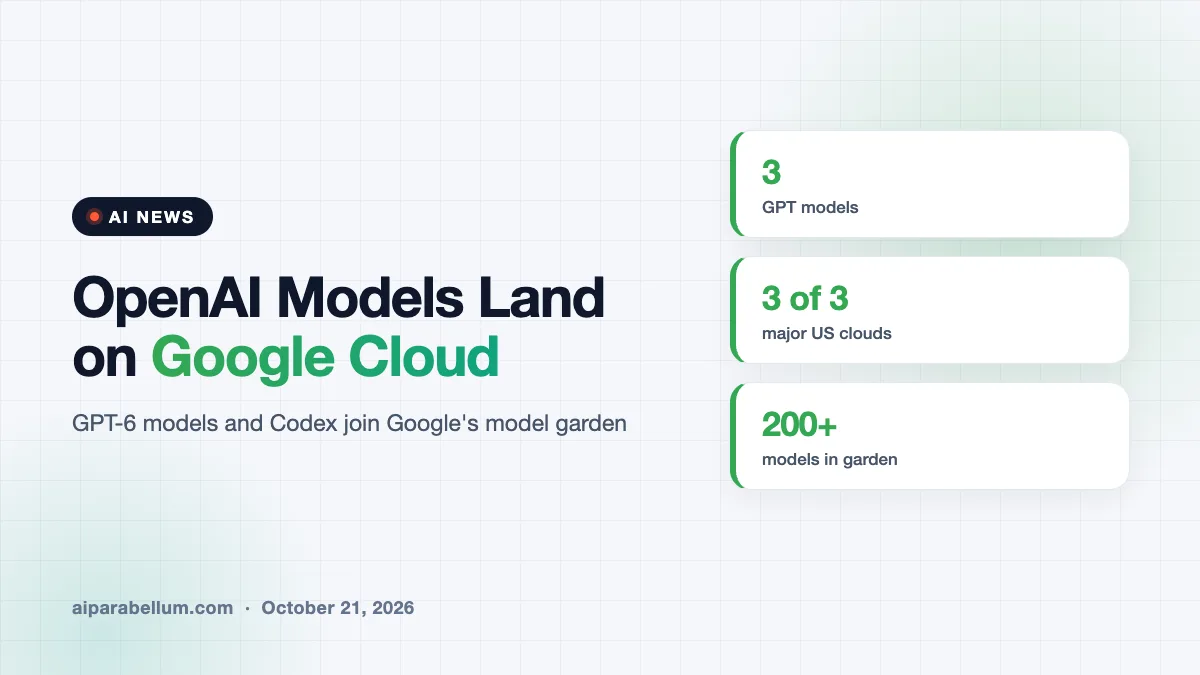
OpenAI models are coming to Google Cloud, a move few people would have predicted a couple of years ago. The two rivals said on October 21 that OpenAI’s newest GPT models and its Codex coding workflows will be sold through Google Cloud’s model garden. That means OpenAI’s technology now reaches business customers on all three of the biggest US cloud platforms.
What the OpenAI and Google Cloud Deal Includes
Google says three OpenAI models are rolling out now in private preview to select enterprise customers. OpenAI says general availability is planned in the coming weeks. Businesses that want in early have to request access first.
Here is the lineup Google listed for its model garden:
| Model | What Google says it is for |
|---|---|
| GPT-6 Astra | Demanding work in coding, computer use, professional tasks and science |
| GPT-6.1 Sol | Near-Astra smarts at a lower cost for agentic coding and office work |
| GPT-6 Luna | A fast, cheaper model for everyday tasks at scale |
Starting today, Google says developers can also point their local Codex CLI and Codex Desktop setups at its Gemini platform for inference. OpenAI models are also headed to Google Antigravity and to Google’s Gemini tools for business. Neither company gave an exact date for those two.
One bill, existing budgets
The money side may matter as much as the models. Purchases run through Google Cloud Marketplace, so OpenAI usage shows up on a single Google Cloud invoice. Companies with spending commitments on Google Cloud can draw those down to pay for OpenAI models, and Google says the usage also counts toward its Flexible Savings Plans.
Why OpenAI Is Expanding Beyond Microsoft
For years, Microsoft was the only big cloud that could host OpenAI’s models. That exclusive license ended less than six months ago, and Amazon announced plans to host OpenAI models the very next day. Google is now the third giant to join.
OpenAI was careful to add that Microsoft remains its primary cloud partner. Still, the direction is clear. The ChatGPT maker wants its models wherever enterprise developers already work, as it pushes to grow its business side beyond consumer subscriptions.
The two companies are not strangers, either. Last year, OpenAI said it was using Google’s cloud capacity to help run ChatGPT and its API. This deal goes further, putting OpenAI’s models on Google’s shelf next to Google’s own Gemini family, including the recent Gemini 4 Argon model.
What Google Cloud Gets From Hosting a Rival
Google says it is now the only hyperscale cloud offering all three leading closed-source model families, alongside more than 200 first-party, third-party and open models. That pitch is simple: pick the right model for each job without signing separate vendor contracts. Claude models from Anthropic are already on the platform too.
The timing fits a strong year for Google’s cloud unit. Its annualized revenue growth sped up to about 82% in the second quarter, compared with 37% at Amazon and 42% at Microsoft over the same stretch. All three report quarterly results next week, so expect this deal to come up on earnings calls.
The real news is not that rivals shook hands. It is that model choice is becoming a cloud feature, not a vendor decision.
Security Promises for Enterprise Teams
Regulated companies tend to worry most about where their data goes. Google made several specific promises about how OpenAI workloads will be handled:
- Prompts, context and outputs stay inside the customer’s data perimeter and are not used to train foundation models.
- OpenAI models run on dedicated Google Cloud infrastructure, with queries sent through isolated gateways.
- Each agent and model call runs under an authenticated identity, with VPC Service Controls and unified audit logs.
- Zero Data Retention options and Confidential Compute are listed as coming soon, not available yet.
Those last two items are worth watching if your security team requires them before any rollout. Strong agent governance tools are quickly becoming a buying requirement, not a bonus.
What This Means for You
If you are an everyday ChatGPT user, nothing changes in the app you already use. This deal is aimed at businesses and developers who build on cloud platforms. The effects will show up in the tools your company buys and builds.
If your team already runs on Google Cloud, here is what to do next:
- Ask your cloud admin whether your account qualifies for the private preview.
- Check whether existing Google Cloud commitments can cover OpenAI usage before you sign anything new.
- Test the same task on GPT-6 Luna, GPT-6.1 Sol and a Gemini model to compare cost and quality.
- Wait for Zero Data Retention if your policies require it for sensitive data.
Developers who use Codex can try routing it through Google’s platform now. If you are still learning how AI agents work in business settings, this is a good moment to start testing several models side by side.
Sources
Primary source: OpenAI’s Google Cloud announcement. Additional details from Google Cloud’s blog and reporting from CNBC.
Conclusion
OpenAI’s arrival on Google Cloud completes its spread across all three major US clouds, just months after Microsoft’s exclusive hold ended. For Google, it strengthens a pitch built on model choice, with GPT, Gemini and Claude under one roof and one invoice. The models are in private preview for now, with wider access promised in the coming weeks. Some key security features are still marked as coming soon. If your company lives on Google Cloud, this is the moment to start comparing models on your own real work.