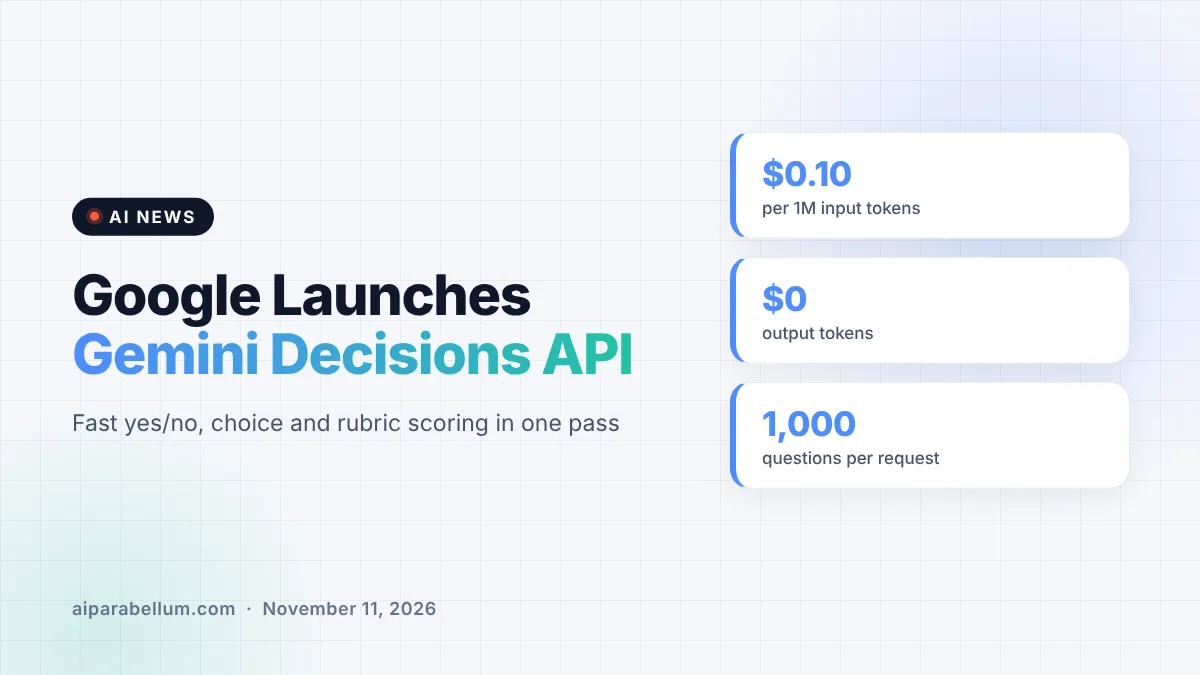
Google has launched the Gemini Decisions API, a new developer endpoint built for quick yes/no, multiple-choice and scoring decisions instead of long written answers. It runs on a new model called Gemini Decision 1, costs $0.10 per million input tokens and charges nothing for output, and it is available today through the Gemini API in Google AI Studio.
The idea is simple. A lot of AI work inside apps is not about writing paragraphs but about picking an option, like which tool to call, whether a post breaks a rule, or which model should handle a question. Google built this API to do that one job very fast.
What the Gemini Decisions API Does
You send the API one shared input plus a list of questions about it. The input can mix text, images, audio, video and PDFs, up to 256K tokens, and you can ask up to 1,000 separate questions in a single request.
Instead of writing out an answer word by word, Gemini Decision 1 scores the possible options in one pass through the model. It returns a probability for each option and a confidence score from 0 to 1, so your code can decide what to do when the model is unsure.
Three kinds of questions
Google says the API supports three question types, and you can mix them in the same request:
- Yes/no checks that estimate how likely a condition is to be true.
- Multiple choice with anywhere from 2 to 255 options, returning the winner and a probability for every option.
- Rubric scoring that grades an input on an ordered scale and returns a weighted score.
For example, you could pair a scanned insurance claim with damage photos and ask, in one call, whether the claim is complete, which category it fits and how severe the damage looks.
Gemini Decision 1 Speed and Pricing
Speed is the main pitch. Google says the model needs about 50 to 100 milliseconds of compute, or 150 to 250 milliseconds end to end, and that latency stays nearly flat whether you ask 1 question or 100 (Google measured this on inputs up to 16K tokens).
The pricing is also unusual. Because the model does not write text, there are no output-token charges, no surprise thinking-token bills and no separate fees for audio transcription or OCR. Your shared input is billed once per request, and each extra question only adds its own short instruction tokens.
| Detail | Gemini Decisions API |
|---|---|
| Model | Gemini Decision 1 (gemini-decision-1) |
| Input price | $0.10 per 1M tokens |
| Output price | $0 |
| Max input | 256K tokens, multimodal |
| Questions per request | Up to 1,000 |
| End-to-end latency | 150-250 ms (Google’s figure) |
| Free option | No-cost tier in Google AI Studio for prototyping |
Google claims that across its shared benchmark suite, the new setup is nearly 5x cheaper than running Gemini 3.5 Flash-Lite through its regular Interactions API. The company also says Gemini Decision 1 leads its benchmarks for agent routing, reasoning, ranking and multimodal understanding, with the lowest calibration error, though those are Google’s own tests.
How Google Uses the Decisions API Today
Google says several of its own products already run on the Decisions API. These examples show the kind of jobs it is meant for:
- Gemini Notebook uses it as a router that sends each query to the right model and thinking level, which Google says cuts latency for everyday questions by up to 40%.
- A new rapid canvas experiment in Stitch uses it to build playable wireframes of an app flow in seconds and apply voice or tap edits almost instantly.
- CC from Google Labs uses it to pick the right emoji reaction from more than 200 options without a noticeable delay.
- Google Search uses it as a safety layer to catch adversarial behavior around MCP tools.
That routing use case matters for anyone building AI agent workflows. Picking the right tool or model quickly, and cheaply, is one of the biggest costs in an agent system.
A Growing Race for Decision Models
Google is not alone here. OpenAI recently opened its own fast Decisions API to every developer, so this launch puts the two companies head to head on a new kind of product. Both bets rest on the same idea: many app features need a fast, calibrated choice more than a chatty answer.
The launch also follows a busy month for Google’s developer tools, including the wider release of Gemini 4 Carbon and new AI Studio tools for building apps. Google says Decisions API support is rolling out across OpenRouter, LangChain, Vercel, LiteLLM, Pydantic AI, Pipecat, LiveKit and OpenCode, with support for Gemini in Google Cloud coming soon.
What This Means for You
If you build apps or agents, this could lower both your bill and your wait times. Here are some practical takeaways:
- Use it for sorting jobs like content moderation, ticket triage, model routing and form checks, not for writing replies.
- Use the confidence scores to send unclear cases to a human or a bigger model.
- Bundle many questions about the same input into one request, since the shared input is billed only once.
- Test it on the free tier in AI Studio and compare it against your current classifier before switching.
- Treat the speed and benchmark numbers as Google’s claims until you measure them on your own data.
For everyday users, the change will mostly be invisible. But faster routing behind the scenes can make AI products feel snappier, as Google says it already does in Gemini Notebook.
Sources
Primary source: Google’s Gemini Decisions API announcement.
Conclusion
The Gemini Decisions API gives developers a cheap, fast way to make bounded choices across text, images, audio, video and PDFs without paying for generated text. With zero output-token charges, up to 1,000 questions per call and built-in confidence scores, it targets the routing and checking work that sits inside most AI apps. It also sets up a direct contest with OpenAI’s similar API. The real test will be whether Google’s speed and accuracy claims hold up once developers try it on their own workloads.