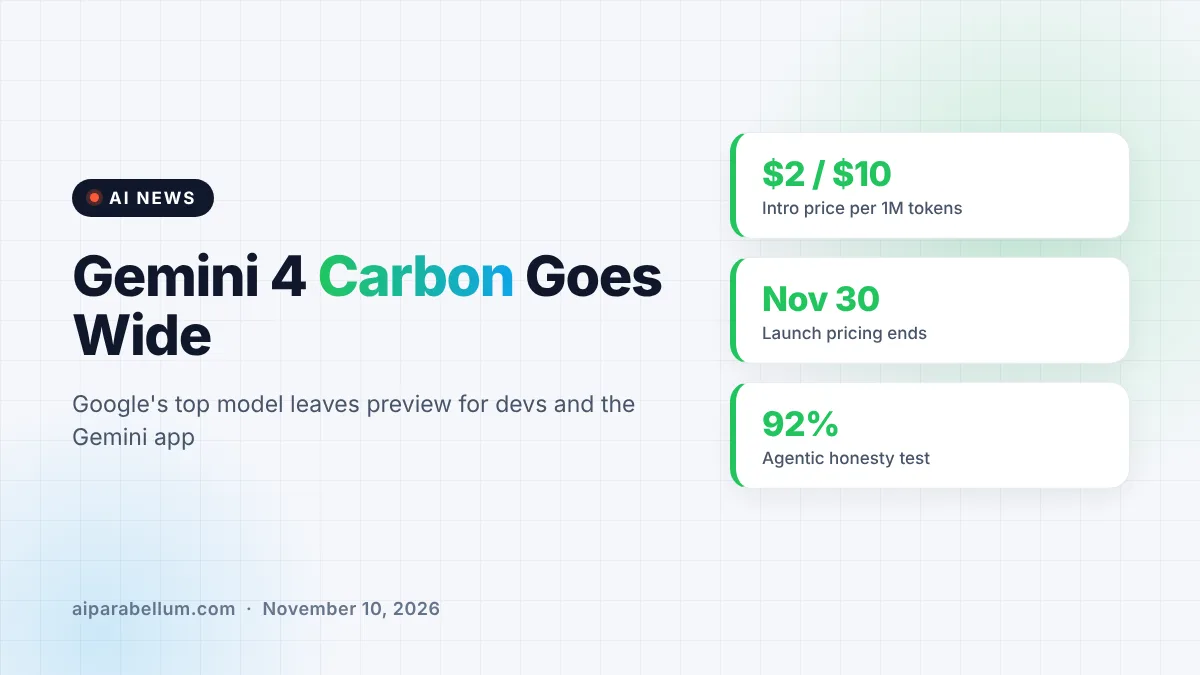
Google has opened up Gemini 4 Carbon, its most capable frontier model, to developers, enterprises, scientists and consumers. Two weeks after a limited release to cybersecurity defenders, Gemini 4 Carbon now joins Gemini 4 Argon across Google’s products, with an introductory API price that doubles after November 30.
Gemini 4 Carbon Moves From Preview to Wide Release
Carbon first arrived in late October, but only for a small group of security teams in Google’s Fairwind Program. That early rollout focused on finding and fixing software vulnerabilities. Now the model is available far more broadly, from the API and Gemini for business to Google’s coding tools.
Google is clear that Carbon is not meant to replace Argon for everyday work. The company says Argon remains the best fit for most software engineering and knowledge work. Carbon is built for the hardest jobs, like complex multi-step coding, long debugging sessions and open-ended scientific research.
The trade-off is effort. Google says Carbon uses more tokens than Argon so it can explore more, reason more deeply and run longer checking loops before it answers.
Where you can use it
- Developers and enterprises: Gemini for business through the API or the model picker, plus Google Antigravity and the CodeMender security agent.
- Gemini app users: the model is rolling out in the consumer app, starting with Google’s top AI Ultra plan, according to 9to5Google.
- Scientists: researchers can apply for free access to both Argon and Carbon in Antigravity’s highest usage tier for six months.
- Security defenders: the special Carbon for cyber version stays behind the Fairwind Program application process.
Gemini 4 Carbon Pricing and Key Numbers
Google is starting with a launch discount for API users. The table below pulls together the main figures Google shared today.
| Item | Detail |
|---|---|
| Intro API price (until Nov. 30) | $2 per 1M input tokens, $10 per 1M output tokens |
| Standard API price (after Nov. 30) | $4 per 1M input tokens, $20 per 1M output tokens |
| Agentic honesty test | 92% of 375 tasks passed, vs. 70% for Argon |
| Cyberattack breach rate per attempt | 0.8%, down from 3.1% on Argon |
| Free science access | Up to 10,000 scientists, six months |
Google also says Carbon ranks first on several outside agent benchmarks, including CursorBench 4.0 and Zapier’s AutomationBench, at less than half the cost per task of the next best outside model. These are Google’s own claims, so treat them as a starting point until independent testers weigh in.
New /swarm Agents in Google Antigravity
Alongside the release, Google is previewing a feature called /swarm in its Antigravity coding platform. It turns a single prompt into a team of coordinated AI agents that you can watch work in real time.
The idea is to give Carbon the roles that need the deepest thinking, like system design, coordination and review. Faster, lighter models handle the rest in separate workspaces, while “adversarial verifiers” test every change before it lands.
Google showed off demos built this way, including 3D web apps and a playable reconstruction of an 18th-century piano. It also says Carbon checks both its code and the rendered interface when building web apps, which should mean fewer broken results.
Security and Science Results
Cybersecurity was Carbon’s headline skill at launch, and Google shared new examples today. The company says Carbon helped its cloud research team prove two bugs in popular open-source software were truly exploitable, which led maintainers to treat them as critical and ship a fix.
Google also points to its AlphaProof Code project, where Carbon helped prove key security properties of the code behind Signal’s encryption protocol. On the science side, Google says Carbon retrieved about 40 times more related protein sequences on hard protein families, which could feed better structure predictions.
Safety guardrails get tighter
Because stronger cyber skills can cut both ways, Google says it added extra protections. In simulated attack tests, Carbon blocked 99% of attempts from an adaptive red-team agent, and outside testers reported no new universal jailbreaks over 13,000 requests.
The real story is less about one benchmark and more about Google splitting its lineup: Argon for daily work, Carbon for the jobs where extra thinking pays off.
What This Means for You
If you build with AI, this is a good month to test Carbon, since the intro price is half the long-term rate. Here are some practical steps:
- Keep Argon as your default and route only your hardest tasks to Carbon, since it spends more tokens per job.
- Run your own evaluation before November 30 so you know whether the doubled price is worth it for your workload.
- If you are a researcher, consider applying for the free six-month access program.
- Security teams that want the full cyber version should apply to the Fairwind Program.
For everyday Gemini app users, the change may be subtle at first. You will mostly notice it on long, multi-step requests where the model can take its time. You can compare it with our earlier look at the Gemini 4 Argon launch and the original Carbon security preview.
How Carbon Fits the AI Model Race
Rival labs are also pushing specialized security models, such as OpenAI’s recent GPT-6 cyber model. Google’s approach is to keep one general flagship family while offering a locked-down cyber version only to vetted defenders.
Pricing will be the next test. At $4 and $20 per million tokens after the discount, Carbon costs more to run, so Google is betting that fewer retries and better results make up the difference. You can follow more launches like this on our AI news page.
Sources
Primary source: Google DeepMind’s Gemini 4 Carbon availability announcement. Additional reporting from 9to5Google and Engadget.
Conclusion
Gemini 4 Carbon’s wide release gives developers, businesses and Gemini app users access to Google’s strongest model, not just a small circle of security teams. Google is positioning it as a specialist for the hardest coding, research and security work, while Argon stays the everyday default. The launch discount runs through November 30, so now is the cheapest time to see whether Carbon earns its place in your workflow.